
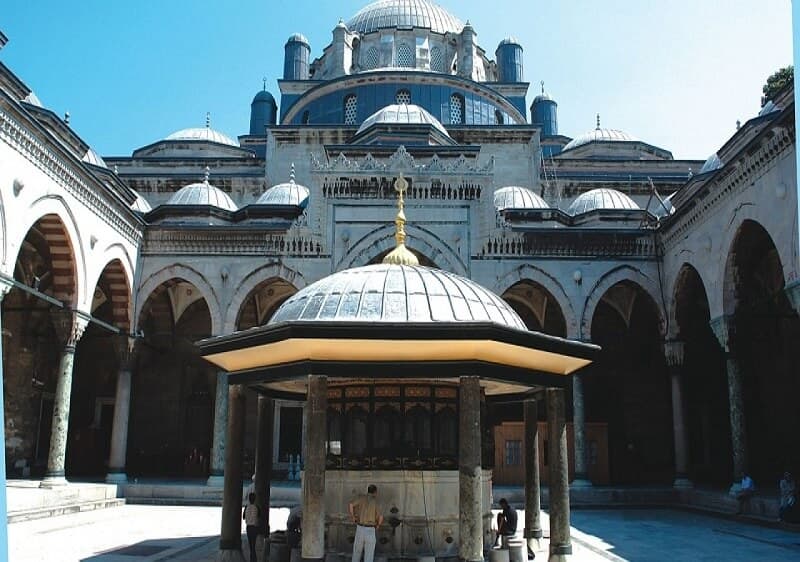
 Mezquita de Beyazid, Estambul
ISTANBUL BEYAZIT MOSQUE
Reasons to Visit the Bayezid Mosque
¿Cómo decides cuál de las numerosas mezquitas de Estambul visitar? No, no puedes. Esa es la sencillez de la cuestión. Sería imposible hacerse una idea de la historia y la arquitectura del Imperio Otomano sin visitar varias mezquitas en esta ciudad, y hay demasiadas. Visitar solo una de las muchas mezquitas de Estambul sería perjudicial para ti, ya que cada una tiene su propia atmósfera y carácter distintivos.
Sin embargo, la impresionante Mezquita de Beyazıt no debe faltar en su lista de mezquitas imprescindibles que visitar en Estambul. Esta mezquita también se conoce como la Mezquita de Beyazıt; ambos nombres se refieren al mismo edificio.
The Bayezid Mosque is one of the most frequently featured mosques in Istanbul's promotional materials. Bayezid Square, where it can be found, is a famous spot due to its proximity to the ruins of ancient Constantinople's Forum of Theodosius. Now, the Bayezid Mosque can be found in the Fatih/Sultanahmet historic district of Istanbul, close to Istanbul University and the Grand Bazaar.
History of the Bayezid Mosque
The construction of the Bayezid Mosque began in 1501 and was finished in 1506. The oldest selatin mosque still in use today can be found in this city. For those unfamiliar, a selatin mosque is one that was originally constructed at the behest of and in the name of a specific Ottoman Sultan. The mosque was commissioned by Sultan Bayezid II, who wished for it to be part of a larger complex that included a Turkish bath, school, hospital, etc., all designed in the imperial style.
Despite being the second mosque complex of its kind to be built in the city after the Ottomans conquered Constantinople, the identity of the architect responsible for designing the Bayezid Mosque remains a mystery. But there is no proof that a certain architect was in charge of designing the mosque.
Particulars of the Bayezid Mosque's Design That Stand Out
The Bayezid Mosque is a well-known example of an imperial complex design; however, its architectural elements are also widely regarded as being typically Ottoman. The majority of the mosque is built with granite and marble, but you can also find other types of stone and some coloration. The image is dominated by two minarets and a dome that is 44 meters tall and 17 meters across. Marbles and columns adorn the mosque's stunning courtyard, adding to the building's overall beauty.
La mezquita en sí es una obra maestra de la arquitectura, pero el patio también alberga la tumba del sultán Bayezid II. Se dice que el propio sultán dirigió la primera oración en la mezquita durante sus primeros años.
Bayezid Mosque has been damaged by the numerous earthquakes that have struck Istanbul throughout history. Much of the city was destroyed in an earthquake in 1509, and the mosque was severely damaged. The mosque was quickly restored, but it underwent a more extensive renovation a few decades later, led by the celebrated Ottoman architect Mimar Sinan. Inside the mosque, a new arch was built at this time.
Bayezid Mosque has undergone many restoration projects over the years, the most recent of which began in 2013 and is now over.
Mezquita de Beyazıt: un lugar que no te puedes perder.
A visit to the Bayezid Mosque (also known as the Beyazit Mosque) in Istanbul is a must. Because it is extremely ancient, of course, but also because it is stunningly lovely. In addition to being a lively people-watching destination, this area is also historically significant. During the winter months, when snow frequently falls on the streets of Istanbul, students can be seen milling about before heading to classes at the university, shoppers are heading to the Grand Bazaar, pigeons are everywhere, and the whole feel is otherworldly and so stunningly beautiful that you won't quite believe your eyes.
Photographers will enjoy both the exterior and interior of the courtyard at Bayezid Mosque. The scenery as a whole is stunning.
Frequently Asked Questions About Ahrida Synagogue
P: What is the Bayezid Mosque?
a: The Bayezid Mosque is a historic mosque located in Istanbul, Turkey.
P: When was the Bayezid Mosque built?
a: The Bayezid Mosque was built in the late 15th century.
P: Who built the Bayezid Mosque?
a: Sultan Bayezid II, who was the Ottoman Sultan at the time, built the Bayezid Mosque.
P: What is the significance of the Bayezid Mosque?
a: The Bayezid Mosque is important because it is an example of Ottoman architecture and because it is a place of worship and culture for Muslims in Istanbul.
P: Is the Bayezid Mosque still in use today?
a: Yes, the Bayezid Mosque is still in use today as a mosque and continues to serve the Muslim community in Istanbul.
P: What can visitors expect to see in the Bayezid Mosque?
a: Visitors to the Bayezid Mosque can expect to see a mix of Ottoman and Byzantine architectural styles, as well as intricate tile work, calligraphy, and marble columns.
P: Is the Bayezid Mosque open to visitors?
a: Yes, the Bayezid Mosque is open to visitors, although it is still a functioning mosque, and it is advisable to respect religious customs and dress modestly when visiting.
P: Are there any guided tours available at the Bayezid Mosque?
a: Yes, guided tours of the Bayezid Mosque are available for visitors. It is recommended that you contact a local tour company or travel agency to arrange a tour.
P: How do I get to the Bayezid Mosque from central Istanbul?
a: The Bayezid Mosque can be reached by taking public transportation or a taxi from central Istanbul.
P¿Hay algún lugar de interés turístico cerca que podamos visitar después de la Mezquita de Beyazıt?
a: Yes, there are several nearby attractions to visit after the Bayezid Mosque, including the Suleymaniye Mosque, the Grand Bazaar, and the Topkapi Palace.
Puede reservar una visita guiada por la ciudad de Estambul con nuestros guías turísticos autorizados. Los enlaces se encuentran a continuación:
Map of Bayezid Mosque