
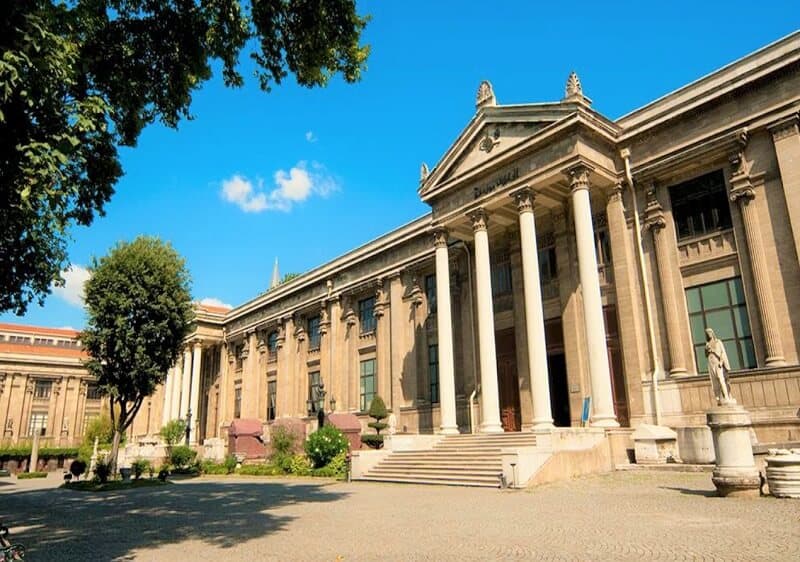
 伊斯坦布尔考古博物馆
伊斯坦布尔考古和考古博物馆
The Archaeology Museum, Museum of the Ancient Orient, and Tiled Kiosk Museum make up the Istanbul Archaeological Museums (Istanbul Arkeoloji Müzeleri), a complex of museums. The collections of the palace that were amassed by the museum director, master painter ("The Tortoise Trainer"/Pera Museum), and archaeologist Osman Hamdi Bey in the late 19th century are housed in these three main units, all of which share the same garden. The Istanbul Archaeological Museum is the first real museum in the history of the Ottoman Empire and Turkey. It has about a million artifacts from different cultures that were brought from the imperial lands.
Ottoman artifact collecting began during Mehmet the Conqueror's reign, but it wasn't until 1869, when the Istanbul Archaeological Museums opened under the name Müze-i Hümayun, that the practice became institutionalized (Imperial Museum). The Istanbul Archaeological Museum has its origins in the Müze-i Humayun, which now contains the artifacts excavated from the Hagia Irene Church. Due to Hagia Irene's limitations, the Tiled Kiosk, which was constructed during the reign of Mehmet the Conqueror, was turned into a museum. In 1880, after being restored, the Tiled Kiosk opened to the public once again under the care of the Istanbul Archaeological Museum.
It wasn't until 1881 when Osman Hamdi Bey (biography) was appointed director of the museum, that museology in Turkey took off. Osman Hamdi Bey discovered the necropolis of King Sidon and brought back many sarcophagi, including the famous one from Alexander the Great to Istanbul during his excavations in Sayda (Sidon) between 1887 and 1888.
砖台博物馆(Çinili Köşk)
The Tiled Kiosk dates back to 1472 CE and is the museum's oldest structure. As a pleasure palace or kiosk, it is also known as the Glazed Kiosk (Sirca Kösk) and was commissioned by the Ottoman Sultan Mehmed the Conqueror (Mehmed II). The building's distinctively Persian appearance—including its polygonal pillars and stone-framed bricks—has led to its attribution to an unnamed Persian architect. At its mosaic-tiled entrance, you'll find a marble arcade supported by 14 columns. While the kiosk's front entrance is a single story, the building's rear features an additional story. The museum's six rooms and central salon are filled with Selcuk and Ottoman-era Turkish tiles and ceramics.
东方博物馆:致力于展示和保存古代文物
In 1883, Osman Hamdi Bey constructed what would become the Ottoman Empire's first academy of fine arts, the School of Fine Arts (Sanayi-i Nefise School), which is now known as the Museum of Ancient Orient and houses many priceless ancient oriental works. This academy was the first institution of its kind in the Ottoman Empire, and it would eventually become the basis for what is now Mimar Sinan Fine Arts University. This structure was designed by Alexander Vallaury, who also designed the Classic building for the Istanbul Archaeological Museums.
1917年,当学院搬到卡加洛卢一个新的位置时,这个建筑被交给了博物馆局。当时的博物馆主任哈里尔·埃德姆·贝认为,将古代中东文化的文物展示在博物馆的单独部分,而不是来自希腊,罗马和拜占庭帝国的文物。
The Tomb of Iskender (Alexander Sarcophagus), the Tomb of "Crying Women" (Sarcophagus of the Mourning Women), the Lycia Tomb, and the Tabnit Tomb were brought to Istanbul from the excavation of the Sidon King Necropolis by Osman Hamdi Bey between 1887 and 1888, and they required a new museum building to properly showcase. The Classical Building of Istanbul's Archeological Museums was designed by the famous architect Alexandre Vallaury and first opened to the public on June 13, 1891, right next to The Tiled Kiosk.
The Archaeological Museum is unique among museums because it was built to house artifacts at the time. One of the finest examples of neo-classical design in Istanbul On the pediments of the gates leading into the museum, the words "Asar-i Atika Müzesi" are carved in Ottoman Turkish (Museum of Antiquities). Sultan Abdulhamid II has his tughra featured in the inscription.
Artifacts from Istanbul's Archaeology Museums That You Can't-Miss
伊斯坦布尔的游客受到伊斯坦布尔考古博物馆的建筑杰作的收藏欢迎,这里有古代东方文物博物馆和砖块馆博物馆等博物馆,一组建筑物,最古老的建筑建于15世纪,最新的建于19世纪末,是来自奥斯曼帝国的一部分的地方的许多文物的所在地。
The Istanbul Archeology Museums share with their visitors the "firsts of love, war, and peace" in addition to the ancient sculptures worth seeing and the unique Sidon sarcophagus, which are works of art in their own right. The narrative's traces can also be used to learn more about the history of archaeology in the Ottoman Empire and Turkey. The Istanbul Archaeological Museums offer a one-of-a-kind experience to their visitors with their extensive collections of artifacts, so we have compiled information about five of the museum's most popular exhibits. If you go to the museum, we hope you enjoy learning about the interesting history shown by the different artifacts and relics there.
爱情诗片 平板电脑
The tablet contains the world's earliest known love poem, which was uncovered during excavations of the Ancient City of Nippur and dates back to the year 2000 B.C. It was believed that the Sumerian king would have a fruitful and prosperous year if he married a nun who represented Inanna, the goddess of love and fertility. The tablet contains a poem that was likely written for Sumerian King Shu-Sin to hear. The world's first known love poem, written in cuneiform on a clay tablet, can be viewed at the Istanbul Archaeology Museums.
Alexander the Great's Bust
The statue's head was discovered in the lower agora of Pergamon, and it is believed that it once belonged to a statue of Alexander the Great or a god or hero modeled after him. The head sculpture dates back to the 2nd century BC and was likely removed from one of the city's upper buildings. The sculpture is just one of many noteworthy pieces in the Istanbul Archaeology Museums; Alexander the Great, a figure who had a profound impact on human history, is the subject of many of the pieces there.
⁇ 石 ⁇ 石
This sarcophagus, discovered in the Ambar Höyük excavations in Konya and relocated to Istanbul, dates back to the third century AD and is a one-of-a-kind artifact. The sarcophagus, weighing in at a hefty 32 tons, boasts a magnificent design. The sarcophagus is notable for being the first discovered sarcophagus of Anatolian production. The sarcophagus's cover features a male and female couple, who are presumed to be the tomb's original occupants, and is decorated with scenes from mythology on the side faces. One of the most significant artifacts on display is a sarcophagus that was discovered in the year 1900 and thus has significant historical significance in archaeology.
Alexander the Great's Sarcophagus
著名的Pentelikon大理石被用在建造的 ⁇ 石,在1887年被发现的沙达的挖掘过程中奥斯曼哈姆迪贝伊,第一个土耳其考古学家。场景,从谁被认为是伊索斯战争,马其顿人统治亚历山大大和波斯人之间的战斗,是其中最突出的描绘在 ⁇ 石。伊斯坦布尔考古博物馆有一个 ⁇ 石,从公元前4世纪,尽管它的名字,被认为属于不是亚历山大大帝,但他的指挥官之一,阿卜达洛米,谁被认为是西多尼国国王后伊索斯战役被赢得。
卡德什和平条约片
哈图萨(Bogazköy)的挖掘发现了卡德斯条约的地雷复印件,这是人类历史上最早的和平条约,可以追溯到公元前13世纪,伊斯坦布尔考古博物馆目前展示了挖掘期间发现的两枚复印件,两位古代超级大国在战争中没有被击败,决定在平等原则上团结起来,通过签署这些平板,这些平板代表了外交历史中最关键的时刻之一,作为我们所知道的国家之间的第一份书面协议。
伊斯坦布尔考古博物馆在哪里?
The complex is located in the Sultanahmet neighborhood of the Fatih district, on the Osman Hamdi Bey slope, which connects Gülhane Park and the Topkapi Palace Museum. You can get to the Istanbul Archeology Museum complex (Rose Park) by going down the slope from the first court of Topkapi Palace or up the hill from the main gate of Gulhane Park.
关于伊斯坦布尔考古博物馆的常见问题
Q ⁇伊斯坦布尔考古博物馆是什么?
A 是伊斯坦布尔考古博物馆(Istanbul Archaeology Museum)是一座位于土耳其伊斯坦布尔的博物馆,展示了该市和周边地区的丰富历史和文化遗产。
Q ⁇伊斯坦布尔考古博物馆什么时候成立?
A 是伊斯坦布尔考古博物馆成立于1891年。
Q ⁇: 伊斯坦布尔考古博物馆中展示了哪些文物?
A 是伊斯坦布尔考古博物馆展示了各种文明的各种文物,包括希腊、罗马、拜占庭和奥斯曼文物。
Q ⁇: 伊斯坦布尔考古博物馆有多大?
A 是伊斯坦布尔考古博物馆占地面积大约4万5千平方米。
Q ⁇伊斯坦布尔考古博物馆在哪里?
A 是: 伊斯坦布尔考古博物馆位于伊斯坦布尔的Sultanahmet。
Q ⁇: 伊斯坦布尔考古博物馆的入场费是多少?
A 是伊斯坦布尔考古博物馆的入场费约为40土耳其里拉。
Q ⁇: 伊斯坦布尔考古博物馆的开放时间是多少?
A 是伊斯坦布尔考古博物馆除周一外,每天开放,上午9点至下午7点。
Q ⁇: 伊斯坦布尔考古博物馆有音频指南吗?
A 是: 是的,在伊斯坦布尔考古博物馆有音频指南。
Q ⁇: 伊斯坦布尔考古博物馆有临时展览吗?
A 是:是的,伊斯坦布尔考古博物馆有许多不同的展览,在一年中发生变化。
Q ⁇: 伊斯坦布尔考古博物馆中有著名的艺术品或文物吗?
A 是是的,伊斯坦布尔考古博物馆展示了几件著名的艺术作品和文物,包括亚历山大 ⁇ 石、苏莱曼尼耶米拉布和 Kasımpaşa 沉船。
Q ⁇伊斯坦布尔考古博物馆的轮椅是否可以访问?
A 是: 是的,伊斯坦布尔考古博物馆可乘轮椅访问。
Q ⁇访客可以在伊斯坦布尔考古博物馆拍照吗?
A 是参观者可以在伊斯坦布尔考古博物馆拍照,但不允许闪光摄影和三脚架。
Q ⁇: 伊斯坦布尔考古博物馆有礼品店吗?
A 是: Yes, there is a gift shop at the Istanbul Archaeology Museum that sells souvenirs and books related to the museum's collections.
Q ⁇: 去伊斯坦布尔考古博物馆的最佳时间是什么时候?
A 是参观伊斯坦布尔考古博物馆的最佳时间是早上或下午,当人群通常较小。
Q ⁇: 伊斯坦布尔考古博物馆有没有有导游的?
A 是: 是的,伊斯坦布尔考古博物馆有几个导游,这些导游以各种语言进行。
Q ⁇: 伊斯坦布尔考古博物馆看到一切需要多长时间?
A 是: 伊斯坦布尔考古博物馆看到一切所需的时间可能有所不同,但大多数游客在博物馆花费大约2到3个小时。
Q ⁇: 伊斯坦布尔考古博物馆适合有儿童的家庭吗?
A 是: 是的, 伊斯坦布尔考古博物馆适合有儿童的家庭,因为它有几个互动展示和教育计划为孩子们。
Q ⁇: 伊斯坦布尔考古博物馆有餐厅或咖啡馆吗?
A 是:是的,伊斯坦布尔考古博物馆有一个餐厅和咖啡馆,游客可以吃点点东西。
Q ⁇: 伊斯坦布尔考古博物馆最近的公共交通工具是什么?
A 是伊斯坦布尔考古博物馆最接近的公共交通工具是Sultanahmet电车站,距离博物馆仅有几分钟的步行路程。
Q ⁇访客可以带背包或大袋子去伊斯坦布尔考古博物馆吗?
A 是参观者可以带背包和行李到伊斯坦布尔考古博物馆,但他们可能在入口处进行安全检查。
您可以通过我们的许可旅游指南预订伊斯坦布尔城市之旅。 链接如下:
伊斯坦布尔考古博物馆地图