
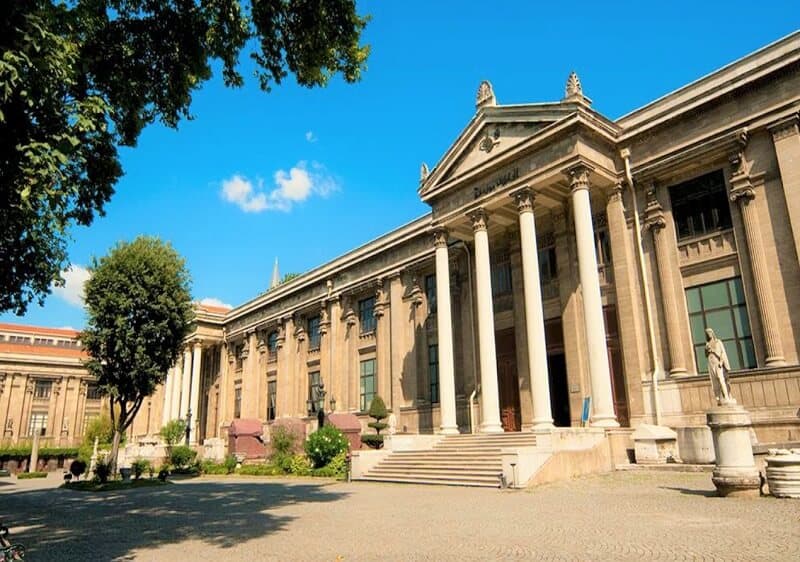
 イスタンブール考古学博物館
(Istanbul Archaeological and Archaeological Museum)
The Archaeology Museum, Museum of the Ancient Orient, and Tiled Kiosk Museum make up the Istanbul Archaeological Museums (Istanbul Arkeoloji Müzeleri), a complex of museums. The collections of the palace that were amassed by the museum director, master painter ("The Tortoise Trainer"/Pera Museum), and archaeologist Osman Hamdi Bey in the late 19th century are housed in these three main units, all of which share the same garden. The Istanbul Archaeological Museum is the first real museum in the history of the Ottoman Empire and Turkey. It has about a million artifacts from different cultures that were brought from the imperial lands.
Ottoman artifact collecting began during Mehmet the Conqueror's reign, but it wasn't until 1869, when the Istanbul Archaeological Museums opened under the name Müze-i Hümayun, that the practice became institutionalized (Imperial Museum). The Istanbul Archaeological Museum has its origins in the Müze-i Humayun, which now contains the artifacts excavated from the Hagia Irene Church. Due to Hagia Irene's limitations, the Tiled Kiosk, which was constructed during the reign of Mehmet the Conqueror, was turned into a museum. In 1880, after being restored, the Tiled Kiosk opened to the public once again under the care of the Istanbul Archaeological Museum.
It wasn't until 1881 when Osman Hamdi Bey (biography) was appointed director of the museum, that museology in Turkey took off. Osman Hamdi Bey discovered the necropolis of King Sidon and brought back many sarcophagi, including the famous one from Alexander the Great to Istanbul during his excavations in Sayda (Sidon) between 1887 and 1888.
タイルキオスク博物館(Çinili Köşk)
The Tiled Kiosk dates back to 1472 CE and is the museum's oldest structure. As a pleasure palace or kiosk, it is also known as the Glazed Kiosk (Sirca Kösk) and was commissioned by the Ottoman Sultan Mehmed the Conqueror (Mehmed II). The building's distinctively Persian appearance—including its polygonal pillars and stone-framed bricks—has led to its attribution to an unnamed Persian architect. At its mosaic-tiled entrance, you'll find a marble arcade supported by 14 columns. While the kiosk's front entrance is a single story, the building's rear features an additional story. The museum's six rooms and central salon are filled with Selcuk and Ottoman-era Turkish tiles and ceramics.
オリジン博物館:古代の遺物の展示と保存に捧げる
In 1883, Osman Hamdi Bey constructed what would become the Ottoman Empire's first academy of fine arts, the School of Fine Arts (Sanayi-i Nefise School), which is now known as the Museum of Ancient Orient and houses many priceless ancient oriental works. This academy was the first institution of its kind in the Ottoman Empire, and it would eventually become the basis for what is now Mimar Sinan Fine Arts University. This structure was designed by Alexander Vallaury, who also designed the Classic building for the Istanbul Archaeological Museums.
1917年、カガログルに新しい場所に移ったとき、この建物は博物館局に譲渡された。当時の博物館長、ハリル・エドヘム・ベイは、ギリシャ、ローマ、ビザンチン帝国から来たものよりも、古代中東文化の文物を博物館の別々のセクションに展示することがより良いと考えた。
The Tomb of Iskender (Alexander Sarcophagus), the Tomb of "Crying Women" (Sarcophagus of the Mourning Women), the Lycia Tomb, and the Tabnit Tomb were brought to Istanbul from the excavation of the Sidon King Necropolis by Osman Hamdi Bey between 1887 and 1888, and they required a new museum building to properly showcase. The Classical Building of Istanbul's Archeological Museums was designed by the famous architect Alexandre Vallaury and first opened to the public on June 13, 1891, right next to The Tiled Kiosk.
The Archaeological Museum is unique among museums because it was built to house artifacts at the time. One of the finest examples of neo-classical design in Istanbul On the pediments of the gates leading into the museum, the words "Asar-i Atika Müzesi" are carved in Ottoman Turkish (Museum of Antiquities). Sultan Abdulhamid II has his tughra featured in the inscription.
Artifacts from Istanbul's Archaeology Museums That You Can't-Miss
イスタンブールの訪問者は、古代東洋文物博物館やタイルキオスク博物館などの博物館を収容するイスタンブール考古学博物館で建築傑作のコレクションが集まっています。
The Istanbul Archeology Museums share with their visitors the "firsts of love, war, and peace" in addition to the ancient sculptures worth seeing and the unique Sidon sarcophagus, which are works of art in their own right. The narrative's traces can also be used to learn more about the history of archaeology in the Ottoman Empire and Turkey. The Istanbul Archaeological Museums offer a one-of-a-kind experience to their visitors with their extensive collections of artifacts, so we have compiled information about five of the museum's most popular exhibits. If you go to the museum, we hope you enjoy learning about the interesting history shown by the different artifacts and relics there.
愛の詩 タブレット
The tablet contains the world's earliest known love poem, which was uncovered during excavations of the Ancient City of Nippur and dates back to the year 2000 B.C. It was believed that the Sumerian king would have a fruitful and prosperous year if he married a nun who represented Inanna, the goddess of love and fertility. The tablet contains a poem that was likely written for Sumerian King Shu-Sin to hear. The world's first known love poem, written in cuneiform on a clay tablet, can be viewed at the Istanbul Archaeology Museums.
Alexander the Great's Bust
The statue's head was discovered in the lower agora of Pergamon, and it is believed that it once belonged to a statue of Alexander the Great or a god or hero modeled after him. The head sculpture dates back to the 2nd century BC and was likely removed from one of the city's upper buildings. The sculpture is just one of many noteworthy pieces in the Istanbul Archaeology Museums; Alexander the Great, a figure who had a profound impact on human history, is the subject of many of the pieces there.
サルコファグス
This sarcophagus, discovered in the Ambar Höyük excavations in Konya and relocated to Istanbul, dates back to the third century AD and is a one-of-a-kind artifact. The sarcophagus, weighing in at a hefty 32 tons, boasts a magnificent design. The sarcophagus is notable for being the first discovered sarcophagus of Anatolian production. The sarcophagus's cover features a male and female couple, who are presumed to be the tomb's original occupants, and is decorated with scenes from mythology on the side faces. One of the most significant artifacts on display is a sarcophagus that was discovered in the year 1900 and thus has significant historical significance in archaeology.
Alexander the Great's Sarcophagus
著名なペンテリコン大理石は、1887年にオスマン・ハムディ・ベイ(Osman Hamdi Bey)が、最初のトルコの考古学者によってサイダで発見されたサルコファグの建設に使用されました。 イソス戦争と信じられているものから来たシーンは、大アレクサンドル大王とペルシャ人の支配下のマケドニア人との間で戦ったが、シドンのサルコファグの中で最も印象的な描写の1つであると考えられています。イスタンブール考古学博物館には、イソス戦争が勝利した後、シドンの王であると信じられていたアブダロミウス大王の1人ではなく、その名にもかかわらず、4世紀紀紀にかけて作られたサルコファグがあります。
カデシュ平和条約のタブレット
ハトゥサ(Bogazköy)の発掘で、13世紀前半にさかのぼる人類史上最も古い平和条約であるカデシュ条約のテラコットコピーが発見されたイスタンブール考古学博物館では、現在、発掘中に発見された2つの複製の展示が展示されています。
イスタンブールの考古学博物館はどこにありますか?
The complex is located in the Sultanahmet neighborhood of the Fatih district, on the Osman Hamdi Bey slope, which connects Gülhane Park and the Topkapi Palace Museum. You can get to the Istanbul Archeology Museum complex (Rose Park) by going down the slope from the first court of Topkapi Palace or up the hill from the main gate of Gulhane Park.
イスタンブール考古学博物館に関するよくある質問
Q: What is the Istanbul Archaeology Museum?
A は: The Istanbul Archaeology Museum is a museum located in Istanbul, Turkey, that showcases the rich history and cultural heritage of the city and the surrounding regions.
Q: When was the Istanbul Archaeology Museum established?
A はイスタンブール考古学博物館は1891年に設立されました。
Q: What kind of artifacts are displayed in the Istanbul Archaeology Museum?
A はイスタンブール考古学博物館は、ギリシャ、ローマ、ビザンチン、オスマン文物を含むさまざまな文明の遺物の幅広い範囲を展示しています。
Q: How large is the Istanbul Archaeology Museum?
A は: The Istanbul Archaeology Museum covers a large area of approximately 45,000 square meters.
Qイスタンブール考古学博物館はどこにありますか?
A はイスタンブール考古学博物館は、イスタンブールのスルタナメットにあります。
Qイスタンブール考古学博物館の入場料は?
A はイスタンブール考古学博物館の入場料は、約40トルコリラです。
Q: イスタンブール考古学博物館の開館時間は?
A はイスタンブール考古学博物館は、月曜日を除いて、午前9時から午後7時まで毎日開館しています。
Q: イスタンブール考古学博物館でオーディオガイドが利用できますか?
A は: はい、イスタンブール考古学博物館でオーディオガイドが利用できます。
Q: イスタンブール考古学博物館には臨時展示があるでしょうか。
A ははい、イスタンブール考古学博物館は、1年を通して変化するさまざまな展示があります。
Q: イスタンブール考古学博物館に有名な芸術作品や文物はありますか?
A ははい、アレクサンダー・サルコファグス、スレイマニエ・ミハラブ、ノーマルパシャの沈没など、イスタンブール考古学博物館で展示されているいくつかの有名な芸術作品や文物があります。
Q: イスタンブール考古学博物館は車椅子で利用できますか?
A は: はい、イスタンブール考古学博物館は車椅子でアクセスできます。
Q: イスタンブール考古学博物館で写真を撮ることができますか?
A はイスタンブール考古学博物館では写真を撮ることができますが、フラッシュ写真やトリポッドは許可されません。
Q: イスタンブール考古学博物館にギフトショップはありますか?
A は: Yes, there is a gift shop at the Istanbul Archaeology Museum that sells souvenirs and books related to the museum's collections.
Q: イスタンブール考古学博物館を訪れるのに最適な時期はいつですか?
A はイスタンブール考古学博物館を訪れるのに最適な時期は、群衆が通常より小さく、午前中または午後遅くです。
Q: イスタンブール考古学博物館で提供されるガイドツアーはありますか?
A は: はい、イスタンブール考古学博物館では、様々な言語で行われるいくつかのガイドツアーがあります。
Q: イスタンブール考古学博物館のすべてを見るにはどのくらいの時間がかかりますか?
A はイスタンブール考古学博物館のすべてを見るのにかかる時間は異なりますが、ほとんどの訪問者は博物館で約2~3時間過ごします。
Q: イスタンブール考古学博物館は子供を持つ家族に適していますか?
A は: はい、イスタンブール考古学博物館は、子供を含む家族に適しています、子供のためのいくつかのインタラクティブな展示や教育プログラムがあります。
Q: イスタンブール考古学博物館にレストランやカフェはありますか?
A ははい、イスタンブール考古学博物館にはレストランとカフェがあり、訪問者が食べるために噛みつけることができます。
Q: イスタンブール考古学博物館に最も近い公共交通機関はどこですか?
A はイスタンブール考古学博物館に最も近い公共交通機関は、博物館から徒歩数分のSultanahmet電車駅です。
Q訪問者はイスタンブール考古学博物館にバッグや大きなバッグを持って行けるでしょうか。
A はイスタンブール考古学博物館にはバッグやバッグを持ち込むことが許可されていますが、入り口でセキュリティチェックを受ける場合があります。
イスタンブール市内ツアーは、当社のライセンス付きツアーガイドと一緒に予約できます。
イスタンブール考古学博物館(Istanbul Archaeology Museum)