
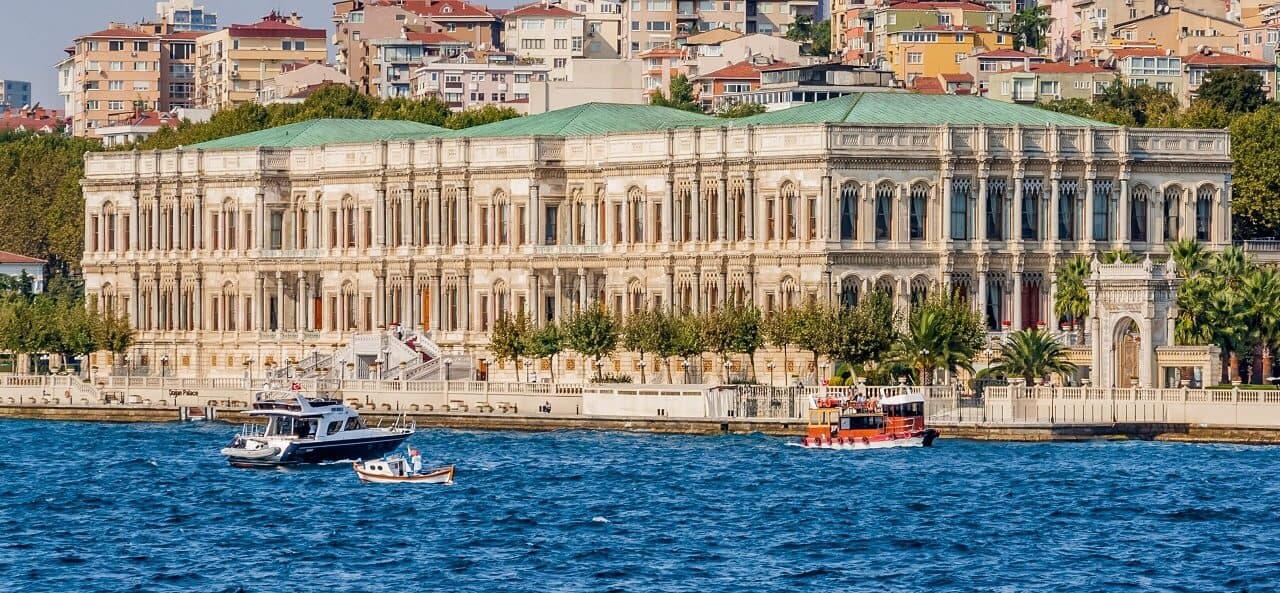
 dolmabahce palace bosphorus
ISTANBUL DOLMABAHCE PALACE
Dolmabahce Palace History
This location is one of the Bosporus's former coves, which has been reclaimed for other uses. Legend has it that the Argonauts anchored here in search of the Golden Fleece, and history records that Sultan Mehmet the Conqueror used this same bay to cross across to the Golden Horn in his conquest of Istanbul.
From the seventeenth century on, this cove began to be filled in and transformed into one of the Bosporus's unique gardens known as Dolmabahce. Previously, it had served as a natural harbor where Ottoman admirals anchored the naval fleet and held traditional nautical festivities (the "Filled Up Garden").
Az évszázadok során különböző szultánok építették villákat és pavilonokat, amelyek segítenek a Dolmabahce-nak abban, hogy a mostani Besiktas Waterside-palota legyen.
In 1843, when Sultan Abdülmedjid was in charge, the Besiktas Waterside Palace was torn down, and the foundation for the Dolmabahce Palace we know today was laid.
In 1856, the work was finished in its entirety, including the exterior walls. Dolmabahce Palace was constructed on a plot larger than 110.000 square meters, and it is divided into sixteen distinct wings and wings inside wings. Stables, mills, pharmacies, restaurants, aviaries, a glass shop, a foundry, and a patisserie are just a few examples of the many types of structures that make up the palace's various ancillary areas. The Heir Apparent's residence received a clock tower and dwellings in the garden at the back during the reign of Sultan Abdülhamid II (1876–1909).
Karabet and Nikogos Balyan, two of the best-known Ottoman architects of the time, built the palace. Three distinct buildings make up the main block of the palace: the Harem-i Hümayun, the Muayede, and the Mabeyn-i Hümayun (Selamlik) (Harem). State business is handled in Mabeyn-i Hümayun; Sultan's private quarters are located in Harem-i Hümayun; and official events and guest receptions take place in Muayede, located in the palace's central courtyard.
The total number of floors at Dolmabahce Palace is three when counting the basement. The building's Western inspiration is clear in its shape, ornamentation, and details, yet the Ottoman architects who designed it did a masterful job of translating these influences into an original style. Alternatively, the layout is a modern take on a traditional Turkish house of vast proportions, featuring stone outside walls, brick interior walls, and wooden floors. The Palace's central heating and electrical systems were installed between 1910 and 1912, showing an acceptance of contemporary technology. Totaling 45,000 square feet in use, the palace is home to 285 bedrooms, 46 reception areas, 6 Turkish baths (hammams), and 68 restrooms. The 4.454 square meters of carpeting on the fine parquet floors were woven in the palace's weaving building and afterward in Hereke, which is well-known for its carpets.
The most impressive part of the edifice is the Mabeyn, which is where the Sultan conducts state affairs and is also the most functional and beautiful. The entrance's Medhal (entrance) Hall, the Crystal Stairs leading to the upper floor, the Süfera (ambassadors) Hall, the guest chamber for the ambassadors, and the Red Room where the Sultan met the ambassadors are all adorned and equipped to accentuate the historical splendor of the Empire. To reach Sultan's rooms in the Mabeyn area, one must cross the Zülvecheyn (two-planed) Hall on the upper floor. In addition to classrooms and assembly halls, this district is home to an exquisite hammam decked out in Egyptian marble.
Located between the Harem and the Mabeyn, the Muayede (celebration) Hall is the highest and grandest part of Dolmabahce Palace. The hall's 36-meter-high dome and 4.5-ton British-made chandelier set it apart from the rest of the palace, which is spread out over a total area of about 2000 square meters and only 32 columns. Even on the chilliest of days, guests will be comfortable thanks to the hall's central heating system, which pumps warm air from the base of the columns. The Sultan would host dignitaries and foreign diplomats on the golden throne during traditional holy day celebrations. Ambassadors, male and female guests, and the Palace orchestra all had their own designated galleries.
Dolmabahce's Harem was built as a separate area, though not as strictly defined as it once was in terms of functional links and space layouts, in part because the palace was inspired by and modeled after European palaces. Similar to Topkapi Palace, it is not a distinct building or compound but rather a private residence that is seamlessly blended within the palace itself.
Half of Dolmabahce Palace is dedicated to the harem. Iron gates and massive timber doors mark the passage from Mabeyn and Muayede Hall to the Harem, a reminder of the prevailing social order of the time. Roomy hallways brightened by Bosphorus reflections, bedrooms for the Sultan, his wives, concubines, sons, and daughters, as well as libraries and sitting areas, can all be found here. The most interesting and impressive features of the harem are the apartment of Valide Sultan (Mother Sultan), the Blue and Pink Halls, the rooms of Sultans Abdülmedjid, Abdülaziz, and Resad, the concubines' section, the matrons' rooms, the study and bedroom of Great Atatürk, and the many valuable artifacts, including furniture, rugs, and kilims, inscriptions, vases, chandeliers, and oil paintings.
Dolmabahce Palace is now fully renovated and accessible to the public. Dolmabahce Palace's main exhibition units include the two "Precious Items Exhibition Halls," where the palace's most prized possessions are on display; the "Internal Treasury Exhibition Building," which features examples from the National Palaces Yildiz (Star) Porcelain collection; the "Art Gallery," which features selections from the National Palaces Painting collection; and the "Abdülmedjid Efendi Library," located in the Mabeyn wing of the palace.
The "Cultural Information Center" has taken over the former "Furnishing Department" at the Palace's main entrance. This hub serves as a command post for scientific research and public exhibitions held at several national palaces. For researchers' convenience, there is also a reference library that primarily houses works from the nineteenth century.
A Kórtorony, a Bútorosztály, a Légitársaság, a Harem és a Házigazda látszólagos lakóépületek udvaraiban kávézók és ajándékboltok vannak kialakítva. A Kulturális Információs Központ bevezető kiadványokat tett közzé a Nemzeti Palotakról, és ezek az ajándékboltok a Nemzeti Palota Művészeti Gyűjteménye művészeti alkotásainak széles választékát és reprodukcióit is értékesítik. Nemzeti és nemzetközi gyűléseket is tartanak a Muayede-teremben és a környező kertekben. Ezen változások eredményeként a Palota ismét múzeumok és kulturális események otthona.
The Architecture of Dolmabahce Palace
Dolmabahçe Palace was designed in the neo-Baroque style and features a combination of Turkish and European elements. The palace is comprised of 285 rooms, 43 halls, 6 baths, 68 toilets, and one mosque, and covers an area of 45,000 square meters. It has a symmetrical facade with a central dome and two lower flanking domes, surrounded by many balconies and towers. The interiors of the palace feature a rich variety of decorative elements, including marble columns, intricate tilework, and chandeliers. The palace's furnishings and decor reflect both Ottoman and European styles, with a mix of Turkish, French, and Italian influences. The palace's most famous room is the ceremonial Hall of Mirrors, which is covered in crystal chandeliers and is considered to be one of the largest and most magnificent in the world.
A Dolmabahçe-palota belsőépítészete
The interior decoration of Dolmabahçe Palace is a mix of Ottoman and European styles. It features intricate crystal chandeliers, ornate wood paneling, and lavish furnishings. The palace has several rooms, including the Grand Reception Hall, the Imperial Hall, the Ceremonial Hall, and the Harem, which are all decorated with intricate gold leaf, ornate moldings, and elaborate textiles. Some of the notable features of the palace's interior include a large staircase with a white marble balustrade, a Bohemian crystal chandelier that weighs 4.5 tons, and an extensive collection of European art and furnishings.
A Dolmabahçe-palota külső dekorációja
The exterior decoration of Dolmabahçe Palace features a mix of Ottoman and European architectural styles. It has a symmetrical facade with a central dome, multiple balconies and towers, and an ornate entrance gate. The palace is surrounded by a large garden and situated on the shores of the Bosphorus Strait. The palace's exterior is adorned with intricate details, including carved stone and marble elements, wooden shutters and balconies, and elegant roof tiles. The central dome is covered with a lead roof and is surrounded by smaller domes and towers. Overall, the exterior of Dolmabahçe Palace is a stunning display of Ottoman and European architectural styles, combining grandeur and elegance.
What to See and Do at Dolmabahce Palace
Dolmabahçe Palace is a historic palace located in Istanbul, Turkey, and features many notable sights and attractions. Some must-see features of the palace include:
- The Main Entrance Hall and Staircase of the Palace—a grand and elegant space that serves as the palace's main entrance.
- A kristály lépcső egy lenyűgöző lépcső, amely üvegből és kristályból készül, és a világ egyik legszebb lépcsőházának számít.
- A Harem, az oszmán szultánok magánszobái, gazdagon díszített szobáival és a Boszporusz lenyűgöző kilátásaival
- The State Rooms are a series of lavish and ornate rooms used for entertaining and conducting state business, including the Ceremonial Hall and the Ambassador's Lounge.
- A császári terem a palotában található legnagyobb terem, és számos fontos esemény helyszíne, köztük a Nemzeti Egyezség aláírása.
- A könyvtár egy gyönyörű helyiség, amely nagy gyűjteménye könyvek és kéziratok, beleértve a művek neves oszmán tudósok és költők.
- Mustafa Kemal Atatürk, a modern Törökország alapítója, aki a palotát az elnöksége alatt rezidenciaként használta
Ezek csak néhány a Dolmabahçe-palota sok kiemelkedő pontjáról, és a látogatók egész évben számos ideiglenes kiállítást és kulturális eseményt élvezhetnek.
Frequently Asked Questions About the Dolmabahce Palace
Kérdés: What is the Dolmabahce Palace?
A: The Dolmabahce Palace is a historic palace located in Istanbul, Turkey. It was built in the 19th century as a residence for Ottoman sultans.
Kérdés: Mi a története?
A: The Dolmabahce Palace was built in the mid-19th century and served as the main administrative center and residence of Ottoman sultans from 1856 to 1922. After the Republic of Turkey was established, it was used as the presidential palace until the late 20th century.
Kérdés: Who designed the Dolmabahce Palace?
A: The Dolmabahce Palace was designed by Armenian architect Garabet Amira Balyan and his son Nikogos Balyan, who were prominent Ottoman architects and builders of several other palaces for Ottoman sultans.
Kérdés: What is the significance of the Dolmabahce Palace?
A: The Dolmabahce Palace is one of the most important examples of Ottoman architecture. It is also important because it shows how the Ottoman Empire changed from a traditional Islamic monarchy to a modern, secular state.
Kérdés: How many rooms does the Dolmabahce Palace have?
A: The Dolmabahce Palace has 285 rooms, 43 halls, and 6 Turkish baths (hammams).
Kérdés: What is inside the Dolmabahce Palace?
A: Inside the Dolmabahce Palace, visitors can see the luxurious decor of Ottoman sultans, including elaborate crystal chandeliers, intricate marble flooring, and beautifully tiled fireplaces.
Kérdés: Is the Dolmabahce Palace open to the public?
A: Yes, the Dolmabahce Palace is open to the public and is a popular tourist attraction in Istanbul.
Kérdés: What is the style of the Dolmabahce Palace?
A: The Dolmabahce Palace is designed in a blend of Ottoman and European architectural styles, reflecting the influence of the Ottoman sultans' exposure to European design and decoration.
Kérdés: How large is the Dolmabahce Palace?
A: The Dolmabahce Palace covers an area of 110,000 square meters.
Kérdés: Can visitors go inside the Dolmabahce Palace?
A: Yes, visitors can go inside the Dolmabahce Palace and explore the rooms and exhibits, which showcase the luxurious lifestyle of Ottoman sultans and the elegance of Ottoman design and decoration.
Ügyfőnkkel együtt, engedélyezett idegenvezetőkkel foglalhatja le Istanbuli városi túrát. A linkek az alábbiak:
Map of Dolmabahce Palace