
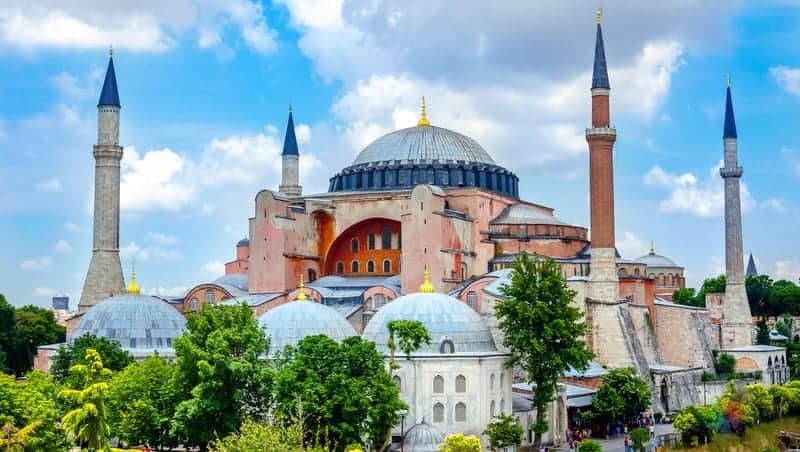
 Hagia Sophia i Istanbul
ISTANBUL HAGIA SOPHIA
Hagia Sophia historie
Den største bygning nogensinde bygget
The Hagia Sophia Grand Mosque, or Ayasofya-i Kebir Cami-i Serifi, the largest Eastern Roman Church in Istanbul, has been fighting against time for centuries with its groundbreaking architecture, rich history, religious significance, and extraordinary characteristics. It is both the oldest and the quickest-completed cathedral in the world, having been built three times in the same spot. one of the most impressive buildings ever built, thanks to its seemingly weightless domes, massive marble columns, and exquisite mosaics.
Simply looking at a mosque, with its magnificent use of space, light, and color, can make a believer feel moved to worship. Hagia Sophia is located on Istanbul's first hill, right at the tip of the historic peninsula, with the Sea of Marmara, the Bosphorus, and the Golden Horn on three sides.
Den første Hagia Sophia
Originally called Megale Ekklesia (the Grand Church), the Hagia Sophia gained its current name sometime in the fifth century (Holy Wisdom). During the Byzantine era, the cathedral was the largest building in the city and served as the setting for royal coronations. During his reign, Emperor Konstantinos (337–361) commissioned the building of the first church in 360.
The first church in Istanbul, which had a wooden roof and had grown vertically (a basilica), was destroyed in a public riot in 404 due to a dispute involving Emperor Arkadios' (395–408) wife, Empress Eudoksia, and the exiled patriarch of Istanbul, Ioannes Chrysostomos. At the Tymphanon wall in the northern part of the Hagia Sophia, visitors can still see the mosaic portrait of the patriarch. It is unlikely that the bricks labeled "Megale Ekklesia" in a mosque's storage area are from the original church, but they could be.
Den anden Hagia Sophia
By 415, Emperor Theodosius II (408–450) had rebuilt the second church. It is widely known that this basilica has five aisles, a massive front door, and a wooden roof. On January 13, 532, the church was destroyed following the public riot (Nika revolts) that occurred in the fifth year of Emperor Justinianos' (527–565) reign, when the "blues," representing the aristocracy, and the "greens," representing the merchant class, joined forces against the Empire.
Trin fra Propylon (den monumentale dør), kolonnebaser og stykker med lammetæpper, der repræsenterer de 12 apostle, blev opdaget under udgravninger ledet af A. M. Scheinder fra Istanbul Tysk Arkeologisk Institut, som fandt sted 2 meter under jordniveau.
The present-day Hagia Sophia (Turkish: Ayasofya, Latin: Sancta Sophia, Spanish: Santa Sofia, and Russian:oор вто оии, literally: "Holy Wisdom or Divine Wisdom") is the third building to stand on the same site, each of which reflects a different architectural philosophy. It is widely agreed that Hagia Sophia represents the pinnacle of Byzantine architecture and that it fundamentally altered the course of building design.
Emperor Justinianos commissioned its construction from the mathematician Anthemios of Tralles (modern-day Aydin) and the geometrician and engineer Isidoros of Miletos (modern-day Balat). The building began in 532, took five years to complete, and was officially opened for worship on December 27, 537. According to historical records, on the inaugural day of the Hagia Sophia's operation, Emperor Justinianos entered the temple and prayed, "My Lord, thank you for giving me the chance to create such a worshipping place," and then boasted, "Süleyman, I beat you," about Süleyman's temple in Jerusalem.
Between 546 and 557, a series of devastating earthquakes rocked Constantinople, with the most recent occurring on May 7, 558. Thousands of buildings were destroyed, including the dome of Hagia Sophia, as the earthquake's force shook the area.
I april 1204 plyndrede venetianere og korsfarere i det fjerde korstog Hagia Sophia og den byzantinske by Konstantinopel, som blev set som et chokerende forræderi blandt kristne. Baldwin af Flandern, en adel i korstogshæren, blev kronet kejser i Hagia Sophia.
Den tredje Hagia Sophia bygning var en syntese af de tre basilikaplaner og den centrale kuppelplan. Der er to narthexes på indersiden og udenfor bygningen, samt tre naver og en apsis. Bygningen er 100 meter lang fra apse til den ydre narthex og 69,5 meter bred. Dommen diameter er 31,87 meter fra nord til syd og 30,86 meter fra øst til vest, og dens højde fra jorden er 55.60 meter.
To make the Hagia Sophia even more magnificent, Emperor Justinianos demanded that all provinces under his rule contribute their finest architectural pieces to the project. Ancient cities in the region of Anatolia and Syria, including Aspendus, Ephesus, Baalbek, and Tarsus, provided the structure's columns and marble. Marble in four different colors—white from Marmara, green from Eriboz, pink from Afyon, and yellow from North Africa—was used to construct the building.
Marmorblokke blev skåret i halvdelen og derefter kombineret til at danne symmetriske former for de dekorative vægdækkene inde i bygningen.
The building features 104 columns in total, with 40 located in the basement and 64 located in the upper gallery. Beautiful mosaics adorn every surface of the Hagia Sophia except the marble. The mosaics are made of a wide variety of materials, including gold, silver, glass, terra cotta, and colorful stones. Mosaics with floral and geometric motifs date to the sixth century, while those with human figures are older, from the Iconoclast era. The East Roman emperors were crowned in the Hagia Sophia because it served as the Empire Church. To the right of the naos is the coronation chamber for Eastern Roman emperors, which features a floor of multicolored stones arranged in a circular pattern (omphalion).
I den osmanniske tid bevarede den sin moskéstatus.
During the Ottoman era of rule, the Konstantiniye (during the Ottoman period of rule, the following names were used in Turkish for Istanbul: Konstantiniye, Stanpolis, Dersaadet, and Asitane) was conquered and converted into the imperial mosque of Sultan Mehmet the Conqueror. Historic architect Sinan, who was influenced by the ancient edifice and fused its style with Islamic art and aesthetics in a series of grand mosques, added buttresses to the Hagia Sophia during the reign of Murad III to prevent its collapse.
Even though there were many terrible earthquakes in Istanbul, Sinan the Architect was able to fix the Hagia Sophia. During the time of the Eastern Roman Empire, the domes and walls of the Hagia Sophia kept falling.
Since Fatih Sultan Mehmet Khan's reign, successive sultans have worked to make Hagia Sophia even more beautiful, expanding the original building into a full complex that now includes a mihrab, minbar, rostrum, minarets, the sultan's office, shadirvans (fountains providing water for ritual ablutions), a madrasah, a library, and a soup kitchen. The interior decorations of the Hagia Sophia Mosque were also given considerable attention during the Ottoman era. Hagia Sophia was given new aesthetic values after being decorated with exquisite examples of Turkish art such as calligraphy and tile art.
Therefore, not only was Hagia Sophia in Istanbul converted into a mosque but this shared human heritage was also maintained and enhanced. It continued to exist after the Ottomans added their touches of architecture, but after being closed to the public for four years, Hagia Sophia Mosque was declared a museum by a decision of the Council of Ministers dated November 24, 1934, and has since been run as a "Memorial Museum" by the General Directorate of Cultural Heritage and Museums.
Deeds from 1936 indicate that the Hagia Sophia was donated to the Fatih Sultan Mehmed Foundation for use as a mausoleum, akaret, muvakkithane, and madrasah on the 57 pafta, 57 islands, and 7th parcel. Since 1985, the Hagia Sophia and the surrounding historic areas of Istanbul have been recognized as part of the UNESCO World Heritage Site. It is now one of the most popular tourist destinations in Turkey and a well-known symbol of Istanbul.
After an 86-year hiatus, on July 10, 2020, a Turkish apex court overturned a Cabinet decree from 1934 that had turned the Hagia Sophia Mosque into a museum. Since the Hagia Sophia was already owned by the Fatih Sultan Mehmet Khan Foundation or Waqf, the government was ruled to have no authority to alter its ownership.
After capturing Istanbul, Fatih Sultan Mehmed Khan became the Roman Emperor, took control of all properties previously owned by the Byzantine dynasty, and established the "Fatih Complex and the Hagia Sophia Al-Kabeer Foundation." "All that I have explained and designated here has been set down in written form in the foundation charter in the manner appointed; the conditions may not be altered, the laws may not be amended, they may not be diverted from their original purpose, and the appointed rules and principles may not be diminished or interfered with." This is from Fatih Sultan Mehmed's waqfiyya (a foundation charter or endowment document) written on a 66-meter length of well-preserved gazelle skin. Anyone who alters the terms of this foundation incurs the wrath of God, the angels, and all people.
In his wagfiyya, Sultan Fatih calls Hagia Sophia Grand Mosque "kenise-i nefise-i münakkase," or "[the] exquisitely ornamented church" in Ottoman Turkish.
On July 24, 2020, the President of the Republic of Turkey Recep Tayyip Erdogan presided over the opening ceremony for worship at Hagia Sophia. Both the Surah Al-Fatihah and the Surah Al-Baqarah were represented in President Erdoan's Qur'an recitation, which he delivered before the prayers in the converted mosque.
As many as 350,000 people attended Friday prayers at Istanbul's Hagia Sophia Mosque. The Diyanet, the Turkish Republic's Directorate of Religious Affairs, and the Ministry of Culture and Tourism share responsibility for the mosque's administration. Religious services are managed by the diyanet, while the mosque's conservation and restoration committees continue to oversee the care of any religious artifacts housed there.
Addressing the nation regarding Hagia Sophia Mosque’s re-opening for worship, President Erdogan said: "Hagia Sophia’s doors will be, as is the case with all our mosques, wide open to all, whether they be foreign or local, Muslim or non-Muslim. With its elevated status, Hagia Sophia—a world treasure—will continue to welcome all more genuinely and innovatively.
Authorities announced that the features of Hagia Sophia will continue to be preserved and protected and will remain open to the public in the same manner in which the Blue Mosque is open to visitors and tourists of all denominations and faiths. The Hagia Sophia is not only a working mosque, but it is also one of the most popular places for both Turkish and foreign tourists to visit in Turkey.
Mosaikker og prædikestole: værd at se!
Hagia Sophia fascinates people not only with its awe-inspiring architectural design but also with its gold-plated, silver-plated, glass, terracotta, and colored stone mosaics and the original ceiling mosaics of the 6th century with their floral and geometric motifs. The mosaics with figures following the icon ban in the 8th century, especially Mother Mary depicted with child Jesus in her arms, the Archangel Gabriel, the Archangel Michael, and the Deisis stage mosaics, must be seen.
Nogle af de mest berømte mosaikker, herunder et Deisis panel og kejserlige portrætter, findes i det sydvestlige galleri, som blev brugt til religiøse møder og ceremonier. Dome Angel Figures har fire unikke engelfigurer, og det menes, at disse enhovedede, seks-vinge engle (seraphim) beskytter Herrens trone i himlen.
Emperor IX, Konstantinos Monomakhos (1042–1055), and Empress Zoe are placed on the mosaic board. "The Romans' Religious Emperor, Servant of God's Jesus Konstantinos Monomakhos," it reads atop the emperor's head. "Devoutly Religious Agusta Zoe" is inscribed atop the Empress's head. Jesus Christ's monograms IC and XC appear on either side of the Pantocrator, king of the world.
The imperial family underwrote the restoration of Hagia Sophia in large part thanks to the contributions represented by this mosaic board. The earliest known use of mosaic in a board format was in the 11th century.
Italian Master N. Lanzoni created the tughra for Sultan Abdulmecid out of the original golden gilded mosaic that had broken off during the 1847–1849 renovations to Hagia Sophia by the Swiss–Italian architects the Fossati Brothers.
Grønne mosaikker indgraveret på en cirkulær overflade af gyldne mosaikstykker pryder Tughra, som Fossati præsenterede til Sultan Abdulmecid som en gave. En ensom række af flådeblå mosaikfliser dekorerer de ydre kanter af tughra.
The Fatih Sultan Mehmed-era madrasah that was constructed to the north of Hagia Sophia was closed down in the seventeenth century. At the same time that Century and the Fossati brothers were renovating, they also rebuilt a madrasah there. In 1982, during the excavations, the remains were uncovered. Haghia Sophia's conservation and restoration by the Fossati brothers took two years. More than 800 men helped restore the mihrab and mimbar, clean the mosaics, and repair the dome and surrounding semi-domes.
Around the same time, calligrapher Kazasker Mustafa Izzet Efendi (1801–1876) hung eight calligraphy panels on the main site's walls, each measuring 7.5 meters in diameter. The largest calligraphy panels in the Islamic world are those that read "Allah, Muhammad, Abu Bekir, Omar, Osman, Ali, Hasan, and Huseyin." The dome's center also features the 35th verse of Chapter Nour, written by Mustafa Izzet Efendi.
Efter sin tilbagevenden fra Budin, Kanuni Sultan Süleyman (1520-1566) gav moskeen med bronslamperne, der nu flankede hver side af mihrab (altar). På hver side af hovedindgangen er to store, hellenistiske æra (1250 L i gennemsnit) marmor kuber, der var gaver fra Sultan Murad III (1574-1595). Disse kuber blev bragt fra den gamle by Bergama.
Four minarets were added to the corners of the Hagia Sophia at different points in its history. Mehmed II is credited with building the brick minaret in the south, while Mimar Sinan, during his restoration, added the stone minaret in the north. The other two minarets are also from the time of Murad III, and they are duplicates.
Hagia Sophia-mærket for ikke-muslimske turister
The Hagia Sophia Mosque welcomes all visitors, both Muslims and non-Muslims alike. Shoes must be taken off before entering the mosque. You should try to avoid the Hagia Sophia Mosque during the five daily prayers, especially during the noon prayer on Fridays. When visiting the Hagia Sophia, women are required to cover their heads. The Hagia Sophia Mosque entrance offers free headscarves to visitors.
Although photography is permitted, it is respectfully requested that you refrain from photographing worshippers during prayer times at the mosque. Don't run around or interrupt anyone who might be praying while you're there. Visits to the Hagia Sophia Mosque are free, but donations are accepted.
While you're in Istanbul
Both the interior and exterior of the Hagia Sophia Mosque are renowned. Visitors often start their tours at the mausoleums of Ottoman Sultans that line the building's perimeter. There are mausoleums and tombs of princes from the reigns of Sultan Selim II, Sultan Murad III, Sultan Mehmed III, Sultan Mustafa I, and Sultan Ibrahim. The Hagia Sophia is more than just a magnificent example of human ingenuity and artistic expression.
As the final resting place of five sultans and their families, it has attained a historical status of veneration commensurate with its age and significance. Hagia Sophia's four minarets, attributed to Mimar Sinan, contribute to the building's grandeur, as do the structure's clock room, fountains, buttresses, treasury, and soup kitchen.
Læs mere om Hagia Sophia Guided Tours
Hagia Sophia, a marvel dating back to the Byzantine era and continuing into the Ottoman era, is the most iconic structure in all of Istanbul. It would be a shame to visit the historic peninsula without seeing Hagia Sophia, an architectural masterpiece with a unique place in time.
Ofte stillede spørgsmål om Hagia Sophia
Q er: What is Hagia Sophia?
a)Hagia Sophia er et antikt monument beliggende i Istanbul, Tyrkiet. Det blev oprindeligt bygget som en katedral i det 6. århundrede og tjente som den primære kirke i den østlige ortodokse kirke i næsten tusind år.
Q erHvornår blev Hagia Sophia bygget?
a)Hagia Sophia blev bygget i 537 e.Kr.
Q erHvem byggede Hagia Sophia?
a): Hagia Sophia was built by the Byzantine Emperor Justinian I.
Q er: What is the significance of Hagia Sophia?
a)Hagia Sophia er et symbol på byzantinsk og osmannisk arkitektur, samt et symbol på religiøs og kulturel udveksling mellem øst og vest.
Q er: Is Hagia Sophia still used as a church today?
a)Nej, Hagia Sophia bruges ikke længere som kirke og er blevet omdannet til museum.
Q er: How many times has Hagia Sophia been destroyed and rebuilt?
a)Efter at have været beskadiget i Nika-oprørene i 532 e.Kr., blev Hagia Sophia ødelagt og genopbygget en gang.
Q erHvad er arkitekturen af Hagia Sophia?
a)Hagia Sophia har en unik blanding af byzantinsk og islamisk arkitektur, med en central kuppel, indviklede mosaikker og store buede vinduer.
Q erHvor ligger Hagia Sophia?
a)Hagia Sophia ligger i Istanbul, Tyrkiet.
Q erHvordan besøger jeg Hagia Sophia?
a): You can visit Hagia Sophia by purchasing a ticket at the museum entrance.
Q erEr der nogen berømte kunstværker eller artefakter i Hagia Sophia?
a)Ja, der er mange berømte kunstværker og artefakter på udstilling på Hagia Sophia, herunder byzantinske mosaikker, marmorskulpturer og indviklet kaligrafi.
Q er: What was the function of Hagia Sophia before it became a museum?
a): Before becoming a museum, Hagia Sophia served as a mosque for nearly 500 years during the Ottoman Empire.
Q er: Who converted Hagia Sophia into a mosque?
a): Hagia Sophia was converted into a mosque by the Ottoman Sultan Mehmed II after the conquest of Constantinople in 1453.
Q er: Was Hagia Sophia ever used as a cathedral after it was converted into a mosque?
a): No, Hagia Sophia was never used as a cathedral after it was converted into a mosque.
Q erHvad var den vigtigste religion i det byzantinske rige?
a)Den vigtigste religion i det byzantinske rige var østlig ortodoks kristendom.
Q er: What is the dome of Hagia Sophia made of?
a)Kuplen af Hagia Sophia er lavet af mursten og er dækket med guldmosaikker.
Q erHvor stor er Hagia Sophia?
a)Hagia Sophia er ca. 250 fod lang, 220 fod bred og 180 fod høj.
Q er: Are there any famous legends or stories associated with Hagia Sophia?
a): Yes, there are several famous legends and stories associated with Hagia Sophia, including the "Weeping Column" and the "Horned altar".
Q erHvad skete der med mosaikkerne i Hagia Sophia, efter at de blev omdannet til en moské?
a)Nogle af mosaikkerne i Hagia Sophia blev dækket eller ødelagt efter at den blev omdannet til en moské, men mange blev bevaret og er stadig synlige i dag.
Q er: Who decided to convert Hagia Sophia into a museum?
a): Hagia Sophia was converted into a museum in 1935 by the Turkish government under the leadership of Mustafa Kemal Atatürk.
Q er: What was the reaction to Hagia Sophia being converted into a mosque in 2020?
a): The conversion of Hagia Sophia into a mosque in 2020 was a highly controversial move and was met with criticism and protests from both the international community and the Turkish opposition.
Du kan bestille en tur til Istanbul med vores licenserede guider.
Seværdigheder i Hagia Sophia