
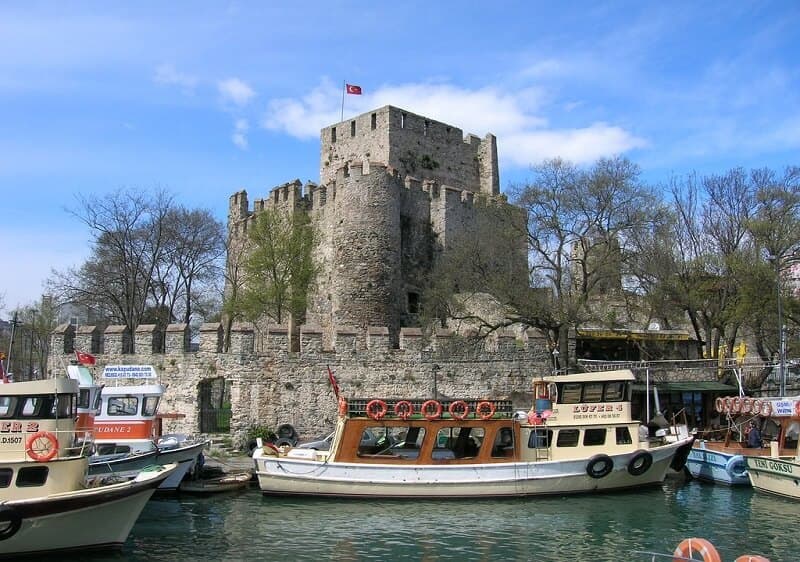
 Fortaleza de Anadolu en Estambul
ISTANBUL ANATOLIAN FORTRESS
ANATOLIAN FORTRESS (ANADOLU FORTRESS)
The area around the Anatolian Fortress was named after the fortress itself, which sits on a seven-acre peninsula jutting out into the sea at the point where the Bosphorus and the Göksu (Aretas) Stream meet. Yldrm Beyazt constructed the Anatolian Fortress in 1395 as a defensive stronghold. There were no more ancient artifacts uncovered in the area where the castle is located.
When Yildirim Beyazit built this fortress, he did so to block access to the Göksu Valley and maintain control of the Bosphorus crossings. This fortress, known as Güzelcehisar during Nişanc Mehmet Pasha's reign, was rechristened as Gözlücehisar. The castle's construction year is given as 1394–1395 in the chronicles of Nisanci Mehmet Pasha.
Después de que Yildirim Beyazit y Timur lucharan en 1402, el castillo permaneció en manos otomanas.Cuando el Principado otomano se acercaba a su fin, tierras cerca de Estambul, como Kartal y Pendik, fueron devueltas a Bizancio para ayudar a Süleyman Çelebi, pero no se sabe qué le pasó al castillo durante este tiempo.
Características de una fortaleza anatoliana
Fatih Sultan Mehmet ordered the construction of the Rumeli Fortress, and when necessary, the fort's cannons were used to fire on ships passing through the Bosphorus. This castle ceased to serve any purpose after the conquest of Istanbul and became a prison for convicted Janissaries. In the 17th and 18th centuries, when fortifications were built at the entrance to the Bosphorus, they were no longer used as a defense against Cossack raids on the Bosphorus.
Con la llegada de soldados y sus familias en el siglo XVI, esta zona se desarrolló rápidamente en una pequeña comunidad peculiar alrededor del fuerte.
Se construye una fortaleza en Anatolia
With its castle-like design, Anatolian Fortress is a fine example of Ottoman architecture. The original structure was a tower and walls with a square layout. In all likelihood, the seawater penetrated the castle's defenses because it was built on a rocky outcrop at the time. With time, the castle's exterior was filled in by alluvium carried by Göksu Stream, and the castle itself remained inside the now-relocated interior.
The primary structures of Anatolian Fortress are the castle, the inner castle walls, and the three towers. The tower of the Anatolian Fortress rises from a rectangular base and serves as the castle's central feature. The tower is built on top of a bare rock outcropping. Today, the southwest door is the primary point of access to this 4-story tower. In contrast, the inner castle walls of Anatolian Fortress are only two or three meters thick and feature four towers that protect the castle itself.
To the north of the tower in the northeast is the entrance to the inner castle. The outer walls of the castle are both polygonal and arched. It connects the southeast and northwest corners of the inner castle walls and is guarded by three towers. Among the most fascinating examples of Anatolian Turkish architecture is the Anatolian Fortress, whose outer wall was constructed during the reign of Mehmet the Conqueror and which, along with the Rumeli Fortress, played a significant role in the control of the Bosphorus.
Anatolian Fortress's Location
Istanbul's province of Beykoz is where you'll find the Anatolian Fortress. About 7 acres make up the area where Anatolian Fortress stands. It's roughly equal to a quarter of Rumeli Fortress' total land area. Anatolian Fortress, like Rumeli Fortress, was erected at the strait's narrowest point. Both sides of the Bosphorus feature these forts, which face each other across the water. They're separated by roughly 850 meters.
¿Qué hay que hacer en el Forte de Anatolia?
Weekends are especially busy for tourism at Anatolian Fortress due to its stunning Bosphorus panorama and lush, green surroundings. Weekends are spent most often at the pier and square near the Anatolian Fortress, as well as at the tea gardens and restaurants near where Göksu Stream meets the sea.
En las colinas, puede disfrutar de la brisa fría y el aire fresco del barrio mientras se toma un impresionante panorama del Bósforo.
Recorrido por el Castillo Anatoliano
Anatolian Fortress is about ten kilometers from Üsküdar, on the Anatolian side of the Bosphorus. After Kuzguncuk, Beylerbeyi, Çengelköy, and Kandilli, it is the next district on the way to the Black Sea. Getting to Anatolian Fortress by boat is the quickest and most convenient option.
Frequently Asked Questions About Ahrida Synagogue
q: What is the Anatolian Fortress?
a: The Anatolian Fortress is a historic fortress located in Istanbul, Turkey.
q: When was the Anatolian Fortress built?
a: The Anatolian Fortress was built in the 5th century AD, during the reign of the Byzantine Emperor Theodosius II.
q: What is the significance of the Anatolian Fortress?
a: The Anatolian Fortress played a significant role in the defense of Constantinople (modern-day Istanbul) against invading forces. It is also considered an important example of Byzantine military architecture.
q: Is the Anatolian Fortress open to visitors?
a: Yes, the Anatolian Fortress is open to visitors and can be accessed via ferry from Istanbul.
q: What can visitors expect to see at the Anatolian Fortress?
aLos visitantes pueden esperar ver los restos de la antigua fortaleza, incluyendo sus muros, torres y puertas. También hay varios museos y exposiciones dentro de la fortaleza que muestran la historia y el patrimonio cultural de la zona.
q: Are there any guided tours available at the Anatolian Fortress?
a: Yes, guided tours of the Anatolian Fortress are available for visitors. It is recommended that you contact a local tour company or travel agency to arrange a tour.
Puedes reservar un tour de la ciudad de Estambul con nuestras guías de viaje licenciadas.
Map of Anatolian Fortress