 이스탄불 고고학 박물관
이스탄불 고고학 및 고고학 박물관
The Archaeology Museum, Museum of the Ancient Orient, and Tiled Kiosk Museum make up the Istanbul Archaeological Museums (Istanbul Arkeoloji Müzeleri), a complex of museums. The collections of the palace that were amassed by the museum director, master painter ("The Tortoise Trainer"/Pera Museum), and archaeologist Osman Hamdi Bey in the late 19th century are housed in these three main units, all of which share the same garden. The Istanbul Archaeological Museum is the first real museum in the history of the Ottoman Empire and Turkey. It has about a million artifacts from different cultures that were brought from the imperial lands.
Ottoman artifact collecting began during Mehmet the Conqueror's reign, but it wasn't until 1869, when the Istanbul Archaeological Museums opened under the name Müze-i Hümayun, that the practice became institutionalized (Imperial Museum). The Istanbul Archaeological Museum has its origins in the Müze-i Humayun, which now contains the artifacts excavated from the Hagia Irene Church. Due to Hagia Irene's limitations, the Tiled Kiosk, which was constructed during the reign of Mehmet the Conqueror, was turned into a museum. In 1880, after being restored, the Tiled Kiosk opened to the public once again under the care of the Istanbul Archaeological Museum.
It wasn't until 1881 when Osman Hamdi Bey (biography) was appointed director of the museum, that museology in Turkey took off. Osman Hamdi Bey discovered the necropolis of King Sidon and brought back many sarcophagi, including the famous one from Alexander the Great to Istanbul during his excavations in Sayda (Sidon) between 1887 and 1888.
타일 키오스크 박물관 (Çinili Köşk)
The Tiled Kiosk dates back to 1472 CE and is the museum's oldest structure. As a pleasure palace or kiosk, it is also known as the Glazed Kiosk (Sirca Kösk) and was commissioned by the Ottoman Sultan Mehmed the Conqueror (Mehmed II). The building's distinctively Persian appearance—including its polygonal pillars and stone-framed bricks—has led to its attribution to an unnamed Persian architect. At its mosaic-tiled entrance, you'll find a marble arcade supported by 14 columns. While the kiosk's front entrance is a single story, the building's rear features an additional story. The museum's six rooms and central salon are filled with Selcuk and Ottoman-era Turkish tiles and ceramics.
오리엔트 박물관: 고대 유물의 전시 및 보존에 전념
In 1883, Osman Hamdi Bey constructed what would become the Ottoman Empire's first academy of fine arts, the School of Fine Arts (Sanayi-i Nefise School), which is now known as the Museum of Ancient Orient and houses many priceless ancient oriental works. This academy was the first institution of its kind in the Ottoman Empire, and it would eventually become the basis for what is now Mimar Sinan Fine Arts University. This structure was designed by Alexander Vallaury, who also designed the Classic building for the Istanbul Archaeological Museums.
1917 년, 아카데미가 카가로글루에 새로운 위치로 이사했을 때,이 건물은 박물관 지휘부에 주어졌습니다. 당시 박물관 디렉터 인 할릴 에드 ⁇ 베이는 그리스, 로마 및 비잔틴 제국에서 박물관의 별도의 섹션에서 고대 중동 문화의 유물을 전시하는 것이 더 좋다고 생각했습니다.
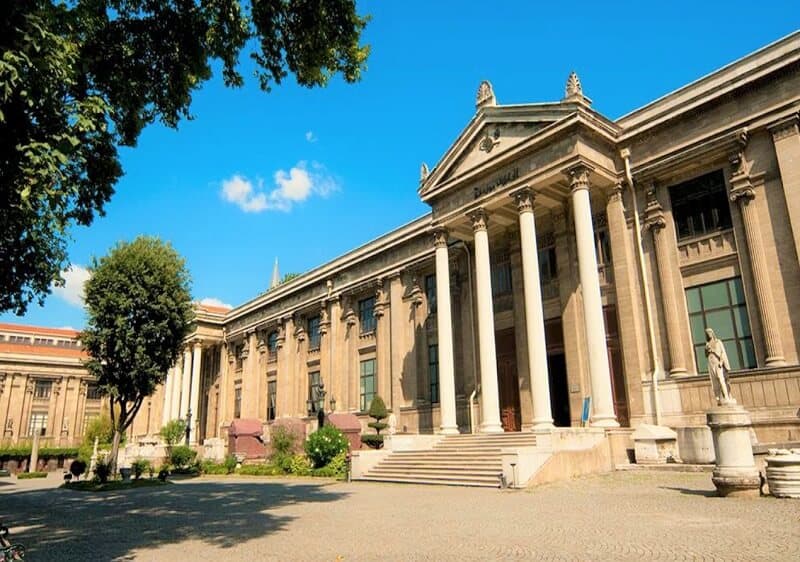
The Tomb of Iskender (Alexander Sarcophagus), the Tomb of "Crying Women" (Sarcophagus of the Mourning Women), the Lycia Tomb, and the Tabnit Tomb were brought to Istanbul from the excavation of the Sidon King Necropolis by Osman Hamdi Bey between 1887 and 1888, and they required a new museum building to properly showcase. The Classical Building of Istanbul's Archeological Museums was designed by the famous architect Alexandre Vallaury and first opened to the public on June 13, 1891, right next to The Tiled Kiosk.
The Archaeological Museum is unique among museums because it was built to house artifacts at the time. One of the finest examples of neo-classical design in Istanbul On the pediments of the gates leading into the museum, the words "Asar-i Atika Müzesi" are carved in Ottoman Turkish (Museum of Antiquities). Sultan Abdulhamid II has his tughra featured in the inscription.
Artifacts from Istanbul's Archaeology Museums That You Can't-Miss
이스탄불 방문자는 고대 동양 유물 박물관과 타일 키오스크 박물관과 같은 박물관을 보유한 이스탄불 고고학 박물관에서 건축적 주제의 컬렉션을 환영합니다. 15 세기에 지어졌으며 19 세기 말에 가장 최근의 건물은 오스만 제국의 일부였던 장소에서 많은 유물이 있습니다.
The Istanbul Archeology Museums share with their visitors the "firsts of love, war, and peace" in addition to the ancient sculptures worth seeing and the unique Sidon sarcophagus, which are works of art in their own right. The narrative's traces can also be used to learn more about the history of archaeology in the Ottoman Empire and Turkey. The Istanbul Archaeological Museums offer a one-of-a-kind experience to their visitors with their extensive collections of artifacts, so we have compiled information about five of the museum's most popular exhibits. If you go to the museum, we hope you enjoy learning about the interesting history shown by the different artifacts and relics there.
사랑의 詩 tablet
The tablet contains the world's earliest known love poem, which was uncovered during excavations of the Ancient City of Nippur and dates back to the year 2000 B.C. It was believed that the Sumerian king would have a fruitful and prosperous year if he married a nun who represented Inanna, the goddess of love and fertility. The tablet contains a poem that was likely written for Sumerian King Shu-Sin to hear. The world's first known love poem, written in cuneiform on a clay tablet, can be viewed at the Istanbul Archaeology Museums.
Alexander the Great's Bust
The statue's head was discovered in the lower agora of Pergamon, and it is believed that it once belonged to a statue of Alexander the Great or a god or hero modeled after him. The head sculpture dates back to the 2nd century BC and was likely removed from one of the city's upper buildings. The sculpture is just one of many noteworthy pieces in the Istanbul Archaeology Museums; Alexander the Great, a figure who had a profound impact on human history, is the subject of many of the pieces there.
⁇ 스카르코파고스
This sarcophagus, discovered in the Ambar Höyük excavations in Konya and relocated to Istanbul, dates back to the third century AD and is a one-of-a-kind artifact. The sarcophagus, weighing in at a hefty 32 tons, boasts a magnificent design. The sarcophagus is notable for being the first discovered sarcophagus of Anatolian production. The sarcophagus's cover features a male and female couple, who are presumed to be the tomb's original occupants, and is decorated with scenes from mythology on the side faces. One of the most significant artifacts on display is a sarcophagus that was discovered in the year 1900 and thus has significant historical significance in archaeology.
Alexander the Great's Sarcophagus
유명한 Pentelikon 대리석은 1887 년에 Osman Hamdi Bey, 터키 최초의 고고학자에 의해 Sayda에서 발굴하는 동안 발견 된 수소의 건설에 사용되었습니다. Issos 전쟁이라고 믿어지는 것에서 장면은 알렉산더 대왕과 페르시아인에 의해 지배 된 마케도니아인 사이에 싸웠으며, 수소에서 가장 눈에 띄는 묘사 중 하나입니다. 이스탄불 고고학 박물관은 4 세기 BC의 수소를 가지고 있습니다. 이름에도 불구하고, 이름이 아니라 아들 알렉산더 대왕의 지휘자 중 하나 인 Abdalonymos에 속한 것으로 생각되며, Issos 전투가 이겼을 때 시돈의 왕이라고 생각되었습니다.
카데시 평화협정 태블릿
하투사 (Bogazköy) 발굴은 인류 역사상 가장 오래된 평화 조약 인 카데스 조약의 테라코타 복사본을 발견했으며, 13 세기 BC에 거슬러 올라갑니다.이스탄불 고고학 박물관은 현재 발굴 중 발견 된 두 개의 복제본을 전시합니다.전쟁에서 패배하지 않은 두 고대의 초강국은 평등의 원칙을 둘러싸고 우리가 알고있는 국가 간의 첫 번째 서면 협정으로 외교 역사에서 가장 중요한 순간 중 하나를 나타내는이 태블릿을 서명함으로써 잠재적 인 공통 적을 싸우기로 결정했습니다.
이스탄불 고고학 박물관은 어디에 있습니까?
The complex is located in the Sultanahmet neighborhood of the Fatih district, on the Osman Hamdi Bey slope, which connects Gülhane Park and the Topkapi Palace Museum. You can get to the Istanbul Archeology Museum complex (Rose Park) by going down the slope from the first court of Topkapi Palace or up the hill from the main gate of Gulhane Park.
Frequently Asked Questions About Istanbul Archeology Museums
Q: 이스탄불 고고학 박물관은 무엇입니까?
A이스탄불 고고학 박물관은 터키 이스탄불에 위치한 박물관으로, 도시와 주변 지역의 풍부한 역사와 문화 유산을 전시합니다.
Q: 이스탄불 고고학 박물관은 언제 설립되었습니까?
A이스탄불 고고학 박물관은 1891년에 설립되었다.
Q: 이스탄불 고고학 박물관에 어떤 유형의 유물이 전시되어 있습니까?
A이스탄불 고고학 박물관은 그리스, 로마, 비잔틴, 오스만 유물을 포함하여 다양한 문명에서 유물의 넓은 범위를 전시합니다.
Q: 이스탄불 고고학 박물관은 얼마나 큰가요?
A이스탄불 고고학 박물관은 약 45,000 평방 미터의 큰 면적을 커버합니다.
Q: 이스탄불 고고학 박물관은 어디에 위치하고 있습니까?
A: 이스탄불 고고학 박물관은 이스탄불의 Sultanahmet에 위치하고 있습니다.
Q: 이스탄불 고고학 박물관 입장료는 얼마입니까?
A: 이스탄불 고고학 박물관 입장료는 약 40 터키 리라입니다.
Q: 이스탄불 고고학 박물관의 개관 시간은 얼마입니까?
A: 이스탄불 고고학 박물관은 오전 9시부터 오후 7시까지 월요일을 제외하고는 매일 열려 있습니다.
Q: 이스탄불 고고학 박물관에서 오디오 가이드가 있습니까?
A: 예, 이스탄불 고고학 박물관에서 오디오 가이드가 있습니다.
Q: 이스탄불 고고학 박물관에 임시 전시회가 있습니까?
A: 예, 이스탄불 고고학 박물관은 일년 내내 변화하는 많은 다른 전시를 보유하고 있습니다.
Q: 이스탄불 고고학 박물관에 유명한 예술 작품이나 유물이 있습니까?
A: Yes, there are several famous works of art and artifacts on display at the Istanbul Archaeology Museum, including the Alexander Sarcophagus, the Süleymaniye Mihrab, and the Kasımpaşa shipwreck.
Q: 이스탄불 고고학 박물관 휠체어는 접근 가능한가요?
A: 예, 이스탄불 고고학 박물관은 휠체어로 접근할 수 있습니다.
Q: 방문객들은 이스탄불 고고학 박물관에서 사진을 찍을 수 있습니까?
A: 방문객들은 이스탄불 고고학 박물관에서 사진을 찍을 수 있지만 플래시 사진과 트리포드는 허용되지 않습니다.
Q: 이스탄불 고고학 박물관에 선물 가게가 있습니까?
A: Yes, there is a gift shop at the Istanbul Archaeology Museum that sells souvenirs and books related to the museum's collections.
Q: 이스탄불 고고학 박물관을 방문하는 가장 좋은시기는 언제입니까?
A: 이스탄불 고고학 박물관을 방문하는 가장 좋은 시간은 대중이 보통 작아질 때 아침이나 늦은 오후입니다.
Q: 이스탄불 고고학 박물관에서 가이드 투어가 있습니까?
A: 예, 다양한 언어로 진행되는 이스탄불 고고학 박물관에서 여러 가이드 투어가 있습니다.
Q: 이스탄불 고고학 박물관에서 모든 것을 볼 때 얼마나 걸리나요?
A: 이스탄불 고고학 박물관에서 모든 것을 볼 수있는 시간이 다를 수 있지만 대부분의 방문자는 박물관에서 약 2-3 시간을 보냅니다.
Q: 이스탄불 고고학 박물관은 어린이를 가진 가족에게 적합합니까?
A: 예, 이스탄불 고고학 박물관은 어린이를위한 여러 개의 대화형 디스플레이와 교육 프로그램을 갖추고 있기 때문에 어린이를위한 가족에게 적합합니다.
Q: 이스탄불 고고학 박물관에 레스토랑이나 카페가 있습니까?
A: 예, 방문자가 먹을 수있는 물고기를 잡을 수있는 이스탄불 고고학 박물관에 레스토랑과 카페가 있습니다.
Q: 이스탄불 고고학 박물관에 가장 가까운 대중 교통편은 무엇입니까?
A: 이스탄불 고고학 박물관에 가장 가까운 대중 교통은 박물관에서 도보로 몇 분 거리에있는 Sultanahmet 트램 정류장입니다.
Q: 방문객들은 이스탄불 고고학 박물관에 뒷바지를 가져갈 수 있습니까?
A방문객들은 이스탄불 고고학 박물관에 뒷바구니와 가방을 들 수 있지만 입구에서 보안 검사를 받게 될 수 있습니다.
당신은 우리의 라이센스 투어 가이드와 함께 이스탄불 시티 투어를 예약할 수 있습니다.
Map of Istanbul Archaeology Museum