
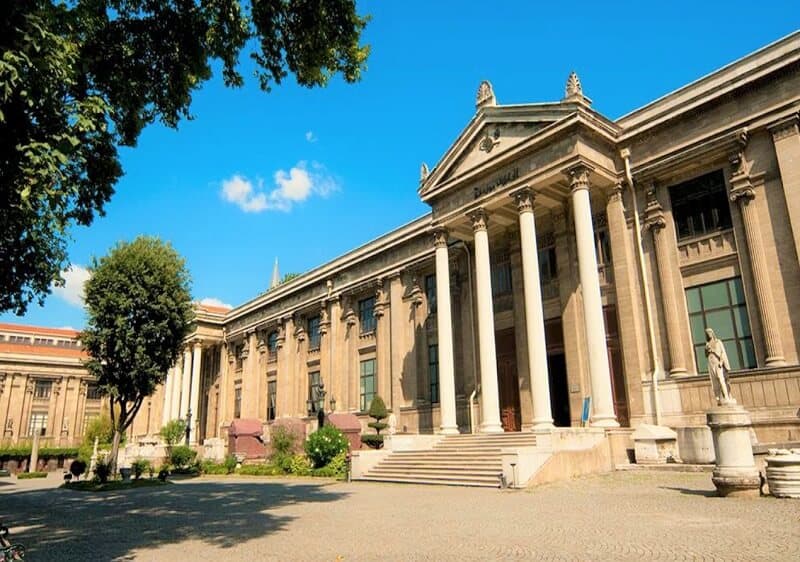
 Archeologické múzeum v Istanbule
Archeologické a archeologické múzeá v Istanbule
The Archaeology Museum, Museum of the Ancient Orient, and Tiled Kiosk Museum make up the Istanbul Archaeological Museums (Istanbul Arkeoloji Müzeleri), a complex of museums. The collections of the palace that were amassed by the museum director, master painter ("The Tortoise Trainer"/Pera Museum), and archaeologist Osman Hamdi Bey in the late 19th century are housed in these three main units, all of which share the same garden. The Istanbul Archaeological Museum is the first real museum in the history of the Ottoman Empire and Turkey. It has about a million artifacts from different cultures that were brought from the imperial lands.
Ottoman artifact collecting began during Mehmet the Conqueror's reign, but it wasn't until 1869, when the Istanbul Archaeological Museums opened under the name Müze-i Hümayun, that the practice became institutionalized (Imperial Museum). The Istanbul Archaeological Museum has its origins in the Müze-i Humayun, which now contains the artifacts excavated from the Hagia Irene Church. Due to Hagia Irene's limitations, the Tiled Kiosk, which was constructed during the reign of Mehmet the Conqueror, was turned into a museum. In 1880, after being restored, the Tiled Kiosk opened to the public once again under the care of the Istanbul Archaeological Museum.
It wasn't until 1881 when Osman Hamdi Bey (biography) was appointed director of the museum, that museology in Turkey took off. Osman Hamdi Bey discovered the necropolis of King Sidon and brought back many sarcophagi, including the famous one from Alexander the Great to Istanbul during his excavations in Sayda (Sidon) between 1887 and 1888.
Múzeum dlažobného kiosku (Çinili Köşk)
The Tiled Kiosk dates back to 1472 CE and is the museum's oldest structure. As a pleasure palace or kiosk, it is also known as the Glazed Kiosk (Sirca Kösk) and was commissioned by the Ottoman Sultan Mehmed the Conqueror (Mehmed II). The building's distinctively Persian appearance—including its polygonal pillars and stone-framed bricks—has led to its attribution to an unnamed Persian architect. At its mosaic-tiled entrance, you'll find a marble arcade supported by 14 columns. While the kiosk's front entrance is a single story, the building's rear features an additional story. The museum's six rooms and central salon are filled with Selcuk and Ottoman-era Turkish tiles and ceramics.
Orient Museum: venovaný zobrazovaniu a zachovaniu starobylých artefaktov
In 1883, Osman Hamdi Bey constructed what would become the Ottoman Empire's first academy of fine arts, the School of Fine Arts (Sanayi-i Nefise School), which is now known as the Museum of Ancient Orient and houses many priceless ancient oriental works. This academy was the first institution of its kind in the Ottoman Empire, and it would eventually become the basis for what is now Mimar Sinan Fine Arts University. This structure was designed by Alexander Vallaury, who also designed the Classic building for the Istanbul Archaeological Museums.
V roku 1917, keď sa akadémia presťahovala na nové miesto v Cagaloglu, bola táto budova odovzdaná riaditeľstvu múzeí. Riaditeľ múzea v tom čase, Halil Edhem Bey, cítil, že by bolo lepšie zobraziť artefakty starovekých kultúr Blízkeho východu v samostatnej časti múzea ako tie z Grécka, Ríma a Byzantskej ríše.
The Tomb of Iskender (Alexander Sarcophagus), the Tomb of "Crying Women" (Sarcophagus of the Mourning Women), the Lycia Tomb, and the Tabnit Tomb were brought to Istanbul from the excavation of the Sidon King Necropolis by Osman Hamdi Bey between 1887 and 1888, and they required a new museum building to properly showcase. The Classical Building of Istanbul's Archeological Museums was designed by the famous architect Alexandre Vallaury and first opened to the public on June 13, 1891, right next to The Tiled Kiosk.
The Archaeological Museum is unique among museums because it was built to house artifacts at the time. One of the finest examples of neo-classical design in Istanbul On the pediments of the gates leading into the museum, the words "Asar-i Atika Müzesi" are carved in Ottoman Turkish (Museum of Antiquities). Sultan Abdulhamid II has his tughra featured in the inscription.
Artifacts from Istanbul's Archaeology Museums That You Can't-Miss
Návštevníkov Istanbulu privítala zbierka architektonických majstrovských diel v Istanbulských archeologických múzeách, ktoré sú domovom múzeí, ako je Múzeum starovekých orientálnych artefaktov a Múzeum dlažobného kiosku.Skupina budov, z ktorých najstaršia bola postavená v 15. storočí a najnovšia na konci 19. storočia, je domovom mnohých artefaktov z miest, ktoré boli súčasťou Osmanskej ríše.
The Istanbul Archeology Museums share with their visitors the "firsts of love, war, and peace" in addition to the ancient sculptures worth seeing and the unique Sidon sarcophagus, which are works of art in their own right. The narrative's traces can also be used to learn more about the history of archaeology in the Ottoman Empire and Turkey. The Istanbul Archaeological Museums offer a one-of-a-kind experience to their visitors with their extensive collections of artifacts, so we have compiled information about five of the museum's most popular exhibits. If you go to the museum, we hope you enjoy learning about the interesting history shown by the different artifacts and relics there.
Láska básne tablet
The tablet contains the world's earliest known love poem, which was uncovered during excavations of the Ancient City of Nippur and dates back to the year 2000 B.C. It was believed that the Sumerian king would have a fruitful and prosperous year if he married a nun who represented Inanna, the goddess of love and fertility. The tablet contains a poem that was likely written for Sumerian King Shu-Sin to hear. The world's first known love poem, written in cuneiform on a clay tablet, can be viewed at the Istanbul Archaeology Museums.
Alexander the Great's Bust
The statue's head was discovered in the lower agora of Pergamon, and it is believed that it once belonged to a statue of Alexander the Great or a god or hero modeled after him. The head sculpture dates back to the 2nd century BC and was likely removed from one of the city's upper buildings. The sculpture is just one of many noteworthy pieces in the Istanbul Archaeology Museums; Alexander the Great, a figure who had a profound impact on human history, is the subject of many of the pieces there.
Sárkovačka Sarkofág
This sarcophagus, discovered in the Ambar Höyük excavations in Konya and relocated to Istanbul, dates back to the third century AD and is a one-of-a-kind artifact. The sarcophagus, weighing in at a hefty 32 tons, boasts a magnificent design. The sarcophagus is notable for being the first discovered sarcophagus of Anatolian production. The sarcophagus's cover features a male and female couple, who are presumed to be the tomb's original occupants, and is decorated with scenes from mythology on the side faces. One of the most significant artifacts on display is a sarcophagus that was discovered in the year 1900 and thus has significant historical significance in archaeology.
Alexander the Great's Sarcophagus
Slávny Pentelikon mramor bol použitý pri výstavbe sarkofágu, ktorý bol objavený v roku 1887 počas vykopávok v Sayde Osman Hamdi Bey, prvý turecký archeológ. Scény z toho, čo sa predpokladá, že je Issos vojna, bojoval medzi Macedónci vládol Alexander Veľký a Peržanov, sú medzi najpozoruhodnejšie zobrazenia v sarkofágu. Istanbul Archeologické múzeá majú sarkofág zo 4. storočia pred nl, že napriek svojmu názvu, sa predpokladá, že patril nie Alexander Veľký, ale jeden z jeho veliteľov, Abdalonymos, ktorý bol veril byť kráľom Sidonu po bitke o Iss bol vyhraný.
Kadesh mierovej zmluvy tablety
Hattusa (Bogazköy) vykopávky objavili terakotovú kópiu Kadeshskej zmluvy, najskoršej dátumovej mierovej zmluvy v ľudskej histórii, ktorá siaha do 13. storočia pred nl. Istanbulské archeologické múzeá v súčasnosti ponúkajú zobrazenia dvoch replík objavených počas vykopávok.Dve starobylé superveľmoci, ktoré boli neporazené vo vojne, sa rozhodli spojiť okolo princípu rovnosti a bojovať proti akémukoľvek potenciálnemu spoločnému nepriateľovi tým, že podpísali tieto tabule, ktoré predstavujú jeden z najdôležitejších momentov v diplomatickej histórii ako prvá písomná dohoda medzi štátmi, o ktorých vieme.
Kde sa nachádzajú Archeologické múzeá v Istanbule?
The complex is located in the Sultanahmet neighborhood of the Fatih district, on the Osman Hamdi Bey slope, which connects Gülhane Park and the Topkapi Palace Museum. You can get to the Istanbul Archeology Museum complex (Rose Park) by going down the slope from the first court of Topkapi Palace or up the hill from the main gate of Gulhane Park.
Najčastejšie otázky o Archeologických múzeách v Istanbule
Q: What is the Istanbul Archaeology Museum?
A: The Istanbul Archaeology Museum is a museum located in Istanbul, Turkey, that showcases the rich history and cultural heritage of the city and the surrounding regions.
Q: When was the Istanbul Archaeology Museum established?
A: The Istanbul Archaeology Museum was established in 1891.
Q: What kind of artifacts are displayed in the Istanbul Archaeology Museum?
A: The Istanbul Archaeology Museum displays a wide range of artifacts from various civilizations, including Greek, Roman, Byzantine, and Ottoman artifacts.
Q: How large is the Istanbul Archaeology Museum?
A: The Istanbul Archaeology Museum covers a large area of approximately 45,000 square meters.
Q: Where is the Istanbul Archaeology Museum located?
A: The Istanbul Archaeology Museum is located in Sultanahmet, Istanbul.
Q: What is the entrance fee for the Istanbul Archaeology Museum?
A: The entrance fee for the Istanbul Archaeology Museum is around 40 Turkish Liras.
Q: What are the opening hours of the Istanbul Archaeology Museum?
A: The Istanbul Archaeology Museum is open every day except Monday, from 9:00 a.m. to 7:00 p.m.
Q: Is there an audio guide available at the Istanbul Archaeology Museum?
A: Yes, there is an audio guide available at the Istanbul Archaeology Museum.
Q: Are there any temporary exhibitions at the Istanbul Archaeology Museum?
A: Yes, the Istanbul Archaeology Museum has many different shows that change throughout the year.
Q: Are there any famous works of art or artifacts in the Istanbul Archaeology Museum?
A: Yes, there are several famous works of art and artifacts on display at the Istanbul Archaeology Museum, including the Alexander Sarcophagus, the Süleymaniye Mihrab, and the Kasımpaşa shipwreck.
Q: Is the Istanbul Archaeology Museum wheelchair accessible?
A: Yes, the Istanbul Archaeology Museum is wheelchair accessible.
Q: Can visitors take photos at the Istanbul Archaeology Museum?
A: Visitors are allowed to take photos at the Istanbul Archaeology Museum, but flash photography and tripods are not permitted.
Q: Is there a gift shop at the Istanbul Archaeology Museum?
A: Yes, there is a gift shop at the Istanbul Archaeology Museum that sells souvenirs and books related to the museum's collections.
Q: What is the best time to visit the Istanbul Archaeology Museum?
A: The best time to visit the Istanbul Archaeology Museum is in the morning or late afternoon when the crowds are usually smaller.
Q: Are there any guided tours available at the Istanbul Archaeology Museum?
A: Yes, there are several guided tours available at the Istanbul Archaeology Museum, which are conducted in various languages.
Q: How long does it take to see everything at the Istanbul Archaeology Museum?
A: The time it takes to see everything at the Istanbul Archaeology Museum can vary, but most visitors spend around 2-3 hours at the museum.
Q: Is the Istanbul Archaeology Museum suitable for families with children?
A: Yes, the Istanbul Archaeology Museum is suitable for families with children, as it has several interactive displays and educational programs for kids.
Q: Are there any restaurants or cafes at the Istanbul Archaeology Museum?
A: Yes, there is a restaurant and a cafe at the Istanbul Archaeology Museum where visitors can grab a bite to eat.
Q: What is the nearest public transportation to the Istanbul Archaeology Museum?
A: The nearest public transportation to the Istanbul Archaeology Museum is the Sultanahmet tram stop, which is just a few minutes walk from the museum.
Q: Can visitors take backpacks or large bags into the Istanbul Archaeology Museum?
A: Visitors are allowed to take backpacks and bags into the Istanbul Archaeology Museum, but they may be subject to a security check at the entrance.
Môžete si rezervovať Istanbul City Tour s našimi licencovanými sprievodcami.
Map of Istanbul Archaeology Museum