
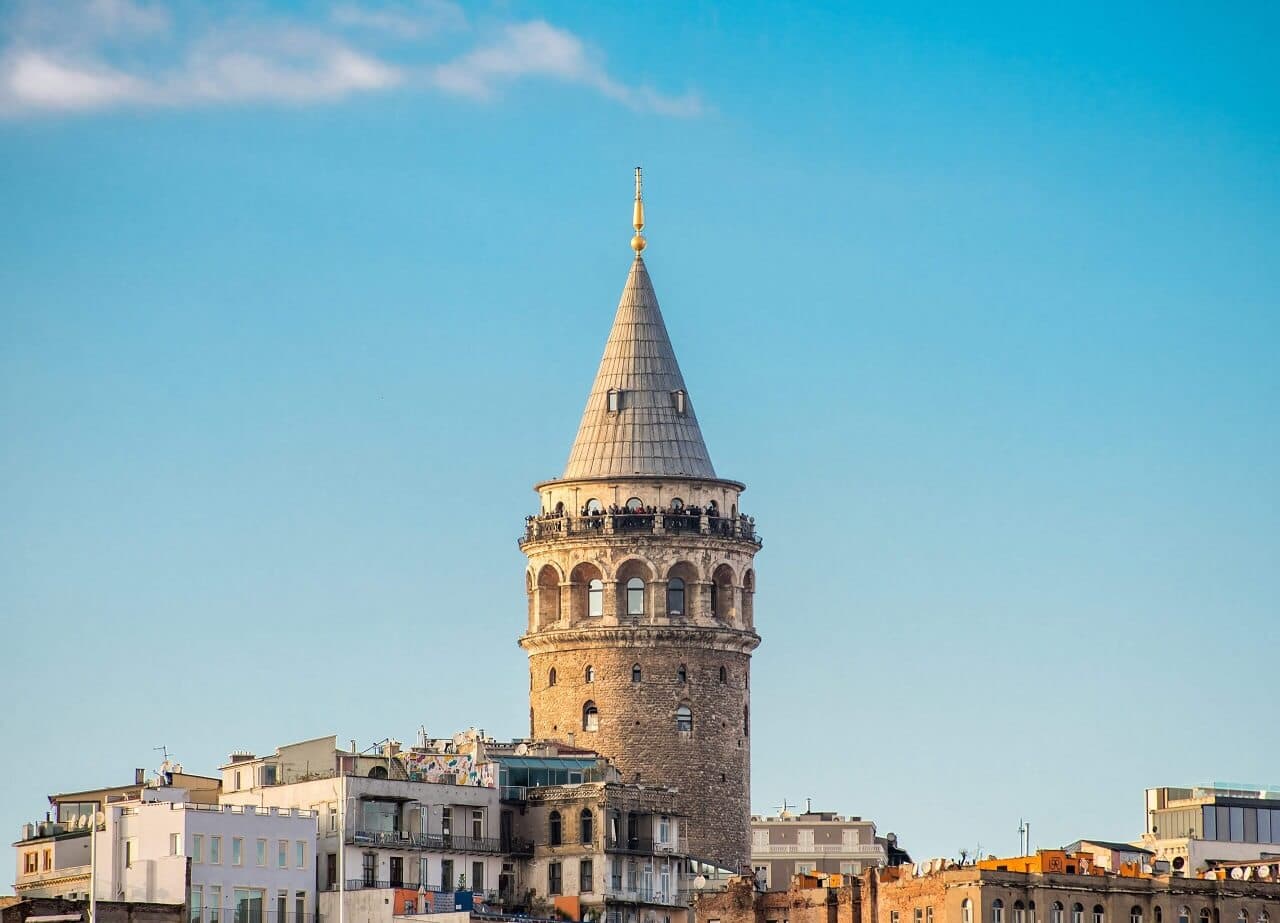
 Tháp Galata Istanbul
Một trong những điểm tham quan nổi tiếng nhất của Istanbul, Tháp Galata
Galata Tower (Galata Kulesi) is a landmark in Istanbul and one of the oldest towers in the world. It was added to the UNESCO World Heritage Temporary List in 2013. A prominent Istanbul landmark, Galata Tower was originally built as a fire watchtower and given the name Galata Fire Tower.
In 507 or 508 AD, the Byzantine Emperor Justinian commissioned the original construction of the Galata Tower. On the north side of the Golden Horn in Istanbul's citadel of Galata stood the ancient Tower of Galata, whose name means "Great Tower." To prevent enemy ships from entering the harbor, the tower served as the northern anchor of a massive chain that stretched across the mouth of the Golden Horn. There was a mechanism in the tower that allowed the chain to be raised and lowered. Don't confuse this tower with the modern Galata Tower, which sits atop the northernmost and highest point of the Galata citadel.
The current tower dates back to 1348–49 when it was renovated by the Genoese. After conquering Galata in the 1300s, the Genoese found that the Byzantines had destroyed the majority of the city's walls and the first tower. All the walls and bastions were eventually fixed. The Galata Tower, perched atop the walls, was also redone, as were the foundations for the current structure. Christea Turris (Tower of Christ) was the name given to the tower because of the cross atop its conical base, and it came to represent the entire small Latin community.
On the morning of May 29th, 1453, after the Ottomans had conquered Istanbul, they handed the key to the Galata Tower over to Fatih Sultan Mehmet. According to a marble inscription on the door, the Genoese handed over control of the Galata colony to Fatih Sultan Mehmed on the morning of May 29, 1453, and the transfer was finalized on June 1. The building of the tower began in 1445 and was completed 46 years later. An earthquake in the 1500s caused some damage, and it was architect Murad bin Hayreddin's job to fix it. Following restoration work on the tower during the Selim era, a bay window was installed on the second floor. After a second devastating fire in 1831, II. Mahmut added two more stories to the tower, and its now-iconic cone-shaped roof was constructed atop the structure. This structure hasn't seen maintenance since 1967.
Galata Tower Architecture
The masonry rubble stone system was used to construct Galata Tower. The outer skin is made of mesh-like stone. The tower was damaged in a fire, and Sultan Mahmud II had it repaired, according to the 16-line poetic inscription above the entrance. Since it was constructed during the Mahmut period, the final verse, "Bu kulle pek metîn oldu pek a'lâ yapti Mahmûd Han," 1248, is taken to be a eulogy written in his honor by poet Pertev (1832–33). Between the two crescent and star designs, the tughra of Sultan Mahmud II has been scratched.
The soldiers kept watch from the round-arched window over the door. From the elevated ground floor up, the structure has eight additional floors. Brick-built circular arches serve as windows on the cylindrical body. The profiled moldings that encircle the cylindrical body highlight the growth of the building's uppermost two stories just below the cone roof. Under the conical roof is an observation platform with a metal trellis floor. The lower level features brick-knit circular arched windows and round arches resting on deep niche piers.
Up until the third floor, the building retains its Genoese character, while the upper floors take on an Ottoman flavor. With money from the Ministry of Culture and Tourism, the building will be turned into a museum in 2020. The public will be able to see the exhibits on October 6, 2020, which is Istanbul's Independence Day.
The Wise Ahmed's First Flight Without a Motor
Hezârfen Ahmed Celebi (born 1609 in Istanbul; died 1640 in Algeria) was one of the earliest humans to achieve controlled flight using wings inspired by those of birds. In 1632, Ahmed "Hezarfen" (meaning "the man who knows everything") jumped off the Galata Tower, crossed the Bosphorus, and landed in the Üsküdar Dogancilar neighborhood on the Asian side of Istanbul. Ismail Cevherî, a Muslim-Turkish scholar, is said to have been an influence, as was Leonardo da Vinci. Before making history with his first flight, he tested the durability of his bird-like wings in Okmeydani, Istanbul. He was inspired to create these wings after observing birds in flight.
The flight of Ahmed Celebi was highly significant for the Ottoman Empire and Europe, and it was admired by Sultan Murad IV. From the Sinan Pasha Mansion in Sarayburnu, Sultan IV. Murad took an early interest in Ahmed Celebi. According to Evliya Celebi, the sultan even made Ahmed happy with "a bag of gold."
Using the wind's power, he practiced flying with eagle wings by passing over the pulpit at Okmeydani eight or nine times. Then, with the aid of the south-west wind, he took off from the top of the Galata Tower (in modern-day Karaköy) and landed in the Dogancilar Square in Üsküdar, all while Sultan Murad Khan (Murad IV) watched from the Sinan Pasha mansion in Sarayburnu. Murad Khan gave him a bag of gold coins and praised him, saying, "This man is uncanny: he is capable of doing anything he wishes." It's wrong to associate with people like that. Ahmed was exiled to Algeria, where he remained until his death, just as he had promised.
Đạo Phật ( 1611 – 1682)
Các đường hầm ngầm của Tháp Galata
At a depth of four meters, a tunnel was discovered in the center of the sphere during excavations conducted in 1965 to reinforce the tower's foundation. The stone passageway measured 70 cm in width and 140 cm in height, and it is believed that it led to the sea and served as a hidden escape route for Genoese citizens. Around 30 meters into the tunnel, researchers discovered rockfall and deformations. Human skeletons, along with four skulls, ancient coins, and an inscription, were uncovered at the same time. In the time of Kanuni (Suleiman the Magnificent, 1494–1566), the tower served as a dungeon, and the authorities determined that the skeletons belonged to prisoners who attempted to escape by digging a tunnel.
The Changes in Galata Tower's Surroundings
Galata Tower's neighboring structures, such as the courtyard surrounding it, the fortification walls extending towards the shore, the Turkish cemetery, and the gates on the walls, were destroyed by Sehremaneti VI, a minority and Levantine dynasty so that Levantine houses could be constructed on the site. Underneath and around the tower, the Turkish-style wooden homes that can be seen in old engravings and even photographs were demolished, and their places were filled with tasteless masonry houses and apartments.
Các hoạt động du lịch và điểm thu hút khách du lịch xung quanh Tháp Galata
The area around the Galata Tower Museum is a lively cultural center in the city's newer parts, and it is home to many historical sites and fascinating attractions. The Galata district of Istanbul is home to a wide variety of modern and historical attractions. Read on for a full rundown of all the must-see attractions during your stay.
Frequently Asked Questions About Galata Tower
QTháp Galata là gì?
a)Tháp Galata là một tòa tháp lịch sử nằm ở Istanbul, Thổ Nhĩ Kỳ.
QTháp Galata nằm ở đâu?
a)Tháp Galata nằm ở khu phố Galata của Istanbul, Thổ Nhĩ Kỳ.
QLịch sử của Tháp Galata là gì?
a)Tháp Galata được xây dựng vào năm 1348 như một phần của các bức tường thành phố, và nó đã được sử dụng cho nhiều mục đích khác nhau trong suốt lịch sử của nó, bao gồm như một nhà tù, một tháp ngọn lửa, và một tháp phát thanh và truyền hình.
QÝ nghĩa của Tháp Galata là gì?
a): The Galata Tower is one of the most famous landmarks in Istanbul, and it offers panoramic views of the city and the Bosphorus.
Q: Thời gian mở cửa của Tháp Galata là gì?
a)Tháp Galata mở cửa cho du khách mỗi ngày từ 9:00 đến 8:00.
Q: Bao nhiêu chi phí để ghé thăm Tháp Galata?
a)Phí nhập cảnh để ghé thăm Tháp Galata năm 2023 là 150 Lira Thổ Nhĩ Kỳ.
Q: Giao thông vận tải như thế nào đến Tháp Galata?
a)Tháp Galata dễ dàng tiếp cận bằng taxi hoặc phương tiện công cộng.
QCó nhà hàng hay quán cà phê ở Tháp Galata không?
a)Có, có một nhà hàng và quán cà phê ở trên đỉnh của Tháp Galata.
Q: What is the best time to visit the Galata Tower?
a): The best time to visit the Galata Tower is at sunset when the view of the city and the Bosphorus is particularly stunning.
QCó những hạn chế nào về việc chụp ảnh tại Tháp Galata không?
a)Không có hạn chế chụp ảnh tại Tháp Galata, nhưng du khách nên tôn trọng khách và nhân viên khác.
Bạn có thể đặt tour du lịch thành phố Istanbul với hướng dẫn viên du lịch được cấp phép của chúng tôi. Các liên kết dưới đây:
Map of Galata Tower