
 hippodrome istanbul
HIPPODROME OF ISTANBUL
HIPPODROME’ History
The Hippodrome in Constantinople, the capital of the Byzantine Empire, served as a gathering place and arena for sporting events. During the Byzantine period of history, people liked to watch horse races and chariot races.
The main event at the Hippodrome of Constantinople was chariot racing. The ancient Greeks coined the word "hippodrome" by combining the words "Hippo" (horse) and "dromos" (track) (way). This is why the area is sometimes still referred to as Atmeydani, which means "Horse Square" in Turkish.
罗马人从203年到330年使用了这个场地,拜占庭人从330年到1453年,奥斯曼人从1453年到1922年使用了这个场地,随着时间的推移,一个繁华的城市在废墟周围长大,现在它被称为Sultanahmet Meydani(阿哈德王子广场)。
Istanbul has become one of the world's most famous and exciting cities thanks to the clever way in which its ancient architecture—such as its circus, statues, and obelisks—has been integrated into its contemporary setting. The Hippodrome was, after the Circus Maximus in Rome, the largest ancient racing track.
Today, an open-air museum features artifacts from antiquity where once there were racetracks and an arena for other forms of entertainment for the emperors. Sphendone's southern semicircle no longer stands, except for a few scattered buildings in the middle of Istanbul.
在第四次十字军和奥斯曼时期,画廊,中央脊柱和起始盒子都被摧毁,最初是一个马戏团,它已成为当地生活的组成部分。
What to See and Do at the Hippodrome
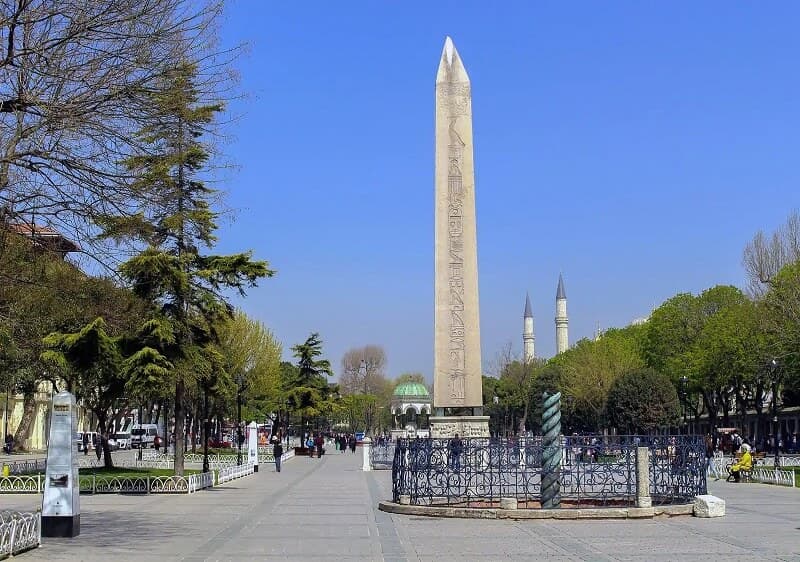
During his Byzantine era reign, Constantine purchased and erected many ancient monuments, some of which can still be seen today in the city center. Several of the statues and other monuments that once stood in the Hippodrome were destroyed by later emperors, but four of the most important ones still stand today.
蛇的列
Constantine and his successor, Theodosius the Great, erected the Serpent Column to boost their empire's reputation. To decorate the serpentine column, they gathered masterpieces from museums and private collections around the globe. In the 5th century B.C., the Greeks won a battle against the Persians. To remember this, the Serpent Column was built in the middle of the Hippodrome.
图特莫斯三世的奥比利斯克
Theodosius the Great not only contributed to the ornamentation of the Serpent Column but also imported an obelisk from Egypt in 390 and set it up in the hippodrome. During the reign of Thutmose
III, the obelisk, which was crafted from pink granite, was erected at the temple of Karnak. The obelisk's uppermost segment is still standing on its marble base, 3,500 years after it was first built.
墙壁的列(Obelisk)
墙壁奥比利斯克建于10世纪,由康斯坦丁·波菲罗根图斯建造,它是由金色的铜板制成的,在第四次十字军战争之后被拉丁军队抛弃之前。
波菲里奥斯雕像
Good charioteers were often hailed as local heroes because chariot and horse racing were two of the most popular forms of entertainment. Porphyrios was a charioteer who competed for both the "Blue" and the "Green" teams.
Seven statues were placed in the hippodrome's spina to commemorate his achievements. The statues themselves were lost, but the bases of two of them are on display at the Istanbul Archaeological Museum.
The Constantinople Palace's Foundations
In his enlargement of the Hippodrome, Constantine I linked it to the Great Palace of Constantinople, which is now buried beneath the Blue Mosque. The museum of the Great Palace mosaics is where the palace's ruins have been preserved.
最佳时间来参观
March through May and September through November are the coolest months in which to visit the Hippodrome in Istanbul. The summer months (June–August) are hot and dry, while the winter months (December–January) are wet, which can be inconvenient for tourists.
The Hippodrome can be seen in about 2 hours when Sultan Ahmed Square is at its busiest. This is between 10 and 11 a.m. You should go to the square very early in the morning if you don't want to deal with the crowds. It's a great way to see the obelisk up close and personal, along with the other ancient Hippodrome relics.
Hippodrome: A Brief History
Originally called Byzantium, Constantinople's Hippodrome dates back to that era. The city was reconstructed and its walls fortified by Emperor Septimius Severus in 203 AD. Chariot racing in the city was made possible by the arena he built.
With Constantine I's the expansion of the Hippodrome's arena in the fourth century CE, it became possible to hold not only chariot and horse races but also public spectacles like the humiliation of enemies and the execution of criminals.
Constantine, I realized that the Hippodrome is more than just a public circus for amusement; it also displays the might of the reigning emperor, as well as his wealth and generosity. For several days, the public was treated to a spectacular show. Severus, a Roman emperor, renamed it Augusta Antonia after conquering it from the Byzantines.
Constantine, however, changed the name of the city to Constantinople after he became emperor of the Byzantine Empire. It was a Greek name for the city named after Constantine. Septimius Severus' first hippodrome was a modest structure. He reconstructed and enlarged it so that it would be connected to the Great Palace of Constantinople, which is now buried beneath the Blue Mosque of Istanbul.
The hippodrome measured about 400 meters in length and 200 meters in width. The capacity of the arena is estimated to be between 30,000 and 60,000 people. One lap around the Hippodrome track would be about 300 meters if the marble seats were reserved for VIPs and the rest of the crowd sat on wooden benches.
History and Information about the Hippodrome
Here are a few interesting tidbits about the Hippodrome:
The Hippodrome was utilized by the Ottomans in addition to the emperors of the third and fourth centuries. The arena was repurposed as a public plaza and given the name At Meydani (Horse Square).
The square's obelisk, which has stood for 3,500 years, was originally brought to Istanbul by Emperor Theodosius I in the year 390 CE. The obelisk was located in Karnak and was built by Thutmose III. He moved the obelisk inside the Hippodrome and rechristened it the Obelisk of Theodosius.
到了拜占庭时代,赛车并不是唯一的娱乐形式,有四个赛车队,都得到了各种政治派别的财政支持,经常进行大规模的赌注。
When Justinian I was emperor in 532 CE, he had 30,000 people killed and locked up in the Hippodrome.
To be a good charioteer and compete in the races was to be held in the same esteem as any other public hero. In the chariot races, Porphyrios was a legend who competed for two of the four teams. Several statues of him with laudatory inscriptions once stood in the Hippodrome.
Advice for Enjoying the Hippodrome
The Hippodrome is a major attraction for visitors to Istanbul. There isn't much left of what was once a massive arena. Visit the Blue Mosque, the Museum of Turkish and Islamic Art, and the Hagia Sophia while you're in the area of the Hippodrome.
夏季的热量是不可忍受的 伊斯坦布尔在3月至5月和9月至11月的月份最愉快。 天气更易受,酒店价格较低,周围的人少。
舒适的短裤很好,但参观清真寺和其他宗教建筑的游客应该避免以尊重为由穿着它们。
Frequently Asked Questions About The Hippodrome
Q ⁇: What is the Hippodrome?
A 是: The Hippodrome was a public space used for chariot racing and other public events in ancient Constantinople (modern-day Istanbul, Turkey).
Q ⁇: Where was the Hippodrome located?
A 是: The Hippodrome was located in the center of Constantinople, near the present-day Sultanahmet neighborhood.
Q ⁇: How big was the Hippodrome?
A 是: The Hippodrome was approximately 450 meters long and 120 meters wide.
Q ⁇: What kind of events were held at the Hippodrome?
A 是: The Hippodrome was used for chariot racing, athletic competitions, and other public events.
Q ⁇: What is the history of the Hippodrome?
A 是: The Hippodrome was built in the 4th century AD and was a center of political and social life in Constantinople for several centuries.
Q ⁇: What happened to the Hippodrome?
A 是: The Hippodrome fell into disuse after the Latin Empire took Constantinople in 1204, and much of its structures were destroyed or repurposed over time.
Q ⁇: What is left of the Hippodrome today?
A 是: Today, only fragments of the Hippodrome remain, including a few columns and the Obelisk of Theodosius.
Q ⁇: Can one visit the Hippodrome?
A 是: Yes, visitors can visit the site of the Hippodrome and view the remaining fragments.
Q ⁇: Is there an entrance fee to visit the Hippodrome?
A 是: Yes, there may be an entrance fee to visit the Hippodrome, depending on the location and current policies.
Q ⁇: What is the best time to visit the Hippodrome?
A 是: The best time to visit the Hippodrome is during daylight hours when the site is open to visitors. Visiting during the spring or fall when the weather is mild is recommended.
您可以与我们的授权的旅游指南预订伊斯坦布尔市之旅。 链接如下:
Map of Hippodrome