
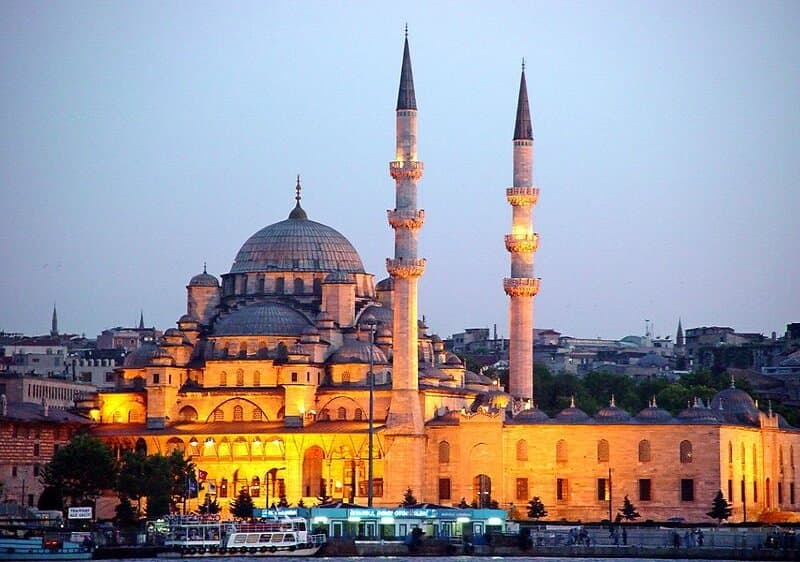
 新清真寺
YENI MOSQUE ISTANBUL
ISTANBUL YENI MOSQUE HISTORY
Originally known as the Valide Sultan Mosque (Turkish: Valide Sultan Camii), the New Valide Sultan Mosque (Turkish: Yeni Valide Sultan Camii) was built between 1660 and 1665 in the Eminonu neighborhood of Istanbul, Turkey. It is one of the most famous pieces of architecture in Istanbul. It is on the Golden Horn, at the end of the Galata Bridge to the south.
精彩的苏丹清真寺(女王母亲)
The construction of the mosque began in 1597. Sultana Safiye, later known as Valide Sultan (Queen Mother) of Sultan Mehmed III, issued the order. Originally called the "Valide Sultan Mosque," it was commissioned by her in her role as Valide Sultan following Mehmed III's accession to the Ottoman throne in 1595.
最初的建筑师是大米马尔·辛南的学徒达沃特·阿加,但达沃特·阿加于1599年去世,并被达尔吉克·阿哈德·卡夫斯接替,建造花费了半个多世纪,并由另一位有效的苏丹,土尔汉·哈蒂兹苏丹,穆罕默德四世的母亲完成。
Disagreement arose in the court over the project because of the location and the financial implications, and political discord delayed the project. The Jewish population of the city was concentrated in the Eminonu district, which also served as the city's main commercial hub. By putting the mosque there, Sultana Safiye hoped to increase Islam's clout in the city, taking advantage of local and foreign merchants' growing unhappiness with the growing influence of their Jewish competitors, who provided an easy pretext for the Sultan to seize their property.
However, the vast monetary outlay drew sharp criticism. In particular, the Janissaries felt the mosque was a waste of money and resented the Valide Sultan's rising political power. After the death of Mehmed III in 1603, Sultana Safiye was compelled to give up on the project. After Sultana Safiye was sent to the harem, the new Sultan, Ahmed I, lost interest in the project, and construction was stopped.
新的有效的苏丹清真寺
After 1603, the unfinished building crumbled to dust, and it was further damaged by the Great Fire of Istanbul (1660), which began on July 24, 1660, and lasted for just over two days (around 49 hours, according to the chronicles of Abdi Pasha). The mother of Sultan Mehmed IV, Sultana Turhan Hatice, was encouraged by Imperial Architect Mustafa Aga to finish the project as an act of devotion later that same year. In addition to the New Mosque, Sultana Turhan Hatice commissioned the construction of the adjacent Spice Bazaar. So, in the closing months of 1660, work resumed on the mosque, and the adjacent bazaar was built.
In 1663, the construction of the mosque was finished, and the following year, in 1665, it opened to the public. The old name "Valid Sultan Mosque" was changed to "New Valide Sultan Mosque" (Yeni Valide Sultan Camii). As time went on, the public began referring to it simply as the "New Mosque" (Yeni Cami).
新清真寺的建筑
The exterior of the mosque itself boasts 66 domes and semidomes in a pyramidal arrangement, as well as two minarets. The main dome is 36 meters tall and is surrounded by four smaller domes on either side. Taking inspiration from both Mimar Sinan's earlier Sehzade Mosque and Sedefkar Mehmed Agha's Sultan Ahmed Mosque, the New Mosque features a dome design similar to those of both.
The mosque proper is preceded on its west side by a monumental courtyard (avlu), as is typical of Istanbul's imperial mosques. The New Mosque has a square courtyard that is 39 meters on a side and is enclosed by a colonnaded peristyle that is itself roofed by 24 miniature domes. The focal point is an ornate sadirvan (ablution fountain). The water faucets used for the ritual washings are located on the south wall of the mosque. Iznik tiles adorn the sub-porch area of the mosque's exterior facade. The mosque's masonry was done with stone blocks brought from Rhodes.
The mosque's interior is a square with sides that are each 41 meters long. Four massive piers serve as the primary structural support for the dome and define the interior space. Colonnades with thin marble columns and arches in a variety of styles surround the perimeter and the back of the main space. The dome has a diameter of 17.5 meters and stands 36 meters tall.
Many Ottoman imperial mosques feature calligraphic plates bearing the names of the first four khalifas—Abu Bakr, Umar, Uthman, and Ali—at the four corners where the dome meets the pillars supporting it. Semi-domes extend the interior space along the building's east-west axis, with smaller domes atop the nave's four corners and even smaller domes atop the galleries' four corners.
A gilded screen can be found in the northeastern corner of the gallery, providing privacy for the imperial court as they worship. This Royal Loge is connected to the Royal Pavilion in the mosque's northeastern quadrant via a long elevated passageway.
蓝色,绿色和白色伊兹尼克砖,通常被认为是较低的质量比早期的帝国清真寺的砖,装饰建筑物的内部。 明巴被一个 ⁇ 形的吊板覆盖,由薄薄的石棉柱支撑。
关于伊斯坦布尔新清真寺的常见问题
Q ⁇新清真寺是什么?
A 是新清真寺是位于土耳其伊斯坦布尔的清真寺。
Q ⁇: Where is the Yeni Mosque located?
A 是新清真寺位于土耳其伊斯坦布尔的Eminönü区。
Q ⁇新清真寺的历史是什么?
A 是: The Yeni Mosque was built in the 16th century by the Ottoman Sultan Mehmed III, and it was one of the largest mosques in Istanbul at the time.
Q ⁇新清真寺的建筑是什么样子?
A 是新清真寺是奥斯曼式清真寺建筑的典范,具有复杂的砖工作和书写。
Q ⁇可以去新清真寺吗?
A 是: Yes, the Yeni Mosque is open to visitors, but appropriate dress and behavior are required.
Q ⁇参观新清真寺有入场费吗?
A 是没有,没有入场费来参观新清真寺。
Q ⁇:新清真寺的访问时间是多少?
A 是: The visiting hours for the Yeni Mosque may vary, but it is typically open for visitors during daylight hours.
Q ⁇难道在新清真寺有地方去行淫(wudu)?
A 是是的,在新清真寺有执行 ⁇ 咒(wudu)的设施。
Q ⁇: 去新清真寺的最佳时间是什么时候?
A 是: 参观新清真寺的最佳时间是白天,当它对游客开放时。建议在天气温和的春天或秋天参观。
Q ⁇: 附近有没有新清真寺的景点?
A 是: Yes, there are several nearby attractions to the Yeni Mosque, including the Spice Bazaar, the Galata Bridge, and the Golden Horn.
您可以与我们的授权的旅游指南预订伊斯坦布尔市之旅。 链接如下:
伊斯坦布尔新清真寺地图