
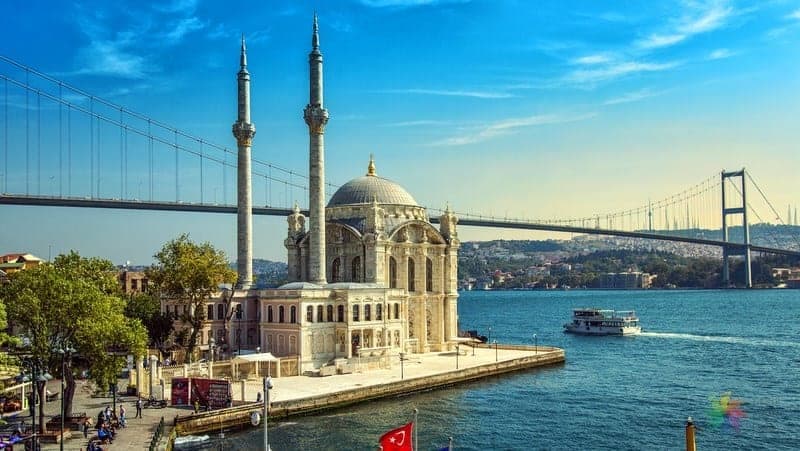
 ortakoy mosque Istanbul
ISTANBUL ORTAKOY MOSQUE
ORTAKOY MOSQUE History
Located in Besiktas, Istanbul, Turkey, the Ortaköy Mosque (Turkish: Ortaköy Camii) or Büyük Mecidiye Camii (Turkish: Büyük Mecidiye Camii, "Great Mosque of Sultan Abdulmejid") is a mosque on the waterfront of the Ortaköy pier square, one of the busiest spots on the Bosphorus. It was built in the 1850s and commissioned by Sultan Abdülmecid I of the Ottoman Empire.
This building represents Ortaköy because of the unique perspective it provides of the Bosphorus Strait and the Bosphorus Bridge in Istanbul. From Bosphorus cruises and ferries, the mosque can be seen.
History of the Ortakoy Mosque
Ortaköy Mosque stands on the site of an earlier, smaller mosque that was destroyed in 1720, during the Patrona Halil Uprising. The current mosque dates back to 1854 or 1856 when construction was commissioned by Ottoman sultan Abdülmecid I (the exact dates of construction vary between scholarly sources). It was designed by the Armenian father-and-son team of Garabet Balyan and Nikogos Balyan in 1853–1855. The pair also created the adjacent Dolmabahce Palace and Dolmabahce Mosque.
the original brick dome of the mosque. The original concrete dome, however, had developed cracks over the years and was on the verge of collapse, necessitating a replacement. The mosque was first damaged in an earthquake in 1894 and then again in a fire in 1984. As a result, the building has had numerous restoration and repair projects carried out on it over the years. It's in reasonable condition right now.
Ortakoy Mosque's Stunning Design
De Balyans, die ook andere Istanbulse bezienswaardigheden ontwierpen, creëerden een eclectische look voor de moskee door elementen van Europese heroplevingsstijlen zoals het neoklassicisme te fuseren met Ottomaanse barokke ornamentatie en algemene lay-out.
There is a U-shaped imperial apartment on the upper floors for the sultan and a square main prayer hall for the mosque below. Each of these rooms is topped by a single dome. Its "dynamic appearance" is due in large part to the carved stone reliefs that adorn the mosque's facades, which feature engaged columns. It is lit by two rows of windows. While stone was used to construct the two tall, thin minarets, concrete was used to rebuild the dome. The minarets are capped with balconies that are reminiscent of Corinthian columns.
The mosque is relatively small when compared to other mosques on the other side of the Golden Horn. Even though it is relatively small on the outside, the interior is quite roomy thanks to the high ceilings and large windows that both reflect the surrounding landscape and let in plenty of natural light. The minbar and mihrab were crafted from marble and porphyry, among other precious stones. Abdülmecid I is credited with introducing trompe l'oeil frescoes to Ottoman architecture, which can be seen inside the dome. The niche-like windows with curtains and mihrab rows depicted in these trompe l'oeil paintings are reminiscent of traditional Islamic architecture and decoration, while the paintings themselves are executed in a Neo-Renaissance style. Abdülmecid I, who was also a calligrapher in addition to being a sultan, executed several panels of calligraphy for the mosque's interior.
Ortakoy Mosque's Exterior
In comparison to other well-known mosques in Istanbul, the mosque's courtyard is relatively small. There is a single dome atop the mosque and two minarets, each of which has a single balcony (serife in Turkish).
Er zijn vier grote kolommen in de hoeken van de vierkante grond. Ontworpen als een zomerresidentie voor de sultan, staat dit paviljoen naast de moskee. Architectuur in paviljoenstijl, in plaats van de traditionele hunkar mahfili (een speciaal gebied dat afgesloten is voor de sultan binnen de moskee), weerspiegelt de loop van de tijd.
Vanaf de grond heeft de buitenkant van de moskee drie verschillende secties: de eerste heeft twee ramen, de tweede heeft drie, de derde heeft gewichten torens, en dan is er de koepel (bekijk ook de verschillende motieven op de kolommen).
The tughra (the sultan's signature) can be seen above the doorway.
Ortakoy Mosque's Interior
The mosque has an entrance hall called a narthex. You've probably seen these chandeliers before in Dolmabahce Palace's main hall, which features one large and eight smaller versions. Magnificent calligraphy adorns large panels (including the names of Allah, the prophet Muhammed, and the first four caliphs), which was a collaborative effort between Sultan Abdulmecid and other artists.
Assuming it's okay with the Sultan, you can ascend to the second floor and admire the view from the women's and Sultan's balconies (unfortunately, sometimes they are closed). For the upper floors, there is an elliptical staircase. As seen from the balcony below, the dome's opening features a motif of the sky. The walls are painted in a rainbow of hues, including pink, blue, orange, green, and many more.
Niet verrassend is dat er een Mihrab is die de weg naar Mekka laat zien en een Minbar voor imams om te gebruiken wanneer ze prediken.
Er zijn tal van ronde ramen voor natuurlijk licht om binnen te komen. Het uitzicht beschikbaar door deze glazen panelen zijn adembenemend. Vergeet niet om een laatste blik op de buitenkant van de moskee te nemen voordat u verlaat.
Bovendien geeft de schoonheid van het interieur de indruk dat het regelmatig wordt schoongemaakt.
Location and Visiting Times for the Ortakoy Mosque
During times of prayer, it is not possible to search the interior. Furthermore, anyone is welcome to visit the mosque at any time to pray. Most large mosques adhere to a standard procedure for greeting visitors (e.g., from 9 a.m. to 5 p.m.). But you can't shut down a mosque, and people will always be able to pray there.
Elke week op vrijdag om de middag is er een speciale preek en een tijd van gemeenschappelijk gebed. dus raden we u aan om de moskee op vrijdag na 2 uur of vroeg in de ochtend te bezoeken.
The views, especially at sunset and sunrise, are fascinating. It's important to keep this in mind for a more satisfying journey. In addition, taking good photographs when the sun is overhead can be challenging.
What's Around the Ortakoy Mosque
The Turkish baked potato, or kumpir, and the Belgian waffle both have a strong following in Ortakoy. In theory, you could give it a shot. The area around the mosque has some excellent cafes where you can enjoy a cup of coffee, Turkish coffee, or Turkish tea. Don't just choose a cafe because you might be disappointed with the service. If you're interested, there are also a few cafes where you can smoke hookah (nargile in Turkish).
Je kunt winkelen op de prachtige kleine straten.Je kunt ook kermesses zien die je kunt controleren op bescheidenheid in kleine stukjes.
Frequently Asked Questions About the Ortakoy Mosque
Q: What is the Ortaköy Mosque?
a: The Ortaköy Mosque is a historic mosque located in the Ortaköy neighborhood of Istanbul, Turkey.
Q: Where is the Ortaköy Mosque located?
a: The Ortaköy Mosque is located in the Ortaköy neighborhood of Istanbul, Turkey.
Q: How old is the Ortaköy Mosque?
a: The Ortaköy Mosque was built in the 19th century, during the Ottoman Empire era.
Q: What is the history of the Ortaköy Mosque?
a: The Ortaköy Mosque was built as a symbol of Ottoman power and architectural prowess and has been an important place of worship for the Muslim community in Istanbul for centuries.
Q: What is the significance of the Ortaköy Mosque?
a: The Ortaköy Mosque is an important religious and cultural landmark in Istanbul and is known for its intricate tile work, calligraphy, and unique architectural style.
Q: What can I see at the Ortaköy Mosque?
a: Visitors to the Ortaköy Mosque can see the mosque itself as well as the surrounding grounds, including a courtyard and a small park.
Q: How do I get to the Ortaköy Mosque?
a: De Ortaköy-moskee is bereikbaar met het openbaar vervoer of met de auto en ligt dicht bij de oever van de Bosporus.
Q: Is there an entrance fee to visit the Ortaköy Mosque?
a: There is no entrance fee to visit the Ortaköy Mosque.
Q: Are there any restrictions for visiting the Ortaköy Mosque?
aBezoekers zijn verplicht om zich bescheiden te kleden en hun schoenen te verwijderen voordat ze de moskee betreden.
Q: Are there any facilities at the Ortaköy Mosque?
a: There are limited facilities at the Ortaköy Mosque, including restrooms and a small café, but visitors are encouraged to bring their food and drinks.
U kunt een Istanbul stadstour boeken met onze gids.
Map of Ortakoy Mosque