
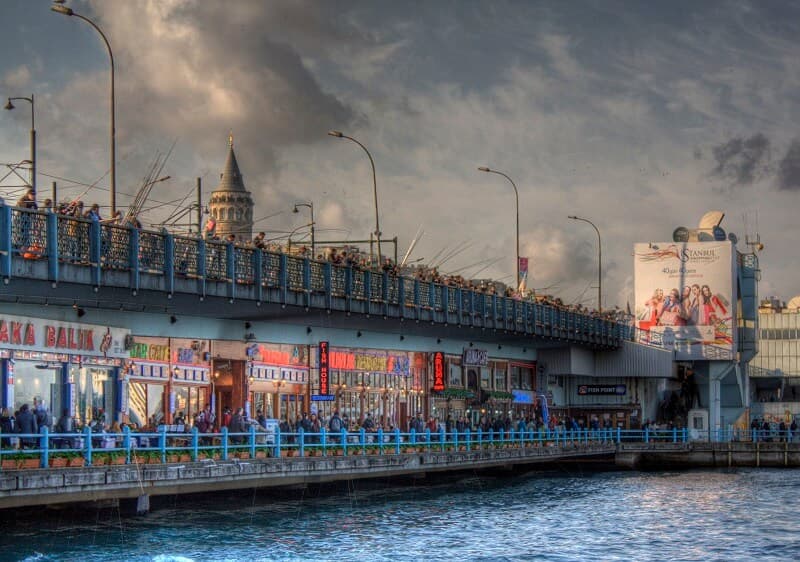
 galata bridge istanbul
ISTANBUL GALATA BRIDGE
GALATA BRIDGE over the Golden Horn
Bridges hold a special allure for humans, and as a result, they frequently become the subjects of myths and legends. That is especially true in Istanbul, where the city's many bridges have become cultural icons.
The Galata Bridge over the Golden Horn is significant for more reasons than its history, so focusing solely on that would be a mistake. Like a fellow citizen, this bridge has served as more than just a practical means of transportation between two points across a body of water; it has also carried deep spiritual significance for its users. The bridge played an important role in Turkish literature, particularly in the late 19th century. Nearly every novelist, like Hüseyin Rahmi Gürpinar and Ahmet Rasim, has written about this bridge, especially in the last medium.
During the Turkish siege of Istanbul in 1453, the city's oldest known bridge was constructed across the Golden Horn. The idea of building a permanent bridge here was discussed in 1502 and 1503, and Leonardo da Vinci used this item to sketch out a design for a single-span bridge with double pillars at either end, measuring 350 meters in length and 24 meters in width (1148 x 79 feet).
Desafortunadamente, los desafíos logísticos impidieron que esto ocurriera, por lo que otro artista italiano, Michelangelo, fue encargado de crear un puente para Estambul en su lugar. Después de que Michelangelo rechazó la propuesta, la idea de construir un puente aquí fue cortada hasta el siglo XIX. El puente que conecta Azapkapi y Unkapani fue encargado por el sultán Mahmut II (1808-1839) y construido a principios del siglo XIX. El Puente Hayratiye fue dedicado el 3 de septiembre de 1836.
Using the navy's manpower and equipment, Deputy Lord High Admiral Fevzi Ahmet Pasha completed the task. The total length of this pontoon bridge ranged from about 500 to 540 meters (1640 to 1771 feet).
In 1845, the mother of Sultan Abdulmecid built the first Galata Bridge at the channel's mouth, and it was in use for the next 18 years. To differentiate it from the older bridge further up the Golden Horn, which became known as the Cisr-i Atik, or Old Bridge, the newer bridge was given the name Cisr-i Cedid or New Bridge.
Abdulmecid Han was the man responsible for constructing the new bridge. The Sultan of Ottomany was the first to cross the bridge, followed by the French captain Magnan of the Cygne. After the first three days, a toll called "mürüriye" was paid to the Naval Ministry to cross the bridge.
After Napoleon III's planned visit to the city in 1863, Sultan Abdulaziz had Ethem Pertev Pasha construct a new wooden bridge.
Después de firmar un contrato con la empresa francesa Forges et Chantiers de la Mediterranée en 1870 para construir un tercer puente, el proyecto fue pospuesto debido al estallido de la guerra entre Francia y Alemania y finalmente fue otorgado a la compañía británica G. Wells en 1872. Este puente pontificio, construido en 1875, midió 480 metros de largo y 14 metros de ancho (1574 x 46 pies). El coste total de la construcción fue de 105.000 liras de oro. Después de estar en uso hasta 1912, cuando se construyó el verdadero antiguo puente Cisr-i Atik, este fue eliminado.
In 1912, the German Man Company spent 350,000 gold liras constructing the fourth Galata Bridge. The length of this bridge was 466 meters, and its width was 25 meters (82 feet). The bridge many people today recognize was badly damaged in a fire in 1992 and was towed up the Golden Horn to make way for the newer bridge. The fifth bridge, measuring 490 meters (1608 feet) in length and 42 meters (138 feet) in width, opened in 1994 and is still in use today.
El Puente de Galata conecta la histórica ciudad de Estambul, hogar del palacio imperial y de las principales instituciones religiosas y seculares del Imperio Otomano, con los barrios modernos de Galata, Beyoglu, Sisli y Harbiye, donde un número desproporcionado de no musulmanes y comerciantes y diplomáticos extranjeros hicieron sus hogares.
According to author Peyami Safa's novel Fatih-Harbiye, anyone who crosses the bridge from Fatih to Harbiye enters an entirely new culture and civilization. The Galata Bridge has appeared in many works of fiction and has also been the subject of numerous paintings and engravings due to its picturesque appearance.
Atracciones del Puente de Galata
El Puente de Galata es el hogar de muchos excelentes restaurantes de mariscos.
Under the bridge, on both sides, are numerous eateries specializing in seafood. Every variety of fish imaginable can be found on restaurant menus. Visitors to the area, who typically dine on fish, find the proliferation of boats and ships to be the most appealing aspect. Grilled fish served with Turkish bread is a popular appetizer on boats and ships. Crew members engage in the rewarding activity of preparing fish for the consumption of the ship's passengers.
Vista nocturna del Puente de Galata
At night, the Galata Bridge is one of the best spots in Istanbul for tourists and partygoers to take in the peaceful sea and the bridge's charming lights while listening to the sounds of the city. They also enjoy the pretty view of the city at night when the colorful lights reflect in the Bosphorus.
Galata Bridge tourist attractions
Near the Galata Bridge in Istanbul are many famous landmarks. The Sultan Ahmed neighborhood is to the south, and the Karakoy neighborhood is to the north. From Eminonu, ferry rides to the Princess Islands can be taken by marine enthusiasts. The Galata Bridge is close to many other popular tourist destinations, including the Galata Tower, the Spice Market (Egyptian Market), the Istanbul Museum of Modern Art, the Fatih Mosque, the Suleymaniye Mosque, the Ayasofya Mosque, Sultan Ahmed Square, and many more.
Frequently Asked Questions About the Galata Bridge
q: What is the Galata Bridge?
a: The Galata Bridge is a suspension bridge over the Golden Horn in Istanbul, Turkey.
q¿Dónde está ubicado el Puente de Galata?
a: The Galata Bridge is located in Istanbul, Turkey, spanning the Golden Horn.
q¿Cuál es la historia del Puente de Galata?
a: The Galata Bridge was built in 1992, replacing an older bridge that was built in the late 19th century.
q¿Cuál es el significado del Puente de Galata?
a: The Galata Bridge is one of the most famous landmarks in Istanbul, and it provides a connection between the old city and the modern city.
q: What are the opening hours of the Galata Bridge?
a: The Galata Bridge is open 24 hours a day.
q: How much does it cost to cross the Galata Bridge?
a: El cruce del Puente de Galata es gratuito.
q¿Cómo es el transporte como el Puente de Galata?
a: The Galata Bridge is easily accessible by taxi or public transportation.
q¿Hay restaurantes o tiendas en el Puente de Galata?
aSí, hay varios restaurantes y tiendas en el Puente de Galata, incluyendo restaurantes de mariscos y tiendas de recuerdos.
q¿Cuál es el mejor momento para visitar el Puente de Galata?
a: El mejor momento para visitar el Puente de Galata es al atardecer cuando la vista de la ciudad y el Bósforo es particularmente asombrosa.
q¿Hay restricciones para tomar fotos en el Puente de Galata?
a: There are no restrictions on taking photos at the Galata Bridge, but visitors should be respectful of the locals and the busy street traffic.
Puedes reservar un tour de la ciudad de Estambul con nuestras guías de viaje licenciadas.
Mapa del Puente de Galata