
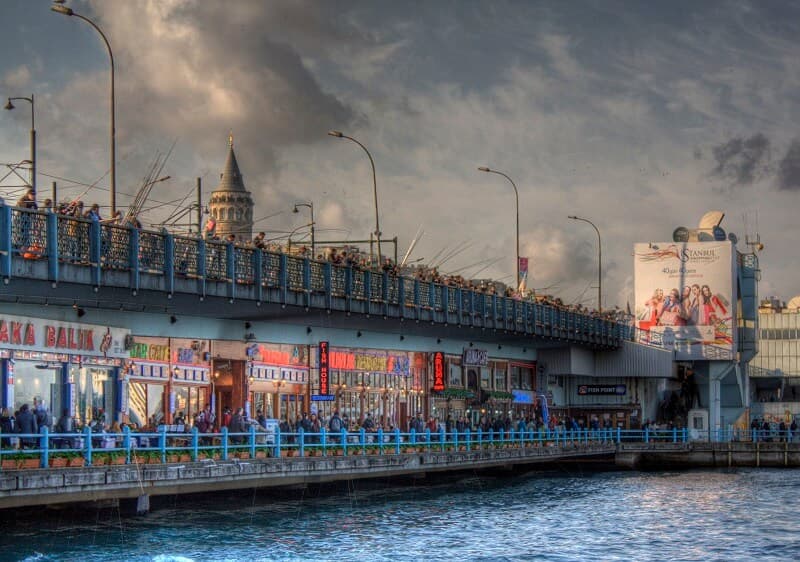
 galata bridge istanbul
ISTANBUL GALATA BRIDGE
GALATA BRIDGE over the Golden Horn
Bridges hold a special allure for humans, and as a result, they frequently become the subjects of myths and legends. That is especially true in Istanbul, where the city's many bridges have become cultural icons.
The Galata Bridge over the Golden Horn is significant for more reasons than its history, so focusing solely on that would be a mistake. Like a fellow citizen, this bridge has served as more than just a practical means of transportation between two points across a body of water; it has also carried deep spiritual significance for its users. The bridge played an important role in Turkish literature, particularly in the late 19th century. Nearly every novelist, like Hüseyin Rahmi Gürpinar and Ahmet Rasim, has written about this bridge, especially in the last medium.
During the Turkish siege of Istanbul in 1453, the city's oldest known bridge was constructed across the Golden Horn. The idea of building a permanent bridge here was discussed in 1502 and 1503, and Leonardo da Vinci used this item to sketch out a design for a single-span bridge with double pillars at either end, measuring 350 meters in length and 24 meters in width (1148 x 79 feet).
Desværre forhindrede logistiske udfordringer dette i at ske, så en anden italiensk kunstner, Michelangelo, blev bestilt til at skabe en bro til Istanbul i stedet. Efter Michelangelo afviste forslaget, blev ideen om at bygge en bro her hyldet indtil det 19. århundrede. Broen, der forbinder Azapkapi og Unkapani blev bestilt af Sultan Mahmut II (1808-1839) og bygget i begyndelsen af det 19. århundrede. Hayratiye Bridge blev dedikeret den 3. september 1836.
Using the navy's manpower and equipment, Deputy Lord High Admiral Fevzi Ahmet Pasha completed the task. The total length of this pontoon bridge ranged from about 500 to 540 meters (1640 to 1771 feet).
In 1845, the mother of Sultan Abdulmecid built the first Galata Bridge at the channel's mouth, and it was in use for the next 18 years. To differentiate it from the older bridge further up the Golden Horn, which became known as the Cisr-i Atik, or Old Bridge, the newer bridge was given the name Cisr-i Cedid or New Bridge.
Abdulmecid Han was the man responsible for constructing the new bridge. The Sultan of Ottomany was the first to cross the bridge, followed by the French captain Magnan of the Cygne. After the first three days, a toll called "mürüriye" was paid to the Naval Ministry to cross the bridge.
After Napoleon III's planned visit to the city in 1863, Sultan Abdulaziz had Ethem Pertev Pasha construct a new wooden bridge.
Efter at have underskrevet en kontrakt med det franske firma Forges et Chantiers de la Mediterranée i 1870 for at bygge en tredje bro, blev projektet udskudt på grund af udbruddet af krigen mellem Frankrig og Tyskland og blev til sidst tildelt det britiske firma G. Wells i 1872. Denne punkterede bro, bygget i 1875, målte 480 meter i længde og 14 meter i bredde (1574 x 46 fod). Den samlede omkostning for konstruktion var 105.000 liras guld. Efter at være i brug indtil 1912, da den virkelig gamle Cisr-i Atik Bridge blev bygget opstrøms, blev denne fjernet.
In 1912, the German Man Company spent 350,000 gold liras constructing the fourth Galata Bridge. The length of this bridge was 466 meters, and its width was 25 meters (82 feet). The bridge many people today recognize was badly damaged in a fire in 1992 and was towed up the Golden Horn to make way for the newer bridge. The fifth bridge, measuring 490 meters (1608 feet) in length and 42 meters (138 feet) in width, opened in 1994 and is still in use today.
Galata-broen forbinder den historiske by Istanbul, hjemsted for det kejserlige palads og de store religiøse og sekulære institutioner i det osmanniske rige, med de moderne kvarterer Galata, Beyoglu, Sisli og Harbiye, hvor et uforholdsmæssigt stort antal ikke-muslimer og udenlandske købmænd og diplomater gjorde deres hjem.
According to author Peyami Safa's novel Fatih-Harbiye, anyone who crosses the bridge from Fatih to Harbiye enters an entirely new culture and civilization. The Galata Bridge has appeared in many works of fiction and has also been the subject of numerous paintings and engravings due to its picturesque appearance.
Galata Bridge Attractions
The Galata Bridge is home to many excellent seafood restaurants.
Under the bridge, on both sides, are numerous eateries specializing in seafood. Every variety of fish imaginable can be found on restaurant menus. Visitors to the area, who typically dine on fish, find the proliferation of boats and ships to be the most appealing aspect. Grilled fish served with Turkish bread is a popular appetizer on boats and ships. Crew members engage in the rewarding activity of preparing fish for the consumption of the ship's passengers.
Nattesyn på Galata-broen
At night, the Galata Bridge is one of the best spots in Istanbul for tourists and partygoers to take in the peaceful sea and the bridge's charming lights while listening to the sounds of the city. They also enjoy the pretty view of the city at night when the colorful lights reflect in the Bosphorus.
Galata Bridge tourist attractions
Near the Galata Bridge in Istanbul are many famous landmarks. The Sultan Ahmed neighborhood is to the south, and the Karakoy neighborhood is to the north. From Eminonu, ferry rides to the Princess Islands can be taken by marine enthusiasts. The Galata Bridge is close to many other popular tourist destinations, including the Galata Tower, the Spice Market (Egyptian Market), the Istanbul Museum of Modern Art, the Fatih Mosque, the Suleymaniye Mosque, the Ayasofya Mosque, Sultan Ahmed Square, and many more.
Ofte stillede spørgsmål om Galata-broen
Q er: What is the Galata Bridge?
a): The Galata Bridge is a suspension bridge over the Golden Horn in Istanbul, Turkey.
Q erHvor ligger Galata-broen?
a): The Galata Bridge is located in Istanbul, Turkey, spanning the Golden Horn.
Q erHvad er historien om Galata-broen?
a)Galata-broen blev bygget i 1992 og erstattede en ældre bro, der blev bygget i slutningen af det 19. århundrede.
Q erHvad er betydningen af Galata-broen?
a)Galata-broen er et af de mest berømte vartegn i Istanbul, og den giver en forbindelse mellem den gamle by og den moderne by.
Q er: What are the opening hours of the Galata Bridge?
a): The Galata Bridge is open 24 hours a day.
Q erHvad koster det at krydse Galata-broen?
a)Overgangen af Galata-broen er gratis.
Q er: What is the transportation like to the Galata Bridge?
a)Galata-broen er let tilgængelig med taxa eller offentlig transport.
Q erEr der restauranter eller butikker på Galata-broen?
a): Yes, there are several restaurants and shops on the Galata Bridge, including seafood restaurants and souvenir shops.
Q er: What is the best time to visit the Galata Bridge?
a): The best time to visit the Galata Bridge is at sunset when the view of the city and the Bosphorus is particularly stunning.
Q er: Are there any restrictions on taking photos at the Galata Bridge?
a): There are no restrictions on taking photos at the Galata Bridge, but visitors should be respectful of the locals and the busy street traffic.
Du kan bestille en tur til Istanbul med vores licenserede guider.
Map of Galata Bridge