
 Istanbul balat and fener area
Estambul Balat y Fener Area
Historia de Balat y Fener
Balón
Located between Fener and Ayvansaray, Balat is part of the historic district on the European side of Istanbul, on the western shore of the Golden Horn. It once served as the hub of Istanbul's Jewish community.
Se cree que el Palacio de Blachernae cerca es la inspiración para el nombre Balat, que proviene de la palabra griega palation (palacio), a través de la palabra latina palatium.
The back streets of Balat, like those of neighboring Fener, are lined with small stone terraced houses on two or three levels, as well as a few grander mansions. Many of the homes in Balat have been converted into hotels, restaurants, and cafes, making it one of the city's most popular tourist destinations in the 2010s and beyond. A lot of the houses have been painted bright colors to give the area its own identity.
Balat está en la línea de tranvía T5, que viaja a Cibali y al terminal de autobuses Alibeyköy (que sirve rutas a Anatolia). Para llegar de Balat a los otros barrios alrededor del Cuerno de Oro como Üsküdar, Karaköy, Kasimpasa, Fener, Ayvansaray, Hasköy, Sütlüce y Eyüp, puede tomar un ferry.
Balat's History
A finales del siglo XV, después de que la Inquisición se había extendido por toda España y África y el Decreto de Alhambra de 1492 había prohibido a todos los judíos vivir en España, un gran número de judíos buscó refugio en Balat.
[3] Balat once had 18 synagogues, but today only the Ahrida Synagogue and the Yanbol Synagogue are in use. Or-Ahayim Hospital, which was opened in 1899 and designed by Gabriel Tedesci, was originally established to serve the Jewish population of Balat, but now serves the general public.
Anteriormente una iglesia cristiana, la mezquita de Fethiye ahora lleva el nombre de Pammakaristos.
People of many different races, cultures, and faiths made their homes in Balat. There has always been a sizable Armenian population in the area, and it is also home to the world-famous Bulgarian Iron Church. There was a sizable Greek Orthodox (Rûm) community because of its proximity to St. George's Church and the Ecumenical Patriarchate of Constantinople in neighboring Fener. As a result of 20th-century events like the Armenian genocide, the Greek genocide, anti-Greek riots, and expulsions, the population of Balat is now overwhelmingly Muslim.
Desde el siglo XVII, los viajeros europeos escribieron sobre Balat como un lugar particularmente pobre e inhigiénico. sin embargo, Marie-Christine Bornes-Varol ha argumentado que estos cuentos pueden no haber sido representativos de Balat en su conjunto, dado que se basaron en visitas a Karabas, la parte más pobre de Balat.
Afirmaron que se defendían de los malos tratos de la unidad local de Janissary cuando los judíos de Balat atacaron sus patrullas en 1810.
Balat was included on the UNESCO World Heritage List as one of Istanbul's Historic Areas back in 1985, and it has since been the site of many contentious revitalization and restoration efforts dating back to the late 1990s and early 2000s.
Atracciones de Balat
Construida en su totalidad con hierro prefabricado, que fue enviado desde Viena al Danubio y luego reorganizada en Balat, la Iglesia de San Esteban de los Búlgaros (también conocida como la Iglesia del Hierro) se encuentra en la orilla del Cuerno de Oro, donde Fener se dirige a la vecina Balat.Después de separarse del Patriarcado Ortodoxo en 1872, ahora sirve como sede del Exarcado búlgaro.
The Ahrida Synagogue, built in the 15th century to serve the Jewish community of Ochrid, is notable for housing a stunning wooden bema (pulpit) and being the site where the heretic Sabbetai Tsvi first publicly proclaimed his heretical beliefs in 1666. The Yanbol Synagogue, which dates back to the 15th century and was constructed for a group of Bulgarian Jews, is known for its stunning painted ceiling.
A la derecha de las escaleras que componen Merdivenli Mektep Sokak es la casa del historiador Dimitri Cantemir (1673-1723).
Usually only accessible on St. George's Day, the Church of Hagios Georgios Metochi can be found within a large compound just off Vodina Caddesi. A chapel for one of Wallachia's governors may have stood on the site originally, but by the 17th century, it had been transformed into a metochion with ties to Jerusalem's Church of the Holy Sepulchre. In the early 20th century, a scholar unearthed the so-called Archimedes Palimpsest, which consisted of seven books written by the Greek mathematician Archimedes that had been recycled to create a prayer book in the Middle Ages. There are only three that haven't been found in any other copies.
The 16th-century Surp Hresdagabed (Church of the Archangels) Armenian Church was rebuilt in the 18th century on top of the original ayazma (sacred spring) it was constructed over. The city's garbage collectors have moved into the former school building from the 19th century. Tim Kelsey, a travel writer, wrote about a once-annual event in which Muslims and Christians came together to sacrifice sheep and cockerels in the hopes that the animal's blood would heal a disabled member of the community.
La Mezquita de Ferruh Kethüda (1562), una obra menor de Mimar Sinan, presenta azulejos Tekfur Sarayi alrededor del mihrab.
Balat is now cut off from the Golden Horn because of the collapsed Sea Walls of Constantinople. A plaque on the seaward side of the walls commemorates the spot where Sultan Mehmet II's troops broke through them on April 23, 1453, during the battle that led to the Conquest of Istanbul.
In addition to the Church of Hagios Ioannis Prodromos (St. John the Baptist), which has strong ties to the St. Catherine's Monastery in the Sinai Desert in Egypt, there are a few other rarely visited Greek Orthodox churches in Balat.
Fener
Istanbul, Turkey; Golden Horn, Fatih neighborhood. Because a column topped with a lantern stood here in the Byzantine period and was used as a street light or lighthouse, the area was given the name "phanarion," which is a Turkish transliteration of the word "phanarion" (Medieval Greek: v), meaning lantern, streetlight, or lamppost.
Fener was a predominantly Greek neighborhood during the Ottoman period, and its streets are lined with historic buildings from the Byzantine and Ottoman eras. One of the grand mansions that once stored wood brought in from the Black Sea (Pontos) area is now home to the Istanbul Women's Library. From the 1930s onward, street-widening projects harmed their picturesque facades.
Fener, en la orilla sur del Cuerno de Oro, se encuentra entre Cibali y Balat.
Fener is connected to Cibali and the small bus terminal (for buses to Anatolia) at Alibeyköy via the T5 tram line. Fener is connected to the neighborhoods of Üsküdar, Karaköy, Kasimpasa, Balat, Ayvansaray, Hasköy, Sütlüce, and Eyüp via the Golden Horn ferry.
Fener Historia
As a result of the 1453 destruction of Constantinople, many of the city's Greeks relocated to the Fener neighborhood. In addition, the seat of the Patriarchate of Constantinople was relocated here and now operates from its new location. So, like "Vatican" is sometimes used to refer to the Holy See of the Roman Catholic Church, "Phanar" can be used to refer to the Ecumenical Patriarchate as a shorthand reference.
In Fener, the Greeks were known as Phanariotes during the Ottoman era, and many of them held high positions in Sultan's court. In the Balkans and Greece, wealthy Phanariotes often held positions as dragomans (translators) or as governors of provinces. Between 1711 and 1821, several people held the position of hospodar of Wallachia and Moldavia.
Atracciones de Fener
The Ecumenical Patriarchate of Constantinople is one of fifteen to seventeen autonomous jurisdictions within the Eastern Orthodox Church. Its seat is in Fener, within the walled compound that encloses the Patriarchal Church of St. George. Batholomew I is the current Patriarch. In 1602, the patriarchate relocated here, but in 1720, a fire destroyed the basilican church that had stood there since its inception. Another fire in 1941 further damaged the older buildings in the compound, so today most of what a visitor sees is relatively new. The only original structures are the church and the brick-and-stone library at the end of the garden. Since 1821, when Greece rebelled against Ottoman suzerainty, the compound's Middle Gate (Orta Kapi) has been locked because it was there that the then-Patriarch was hanged. Thousands of people, some of whom have traveled from Athens, have come to celebrate Greek Orthodox Easter in this city.
Aside from the Patriarchate, the most interesting church in Constantinople is the Church of St. Mary of the Mongols (Panagia Muhliotissa, Theotokos Panagiotussa), located inland and uphill. It is said that the architect Atik Sinan (not to be confused with the more famous Mimar Sinan) convinced Sultan Mehmet II to let it keep serving the Greek community, and a copy of the ferman (edict) still hangs in the church today.
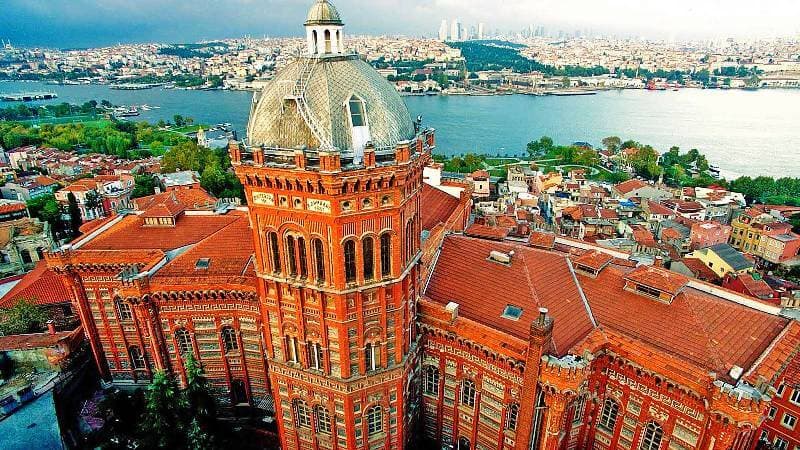
Located close to the Mongols' St. Mary's Church, this colossal red-brick University of the Phanar Greek Orthodox Church Historian Dimitri Cantemir studied at this institution in the 17th century. There are now only a few pupils left. The Marasli Greek Orthodox Primary School, the second Greek school in Fener, is another grand structure that is currently empty of its intended occupants.
Las Murallas del Mar, que una vez separaron Constantinopla del Cuerno de Oro, todavía forman una periferia truncada a lo largo de Fener. Se cree que Mimar Sinan, en 1562, diseñó la puerta de Ayakapi en las murallas.
Las calles traseras en Fener están recubiertas de casas de terraza de diferentes alturas, muchas de las cuales tienen cumbas (ventanas de la bahía), y algunas escogidas que son mucho más grandes.
Las aguas benditas
The Orthodox Church celebrates the Feast of the Epiphany on January 6 with a ceremony known as the Blessing of the Waters, during which a priest throws a cross into the water and swimmers compete to be the first to bring it back to shore. In Istanbul, the Patriarch performs the ceremony by throwing a cross into the Golden Horn, where swimmers then retrieve it.
Frequently Asked Questions About Ahrida Synagogue
q¿Qué son Balat y Fener?
aBalat y Fener son dos barrios históricos ubicados en Estambul, Turquía.
q¿Cuál es la historia de Balat y Fener?
aBalat y Fener fueron antiguamente importantes centros de los imperios bizantino y otomano, respectivamente. tienen una rica historia y patrimonio cultural, y han alojado muchas instituciones religiosas y culturales significativas.
q¿Cuál es el significado de Balat y Fener?
aBalat y Fener son importantes por su rica historia y patrimonio cultural, así como por su arquitectura y monumentos religiosos.
q: ¿Qué pueden esperar los visitantes en Balat y Fener?
a: Los visitantes a Balat y Fener pueden esperar ver una mezcla de arquitectura histórica y moderna, así como numerosos monumentos religiosos y culturales, como sinagogas, iglesias y mezquitas.
q: ¿Es seguro visitar Balat y Fener?
a: Sí, Balat y Fener generalmente se consideran seguros para visitar. Sin embargo, como con cualquier área urbana, se recomienda tomar precauciones de seguridad estándar y estar al tanto de su entorno.
q: ¿Hay alguna gira guiada disponible en Balat y Fener?
a: Sí, los visitantes pueden visitar las ciudades de Balat y Fener. Se recomienda que se contacte con una agencia de viajes local o una compañía de viajes para organizar un tour.
q¿Cómo llegar a Balat y Fener desde el centro de Estambul?
a: Balat y Fener se pueden llegar tomando un ferry desde el centro de Estambul. También es posible llegar a estos barrios en autobús, taxi, o a pie.
Q en: ¿Hay restaurantes o cafés en Balat y Fener?
a: Sí, hay varios restaurantes y cafés en Balat y Fener, que sirven cocina local e internacional.
q: ¿Hay transporte público disponible en Balat y Fener?
a: Yes, there is public transportation in Balat and Fener. Buses and ferries are some of the options.
q: ¿Hay opciones de alojamiento en Balat y Fener?
a: Sí, Balat y Fener tienen una variedad de lugares para alojarse, como hoteles, pensiones y apartamentos.
Puedes reservar un tour de la ciudad de Estambul con nuestras guías de viaje licenciadas.
Mapa de Balat y Fener