
 Istanbul balat and fener area
Istanbul Balat och Fenerområdet
Balat och Fener historia
Balat
Located between Fener and Ayvansaray, Balat is part of the historic district on the European side of Istanbul, on the western shore of the Golden Horn. It once served as the hub of Istanbul's Jewish community.
Det närliggande palatset Blachernae tros vara inspirationen för namnet Balat, som härstammar från det grekiska ordet palation (palats), via det latinska ordet palatium.
The back streets of Balat, like those of neighboring Fener, are lined with small stone terraced houses on two or three levels, as well as a few grander mansions. Many of the homes in Balat have been converted into hotels, restaurants, and cafes, making it one of the city's most popular tourist destinations in the 2010s and beyond. A lot of the houses have been painted bright colors to give the area its own identity.
Balat is on the T5 tramline, which travels to Cibali and the Alibeyköy bus terminal (which serves routes to Anatolia). To get from Balat to the other neighborhoods around the Golden Horn like Üsküdar, Karaköy, Kasimpasa, Fener, Ayvansaray, Hasköy, Sütlüce, and Eyüp, you can take a ferry.
Balat's History
I slutet av 1500-talet, efter att inkvisitionen hade spridit sig över hela Spanien och Afrika och 1492 Alhambra dekret hade förbjudit alla judar från att leva i Spanien, ett stort antal judar sökte tillflykt i Balat.
[3] Balat once had 18 synagogues, but today only the Ahrida Synagogue and the Yanbol Synagogue are in use. Or-Ahayim Hospital, which was opened in 1899 and designed by Gabriel Tedesci, was originally established to serve the Jewish population of Balat, but now serves the general public.
Föregående kristen kyrka, Fethiye moskén bär nu namnet Pammakaristos.
People of many different races, cultures, and faiths made their homes in Balat. There has always been a sizable Armenian population in the area, and it is also home to the world-famous Bulgarian Iron Church. There was a sizable Greek Orthodox (Rûm) community because of its proximity to St. George's Church and the Ecumenical Patriarchate of Constantinople in neighboring Fener. As a result of 20th-century events like the Armenian genocide, the Greek genocide, anti-Greek riots, and expulsions, the population of Balat is now overwhelmingly Muslim.
Från 1700-talet och framåt skrev europeiska resenärer om Balat som en särskilt fattig och ohygienisk plats.Men Marie-Christine Bornes-Varol har hävdat att dessa konton kanske inte har varit representativa för Balat som helhet, eftersom de baserades på besök i Karabas, den fattigaste delen av Balat.
De hävdade att de försvarade sig mot misshandel av den lokala Janissary-enheten när judarna i Balat attackerade sina patruller 1810.
Balat was included on the UNESCO World Heritage List as one of Istanbul's Historic Areas back in 1985, and it has since been the site of many contentious revitalization and restoration efforts dating back to the late 1990s and early 2000s.
Balat Attraktioner
Built entirely from prefabricated iron shipped down the Danube from Vienna and then reassembled in Balat, the Church of St. Stephen of the Bulgars (also known as The Iron Church) stands on the shore of the Golden Horn where Fener runs into neighboring Balat. Having separated from the Orthodox Patriarchate in 1872, it now serves as the seat of the Bulgarian Exarchate. Complete renovations were completed in 2018, and the church reopened to the public.
The Ahrida Synagogue, built in the 15th century to serve the Jewish community of Ochrid, is notable for housing a stunning wooden bema (pulpit) and being the site where the heretic Sabbetai Tsvi first publicly proclaimed his heretical beliefs in 1666. The Yanbol Synagogue, which dates back to the 15th century and was constructed for a group of Bulgarian Jews, is known for its stunning painted ceiling.
Till höger om trappan som utgör Merdivenli Mektep Sokak är hem för historikern Dimitri Cantemir (1673–1723).
Usually only accessible on St. George's Day, the Church of Hagios Georgios Metochi can be found within a large compound just off Vodina Caddesi. A chapel for one of Wallachia's governors may have stood on the site originally, but by the 17th century, it had been transformed into a metochion with ties to Jerusalem's Church of the Holy Sepulchre. In the early 20th century, a scholar unearthed the so-called Archimedes Palimpsest, which consisted of seven books written by the Greek mathematician Archimedes that had been recycled to create a prayer book in the Middle Ages. There are only three that haven't been found in any other copies.
The 16th-century Surp Hresdagabed (Church of the Archangels) Armenian Church was rebuilt in the 18th century on top of the original ayazma (sacred spring) it was constructed over. The city's garbage collectors have moved into the former school building from the 19th century. Tim Kelsey, a travel writer, wrote about a once-annual event in which Muslims and Christians came together to sacrifice sheep and cockerels in the hopes that the animal's blood would heal a disabled member of the community.
Ferruh Kethüda moskén (1562), ett mindre verk av Mimar Sinan, har Tekfur Sarayi plattor runt mihrab.
Balat is now cut off from the Golden Horn because of the collapsed Sea Walls of Constantinople. A plaque on the seaward side of the walls commemorates the spot where Sultan Mehmet II's troops broke through them on April 23, 1453, during the battle that led to the Conquest of Istanbul.
In addition to the Church of Hagios Ioannis Prodromos (St. John the Baptist), which has strong ties to the St. Catherine's Monastery in the Sinai Desert in Egypt, there are a few other rarely visited Greek Orthodox churches in Balat.
Fener
Istanbul, Turkey; Golden Horn, Fatih neighborhood. Because a column topped with a lantern stood here in the Byzantine period and was used as a street light or lighthouse, the area was given the name "phanarion," which is a Turkish transliteration of the word "phanarion" (Medieval Greek: v), meaning lantern, streetlight, or lamppost.
Fener was a predominantly Greek neighborhood during the Ottoman period, and its streets are lined with historic buildings from the Byzantine and Ottoman eras. One of the grand mansions that once stored wood brought in from the Black Sea (Pontos) area is now home to the Istanbul Women's Library. From the 1930s onward, street-widening projects harmed their picturesque facades.
Fener, på den södra stranden av Gyllene hornet, ligger mellan Cibali och Balat.Back bakom det är några mycket branta kullar som leder upp till Fatih distriktet.
Fener is connected to Cibali and the small bus terminal (for buses to Anatolia) at Alibeyköy via the T5 tram line. Fener is connected to the neighborhoods of Üsküdar, Karaköy, Kasimpasa, Balat, Ayvansaray, Hasköy, Sütlüce, and Eyüp via the Golden Horn ferry.
Fener historia
As a result of the 1453 destruction of Constantinople, many of the city's Greeks relocated to the Fener neighborhood. In addition, the seat of the Patriarchate of Constantinople was relocated here and now operates from its new location. So, like "Vatican" is sometimes used to refer to the Holy See of the Roman Catholic Church, "Phanar" can be used to refer to the Ecumenical Patriarchate as a shorthand reference.
In Fener, the Greeks were known as Phanariotes during the Ottoman era, and many of them held high positions in Sultan's court. In the Balkans and Greece, wealthy Phanariotes often held positions as dragomans (translators) or as governors of provinces. Between 1711 and 1821, several people held the position of hospodar of Wallachia and Moldavia.
Fener Attraktioner
The Ecumenical Patriarchate of Constantinople is one of fifteen to seventeen autonomous jurisdictions within the Eastern Orthodox Church. Its seat is in Fener, within the walled compound that encloses the Patriarchal Church of St. George. Batholomew I is the current Patriarch. In 1602, the patriarchate relocated here, but in 1720, a fire destroyed the basilican church that had stood there since its inception. Another fire in 1941 further damaged the older buildings in the compound, so today most of what a visitor sees is relatively new. The only original structures are the church and the brick-and-stone library at the end of the garden. Since 1821, when Greece rebelled against Ottoman suzerainty, the compound's Middle Gate (Orta Kapi) has been locked because it was there that the then-Patriarch was hanged. Thousands of people, some of whom have traveled from Athens, have come to celebrate Greek Orthodox Easter in this city.
Aside from the Patriarchate, the most interesting church in Constantinople is the Church of St. Mary of the Mongols (Panagia Muhliotissa, Theotokos Panagiotussa), located inland and uphill. It is said that the architect Atik Sinan (not to be confused with the more famous Mimar Sinan) convinced Sultan Mehmet II to let it keep serving the Greek community, and a copy of the ferman (edict) still hangs in the church today.
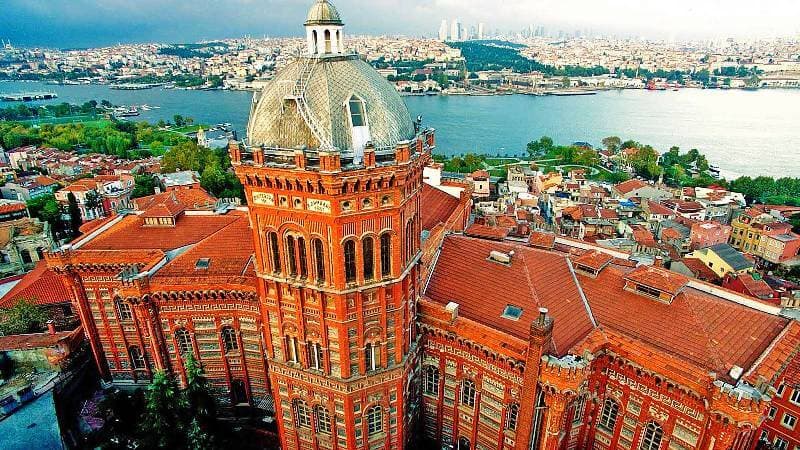
Located close to the Mongols' St. Mary's Church, this colossal red-brick University of the Phanar Greek Orthodox Church Historian Dimitri Cantemir studied at this institution in the 17th century. There are now only a few pupils left. The Marasli Greek Orthodox Primary School, the second Greek school in Fener, is another grand structure that is currently empty of its intended occupants.
Havets murar, som en gång skiljde Konstantinopel från Gyllene hornet, bildar fortfarande en trasig periferi längs Fener.
Bakgatorna i Fener är lined med terrasshus av olika höjder, många av vilka har cumbas (bågsfönster), och ett urval av några som är mycket större.
De välsignade vattnen
The Orthodox Church celebrates the Feast of the Epiphany on January 6 with a ceremony known as the Blessing of the Waters, during which a priest throws a cross into the water and swimmers compete to be the first to bring it back to shore. In Istanbul, the Patriarch performs the ceremony by throwing a cross into the Golden Horn, where swimmers then retrieve it.
Frequently Asked Questions About Ahrida Synagogue
Q ärVad är Balat och Fener?
a ärBalat och Fener är två historiska stadsdelar som ligger i Istanbul, Turkiet.
Q ärVad är historien om Balat och Fener?
a ärBalat och Fener var en gång viktiga centra i det bysantinska och ottomanska riket, respektive.De har en rik historia och kulturarv, och de har varit hem för många betydande religiösa och kulturella institutioner.
Q ärVad är betydelsen av Balat och Fener?
a ärBalat och Fener är betydelsefulla för sin rika historia och kulturarv, liksom för sin arkitektur och religiösa landmärken.
Q är: Vad kan besökare förvänta sig att se i Balat och Fener?
a ärBesökare till Balat och Fener kan förvänta sig att se en blandning av historisk och modern arkitektur, samt många religiösa och kulturella landmärken, såsom synagogor, kyrkor och moskéer.
Q är: Är det säkert att besöka Balat och Fener?
a är: Ja, Balat och Fener anses generellt säkra att besöka. men som med alla stadsområden rekommenderas att du vidtar standardförsiktighetsåtgärder och är medveten om din omgivning.
Q ärFinns det några guidade turer tillgängliga i Balat och Fener?
a är: Ja, guidade turer i Balat och Fener finns tillgängliga för besökare. Det rekommenderas att du kontaktar ett lokalt reseföretag eller resebyrå för att ordna en tur.
Q ärHur kommer jag till Balat och Fener från centrala Istanbul?
a är: Balat och Fener kan nås med färja från centrala Istanbul. Det är också möjligt att nå dessa stadsdelar med buss, taxi eller till fots.
Q är: Finns det några restauranger eller kaféer i Balat och Fener?
a är: Ja, det finns flera restauranger och kaféer i Balat och Fener, som serverar lokala och internationella rätter.
Q ärFinns det kollektivtrafik i Balat och Fener?
a är: Ja, det finns kollektivtrafik i Balat och Fener. Bussar och färjor är några av alternativen.
Q ärFinns det några boendealternativ i Balat och Fener?
a är: Ja, Balat och Fener har en mängd olika ställen att bo på, som hotell, pensionat och lägenheter.
Du kan boka en Istanbul stadsrundtur med våra licensierade guider. Länkarna är nedan:
Karta över Balat och Fener