
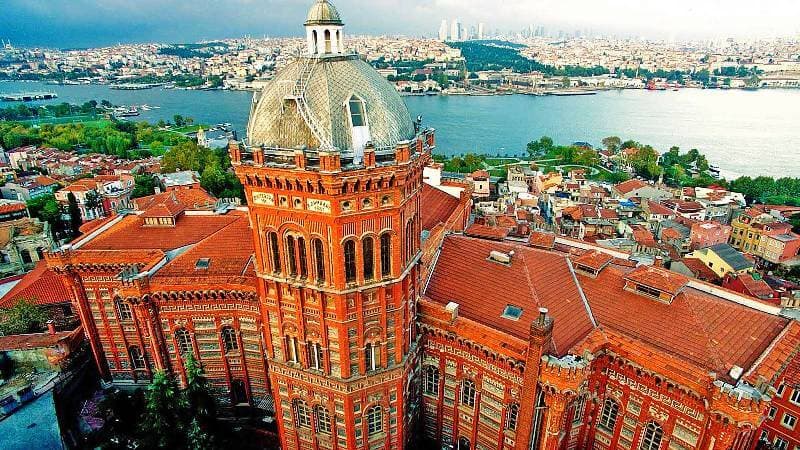
 Istanbul balat and fener area
Istanbul Balat en Fener gebied
Balat en Fener geschiedenis
Balat
Located between Fener and Ayvansaray, Balat is part of the historic district on the European side of Istanbul, on the western shore of the Golden Horn. It once served as the hub of Istanbul's Jewish community.
Het nabijgelegen paleis van Blachernae wordt verondersteld de inspiratie te zijn voor de naam Balat, die afkomstig is van het Griekse woord palatie (paleis), via het Latijnse woord palatium.
The back streets of Balat, like those of neighboring Fener, are lined with small stone terraced houses on two or three levels, as well as a few grander mansions. Many of the homes in Balat have been converted into hotels, restaurants, and cafes, making it one of the city's most popular tourist destinations in the 2010s and beyond. A lot of the houses have been painted bright colors to give the area its own identity.
Balat is op de T5-tramlijn, die naar Cibali en de Alibeyköy busterminal reist (die routes naar Anatolië serveert). Om van Balat naar de andere wijken rond de Gouden Hoorn te komen zoals Üsküdar, Karaköy, Kasimpasa, Fener, Ayvansaray, Hasköy, Sütlüce en Eyüp, kunt u een veerboot nemen.
Balat's History
In de late 15e eeuw, nadat de Inquisitie zich in Spanje en Afrika had verspreid en het Alhambra-decreet van 1492 alle Joden had verboden in Spanje te wonen, zocht een groot aantal Joden toevlucht in Balat.
[3] Balat once had 18 synagogues, but today only the Ahrida Synagogue and the Yanbol Synagogue are in use. Or-Ahayim Hospital, which was opened in 1899 and designed by Gabriel Tedesci, was originally established to serve the Jewish population of Balat, but now serves the general public.
Vroeger een christelijke kerk, de Fethiye Moskee draagt nu de naam Pammakaristos.
People of many different races, cultures, and faiths made their homes in Balat. There has always been a sizable Armenian population in the area, and it is also home to the world-famous Bulgarian Iron Church. There was a sizable Greek Orthodox (Rûm) community because of its proximity to St. George's Church and the Ecumenical Patriarchate of Constantinople in neighboring Fener. As a result of 20th-century events like the Armenian genocide, the Greek genocide, anti-Greek riots, and expulsions, the population of Balat is now overwhelmingly Muslim.
Vanaf de 17e eeuw schrijven Europese reizigers over Balat als een bijzonder arme en onhygiënische plaats.Maar Marie-Christine Bornes-Varol heeft betoogd dat deze accounts misschien niet representatief zijn voor Balat als geheel, aangezien ze gebaseerd waren op bezoeken aan Karabas, het armste deel van Balat.
Zij beweerden dat zij zichzelf verdedigden tegen mishandeling door de lokale Janissary-eenheid toen de Joden van Balat hun patrullen in 1810 aanvielen.
Balat was included on the UNESCO World Heritage List as one of Istanbul's Historic Areas back in 1985, and it has since been the site of many contentious revitalization and restoration efforts dating back to the late 1990s and early 2000s.
Balat attracties
De kerk van St. Stephen van de Bulgaren (ook bekend als de IJzeren Kerk) is volledig gebouwd van geprefabriceerd ijzer, dat vanuit Wenen naar de Donau werd verzonden en vervolgens in Balat werd herovergewerkt, en staat aan de oevers van de Gouden Hoorn, waar Fener naar het naburige Balat loopt.
The Ahrida Synagogue, built in the 15th century to serve the Jewish community of Ochrid, is notable for housing a stunning wooden bema (pulpit) and being the site where the heretic Sabbetai Tsvi first publicly proclaimed his heretical beliefs in 1666. The Yanbol Synagogue, which dates back to the 15th century and was constructed for a group of Bulgarian Jews, is known for its stunning painted ceiling.
Rechts van de trap die Merdivenli Mektep Sokak vormt is de thuisbasis van de historicus Dimitri Cantemir (1673-1723).
Usually only accessible on St. George's Day, the Church of Hagios Georgios Metochi can be found within a large compound just off Vodina Caddesi. A chapel for one of Wallachia's governors may have stood on the site originally, but by the 17th century, it had been transformed into a metochion with ties to Jerusalem's Church of the Holy Sepulchre. In the early 20th century, a scholar unearthed the so-called Archimedes Palimpsest, which consisted of seven books written by the Greek mathematician Archimedes that had been recycled to create a prayer book in the Middle Ages. There are only three that haven't been found in any other copies.
The 16th-century Surp Hresdagabed (Church of the Archangels) Armenian Church was rebuilt in the 18th century on top of the original ayazma (sacred spring) it was constructed over. The city's garbage collectors have moved into the former school building from the 19th century. Tim Kelsey, a travel writer, wrote about a once-annual event in which Muslims and Christians came together to sacrifice sheep and cockerels in the hopes that the animal's blood would heal a disabled member of the community.
De Moskee van Ferruh Kethüda (1562), een klein werk van Mimar Sinan, heeft Tekfur Sarayi tegels rond de mihrab.
Balat is now cut off from the Golden Horn because of the collapsed Sea Walls of Constantinople. A plaque on the seaward side of the walls commemorates the spot where Sultan Mehmet II's troops broke through them on April 23, 1453, during the battle that led to the Conquest of Istanbul.
In addition to the Church of Hagios Ioannis Prodromos (St. John the Baptist), which has strong ties to the St. Catherine's Monastery in the Sinai Desert in Egypt, there are a few other rarely visited Greek Orthodox churches in Balat.
Fener
Istanbul, Turkey; Golden Horn, Fatih neighborhood. Because a column topped with a lantern stood here in the Byzantine period and was used as a street light or lighthouse, the area was given the name "phanarion," which is a Turkish transliteration of the word "phanarion" (Medieval Greek: v), meaning lantern, streetlight, or lamppost.
Fener was a predominantly Greek neighborhood during the Ottoman period, and its streets are lined with historic buildings from the Byzantine and Ottoman eras. One of the grand mansions that once stored wood brought in from the Black Sea (Pontos) area is now home to the Istanbul Women's Library. From the 1930s onward, street-widening projects harmed their picturesque facades.
Fener, aan de zuidelijke oever van de Gouden Hoorn, ligt tussen Cibali en Balat. Achter het is een aantal zeer steile heuvels die leiden tot de wijk Fatih.
Fener is connected to Cibali and the small bus terminal (for buses to Anatolia) at Alibeyköy via the T5 tram line. Fener is connected to the neighborhoods of Üsküdar, Karaköy, Kasimpasa, Balat, Ayvansaray, Hasköy, Sütlüce, and Eyüp via the Golden Horn ferry.
Fener geschiedenis
As a result of the 1453 destruction of Constantinople, many of the city's Greeks relocated to the Fener neighborhood. In addition, the seat of the Patriarchate of Constantinople was relocated here and now operates from its new location. So, like "Vatican" is sometimes used to refer to the Holy See of the Roman Catholic Church, "Phanar" can be used to refer to the Ecumenical Patriarchate as a shorthand reference.
In Fener, the Greeks were known as Phanariotes during the Ottoman era, and many of them held high positions in Sultan's court. In the Balkans and Greece, wealthy Phanariotes often held positions as dragomans (translators) or as governors of provinces. Between 1711 and 1821, several people held the position of hospodar of Wallachia and Moldavia.
Fener attracties
The Ecumenical Patriarchate of Constantinople is one of fifteen to seventeen autonomous jurisdictions within the Eastern Orthodox Church. Its seat is in Fener, within the walled compound that encloses the Patriarchal Church of St. George. Batholomew I is the current Patriarch. In 1602, the patriarchate relocated here, but in 1720, a fire destroyed the basilican church that had stood there since its inception. Another fire in 1941 further damaged the older buildings in the compound, so today most of what a visitor sees is relatively new. The only original structures are the church and the brick-and-stone library at the end of the garden. Since 1821, when Greece rebelled against Ottoman suzerainty, the compound's Middle Gate (Orta Kapi) has been locked because it was there that the then-Patriarch was hanged. Thousands of people, some of whom have traveled from Athens, have come to celebrate Greek Orthodox Easter in this city.
Aside from the Patriarchate, the most interesting church in Constantinople is the Church of St. Mary of the Mongols (Panagia Muhliotissa, Theotokos Panagiotussa), located inland and uphill. It is said that the architect Atik Sinan (not to be confused with the more famous Mimar Sinan) convinced Sultan Mehmet II to let it keep serving the Greek community, and a copy of the ferman (edict) still hangs in the church today.
Located close to the Mongols' St. Mary's Church, this colossal red-brick University of the Phanar Greek Orthodox Church Historian Dimitri Cantemir studied at this institution in the 17th century. There are now only a few pupils left. The Marasli Greek Orthodox Primary School, the second Greek school in Fener, is another grand structure that is currently empty of its intended occupants.
De zeemuren, die ooit Constantinopel van de Gouden Hoorn scheidden, vormen nog steeds een gebroken periferie langs Fener.
De achterste wandelingen in Fener zijn gevormd met terraswoningen van verschillende hoogten, waarvan er veel cumbas (baai ramen) en een selectie van een paar die veel grotere zijn.
De gezegende wateren
The Orthodox Church celebrates the Feast of the Epiphany on January 6 with a ceremony known as the Blessing of the Waters, during which a priest throws a cross into the water and swimmers compete to be the first to bring it back to shore. In Istanbul, the Patriarch performs the ceremony by throwing a cross into the Golden Horn, where swimmers then retrieve it.
Frequently Asked Questions About Ahrida Synagogue
QWat zijn Balat en Fener?
aBalat en Fener zijn twee historische wijken in Istanbul, Turkije.
QWat is de geschiedenis van Balat en Fener?
aBalat en Fener waren ooit belangrijke centra van het Byzantijnse en Ottomaanse rijk, respectievelijk. ze hebben een rijke geschiedenis en cultureel erfgoed, en ze hebben vele belangrijke religieuze en culturele instellingen.
QWat is de betekenis van Balat en Fener?
aBalat en Fener zijn belangrijk voor hun rijke geschiedenis en cultureel erfgoed, evenals voor hun architectuur en religieuze bezienswaardigheden.
Q: Wat kunnen bezoekers verwachten in Balat en Fener?
aBezoekers van Balat en Fener kunnen een mix van historische en moderne architectuur zien, evenals tal van religieuze en culturele bezienswaardigheden, zoals synagogen, kerken en moskeeën.
Q: Is het veilig om Balat en Fener te bezoeken?
a: Ja, Balat en Fener worden over het algemeen als veilig beschouwd om te bezoeken. echter, zoals met elke stedelijke omgeving, is het aan te raden om standaard veiligheidsmaatregelen te nemen en op de hoogte te zijn van uw omgeving.
QZijn er gids rondleidingen beschikbaar in Balat en Fener?
a: Ja, er zijn rondleidingen door Balat en Fener beschikbaar voor bezoekers. Het wordt aanbevolen dat u contact opneemt met een lokaal reisbureau of reisbureau om een rondleiding te regelen.
QHoe kom ik naar Balat en Fener vanuit het centrum van Istanbul?
aBalat en Fener zijn te bereiken met een veerboot vanuit het centrum van Istanbul. Het is ook mogelijk om deze wijken te bereiken met de bus, taxi of te voet.
Q bij: Zijn er restaurants of cafés in Balat en Fener?
a: Ja, er zijn verschillende restaurants en cafés in Balat en Fener, die lokale en internationale gerechten serveren.
Q: Is er openbaar vervoer beschikbaar in Balat en Fener?
a: Ja, er is openbaar vervoer in Balat en Fener. Bussen en veerboten zijn enkele van de opties.
Q: Zijn er accommodatieopties in Balat en Fener?
a: Ja, Balat en Fener hebben een verscheidenheid aan plaatsen om te verblijven, zoals hotels, hostels en appartementen.
U kunt een Istanbul stadstour boeken met onze gids.
Kaart van Balat en Fener