
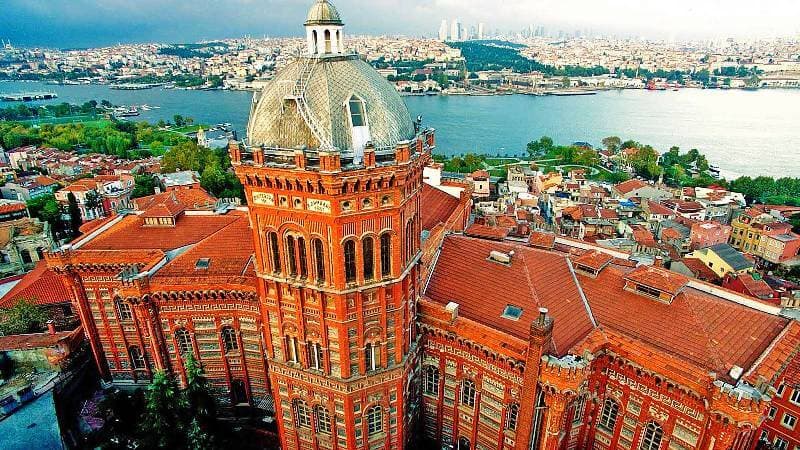
 Istanbul balat and fener area
Istanbul Balat und Fener Bereich
Balat und Fener Geschichte
Balat
Located between Fener and Ayvansaray, Balat is part of the historic district on the European side of Istanbul, on the western shore of the Golden Horn. It once served as the hub of Istanbul's Jewish community.
Der nahe gelegene Palast von Blachernae wird als Inspiration für den Namen Balat angesehen, der aus dem griechischen Wort palation (Palast) über das lateinische Wort palatium stammt.
The back streets of Balat, like those of neighboring Fener, are lined with small stone terraced houses on two or three levels, as well as a few grander mansions. Many of the homes in Balat have been converted into hotels, restaurants, and cafes, making it one of the city's most popular tourist destinations in the 2010s and beyond. A lot of the houses have been painted bright colors to give the area its own identity.
Balat is on the T5 tramline, which travels to Cibali and the Alibeyköy bus terminal (which serves routes to Anatolia). To get from Balat to the other neighborhoods around the Golden Horn like Üsküdar, Karaköy, Kasimpasa, Fener, Ayvansaray, Hasköy, Sütlüce, and Eyüp, you can take a ferry.
Balat's History
Im späten 15. Jahrhundert, nachdem sich die Inquisition in Spanien und Afrika ausgebreitet hatte und das Alhambra-Deck 1492 allen Juden das Leben in Spanien verboten hatte, suchten eine große Anzahl von Juden Zuflucht in Balat.
[3] Balat hatte einst 18 Synagogen, aber heute nur die Ahrida-Synagoge und die Yanbol-Synagoge sind in Gebrauch. Or-Ahayim-Krankenhaus, das 1899 eröffnet wurde und von Gabriel Tedesci entworfen wurde, wurde ursprünglich gegründet, um der jüdischen Bevölkerung von Balat zu dienen, aber jetzt dient es der allgemeinen Öffentlichkeit.
Früher eine christliche Kirche, die Fethiye Moschee trägt jetzt den Namen Pammakaristos.
People of many different races, cultures, and faiths made their homes in Balat. There has always been a sizable Armenian population in the area, and it is also home to the world-famous Bulgarian Iron Church. There was a sizable Greek Orthodox (Rûm) community because of its proximity to St. George's Church and the Ecumenical Patriarchate of Constantinople in neighboring Fener. As a result of 20th-century events like the Armenian genocide, the Greek genocide, anti-Greek riots, and expulsions, the population of Balat is now overwhelmingly Muslim.
Ab dem 17. Jahrhundert schrieben europäische Reisende über Balat als einen besonders armen und unhygienischen Ort. jedoch hat Marie-Christine Bornes-Varol argumentiert, dass diese Berichte möglicherweise nicht repräsentativ für Balat als Ganzes waren, da sie auf Besuchen in Karabas, dem ärmsten Teil von Balat, beruhten.
Sie behaupteten, sie verteidigten sich vor Misshandlung durch die lokale Janissary-Einheit, als die Juden von Balat 1810 ihre Patrouillen angegriffen hatten.
Balat was included on the UNESCO World Heritage List as one of Istanbul's Historic Areas back in 1985, and it has since been the site of many contentious revitalization and restoration efforts dating back to the late 1990s and early 2000s.
Balat Attraktionen
Built entirely from prefabricated iron shipped down the Danube from Vienna and then reassembled in Balat, the Church of St. Stephen of the Bulgars (also known as The Iron Church) stands on the shore of the Golden Horn where Fener runs into neighboring Balat. Having separated from the Orthodox Patriarchate in 1872, it now serves as the seat of the Bulgarian Exarchate. Complete renovations were completed in 2018, and the church reopened to the public.
Die Ahrida-Synagoge, die im 15. Jahrhundert gebaut wurde, um der jüdischen Gemeinde von Ochrid zu dienen, ist bemerkenswert, weil sie ein atemberaubendes Holzbema (Pulpit) beherbergt und der Ort ist, an dem der Ketzige Sabbetai Tsvi 1666 seine ketzigen Überzeugungen zuerst öffentlich verkündete.
Rechts von den Treppen, die Merdivenli Mektep Sokak bilden, ist die Heimat des Historikers Dimitri Cantemir (1673–1723). Während es restauriert wurde, wurde es in den Grundstück eines Cafés aufgenommen.
Usually only accessible on St. George's Day, the Church of Hagios Georgios Metochi can be found within a large compound just off Vodina Caddesi. A chapel for one of Wallachia's governors may have stood on the site originally, but by the 17th century, it had been transformed into a metochion with ties to Jerusalem's Church of the Holy Sepulchre. In the early 20th century, a scholar unearthed the so-called Archimedes Palimpsest, which consisted of seven books written by the Greek mathematician Archimedes that had been recycled to create a prayer book in the Middle Ages. There are only three that haven't been found in any other copies.
The 16th-century Surp Hresdagabed (Church of the Archangels) Armenian Church was rebuilt in the 18th century on top of the original ayazma (sacred spring) it was constructed over. The city's garbage collectors have moved into the former school building from the 19th century. Tim Kelsey, a travel writer, wrote about a once-annual event in which Muslims and Christians came together to sacrifice sheep and cockerels in the hopes that the animal's blood would heal a disabled member of the community.
Die Moschee von Ferruh Kethüda (1562), ein kleineres Werk von Mimar Sinan, zeigt Tekfur Sarayi Fliesen um den mihrab.
Balat is now cut off from the Golden Horn because of the collapsed Sea Walls of Constantinople. A plaque on the seaward side of the walls commemorates the spot where Sultan Mehmet II's troops broke through them on April 23, 1453, during the battle that led to the Conquest of Istanbul.
In addition to the Church of Hagios Ioannis Prodromos (St. John the Baptist), which has strong ties to the St. Catherine's Monastery in the Sinai Desert in Egypt, there are a few other rarely visited Greek Orthodox churches in Balat.
Fenster
Istanbul, Turkey; Golden Horn, Fatih neighborhood. Because a column topped with a lantern stood here in the Byzantine period and was used as a street light or lighthouse, the area was given the name "phanarion," which is a Turkish transliteration of the word "phanarion" (Medieval Greek: v), meaning lantern, streetlight, or lamppost.
Fener was a predominantly Greek neighborhood during the Ottoman period, and its streets are lined with historic buildings from the Byzantine and Ottoman eras. One of the grand mansions that once stored wood brought in from the Black Sea (Pontos) area is now home to the Istanbul Women's Library. From the 1930s onward, street-widening projects harmed their picturesque facades.
Fener, on the southern shore of the Golden Horn, is located between Cibali and Balat. Back behind it is some very steep hills that lead up to the Fatih district.
Fener is connected to Cibali and the small bus terminal (for buses to Anatolia) at Alibeyköy via the T5 tram line. Fener is connected to the neighborhoods of Üsküdar, Karaköy, Kasimpasa, Balat, Ayvansaray, Hasköy, Sütlüce, and Eyüp via the Golden Horn ferry.
Fener Geschichte
As a result of the 1453 destruction of Constantinople, many of the city's Greeks relocated to the Fener neighborhood. In addition, the seat of the Patriarchate of Constantinople was relocated here and now operates from its new location. So, like "Vatican" is sometimes used to refer to the Holy See of the Roman Catholic Church, "Phanar" can be used to refer to the Ecumenical Patriarchate as a shorthand reference.
In Fener, the Greeks were known as Phanariotes during the Ottoman era, and many of them held high positions in Sultan's court. In the Balkans and Greece, wealthy Phanariotes often held positions as dragomans (translators) or as governors of provinces. Between 1711 and 1821, several people held the position of hospodar of Wallachia and Moldavia.
Fener Attraktionen
The Ecumenical Patriarchate of Constantinople is one of fifteen to seventeen autonomous jurisdictions within the Eastern Orthodox Church. Its seat is in Fener, within the walled compound that encloses the Patriarchal Church of St. George. Batholomew I is the current Patriarch. In 1602, the patriarchate relocated here, but in 1720, a fire destroyed the basilican church that had stood there since its inception. Another fire in 1941 further damaged the older buildings in the compound, so today most of what a visitor sees is relatively new. The only original structures are the church and the brick-and-stone library at the end of the garden. Since 1821, when Greece rebelled against Ottoman suzerainty, the compound's Middle Gate (Orta Kapi) has been locked because it was there that the then-Patriarch was hanged. Thousands of people, some of whom have traveled from Athens, have come to celebrate Greek Orthodox Easter in this city.
Aside from the Patriarchate, the most interesting church in Constantinople is the Church of St. Mary of the Mongols (Panagia Muhliotissa, Theotokos Panagiotussa), located inland and uphill. It is said that the architect Atik Sinan (not to be confused with the more famous Mimar Sinan) convinced Sultan Mehmet II to let it keep serving the Greek community, and a copy of the ferman (edict) still hangs in the church today.
Located close to the Mongols' St. Mary's Church, this colossal red-brick University of the Phanar Greek Orthodox Church Historian Dimitri Cantemir studied at this institution in the 17th century. There are now only a few pupils left. The Marasli Greek Orthodox Primary School, the second Greek school in Fener, is another grand structure that is currently empty of its intended occupants.
The Sea Walls, which once separated Constantinople from the Golden Horn, still form a tattered periphery along Fener. It is believed that Mimar Sinan, in 1562, designed the Ayakapi gate in the walls.
Hintergänger in Fener sind mit Terrassenhäusern unterschiedlicher Höhe eingebettet, von denen viele mit Cumbas (Bay-Fenster) und ein paar ausgewählten sind, die viel großartiger sind.
Das gesegnete Wasser
The Orthodox Church celebrates the Feast of the Epiphany on January 6 with a ceremony known as the Blessing of the Waters, during which a priest throws a cross into the water and swimmers compete to be the first to bring it back to shore. In Istanbul, the Patriarch performs the ceremony by throwing a cross into the Golden Horn, where swimmers then retrieve it.
Frequently Asked Questions About Ahrida Synagogue
QWas sind Balat und Fener?
ABalat und Fener sind zwei historische Viertel in Istanbul, Türkei.
QWas ist die Geschichte von Balat und Fener?
ABalat und Fener waren einst wichtige Zentren des byzantinischen und osmanischen Reiches, jeweils. sie haben eine reiche Geschichte und kulturelles Erbe, und sie haben viele bedeutende religiöse und kulturelle Institutionen beherbergt.
QWas ist die Bedeutung von Balat und Fener?
A: Balat und Fener sind für ihre reiche Geschichte und kulturelles Erbe, sowie für ihre Architektur und religiöse Wahrzeichen bedeutend.
Q: Was können Besucher in Balat und Fener erwarten?
A: Besucher von Balat und Fener können eine Mischung aus historischer und moderner Architektur sowie zahlreiche religiöse und kulturelle Sehenswürdigkeiten wie Synagogen, Kirchen und Moscheen sehen.
Q: Ist es sicher, Balat und Fener zu besuchen?
A: Ja, Balat und Fener gelten im Allgemeinen als sicher zu besuchen. jedoch, wie bei jedem städtischen Bereich, ist es empfehlenswert, standardmäßige Sicherheitsvorsichtsmaßnahmen zu treffen und sich der Umgebung bewusst zu sein.
QGibt es Führungen in Balat und Fener?
A: Ja, geführte Touren von Balat und Fener stehen den Besuchern zur Verfügung. Es wird empfohlen, dass Sie sich an eine lokale Reiseveranstalter oder Reisebüro wenden, um eine Tour zu arrangieren.
Q: Wie komme ich von der Innenstadt von Istanbul nach Balat und Fener?
A: Balat und Fener können mit der Fähre aus dem Zentrum von Istanbul erreicht werden. Es ist auch möglich, diese Viertel mit dem Bus, Taxi oder zu Fuß zu erreichen.
Q zu: Gibt es Restaurants oder Cafés in Balat und Fener?
A: Ja, es gibt mehrere Restaurants und Cafés in Balat und Fener, die lokale und internationale Küche servieren.
Q: Gibt es öffentliche Verkehrsmittel in Balat und Fener?
A: Ja, es gibt öffentliche Verkehrsmittel in Balat und Fener. Busse und Fähren sind einige der Optionen.
Q: Gibt es Unterkünfte in Balat und Fener?
A: Ja, Balat und Fener haben eine Vielzahl von Orten zu bleiben, wie Hotels, Gasthäuser und Wohnungen.
Sie können eine Istanbul City Tour mit unseren lizenzierten Reiseleitern buchen. Die Links sind unten:
Karte von Balat und Fener