
 chora church museum Istanbul
CHORA MUSEUM ISTANBUL
What to see in CHORA CHURCH MUSEUM
St. Teodius built the Chora Church in 534, during the reign of Emperor Justinian. The monastery was restored by empress Maria Dukaina in the 11th century. In 1511, the church was converted into a mosque. The Chora Church has many mosaics on the wall, and they are from the 11th and 14th centuries.
Mosaic masih bisa dilihat karena mereka ditata ketika gereja diubah menjadi masjid. Mosaic pada dasarnya tentang kelahiran Yesus Kristus, kelahiran Perawan Maria, keajaiban Yesus Kristus, dan orang-orang kudus Kristen. Gereja Chora diubah menjadi museum pada tahun 1949. Dengan keputusan kabinet, patung museum telah berubah dan telah menjadi masjid lagi. Seperti masjid lain di Turki, semua orang diizinkan untuk mengunjungi Hagia Sophia. Museum ini terletak di lingkungan Edirnekapı di distrik Fatih.
Masjid Istanbul Chora adalah rumah bagi banyak mozaik dan fresko yang tak ternilai, menjadikannya bagian penting dari dunia seni global.
Masjid Chora, juga dikenal sebagai Kariye Camii, berisi banyak mozaik dan fresko yang indah yang telah dilestarikan selama berabad-abad. Ini menampilkan karya-karya terbaik dan paling signifikan dari lukisan Romawi Timur dari periode sebelum bentuk seni mati. Pada Abad Pertengahan, seniman mulai menggunakan kedalaman dalam mozaik dan menarik orang dengan cara yang lebih hidup, yang merupakan tanda dari apa yang akan datang dalam Renaissance.
Because the original church and monastery were located beyond the city walls of Constantinople, the name "Kariye" was derived from the ancient Greek word "Khora," which means countryside. The construction of Chora Church dates back to the 5th century, during the reign of Emperor Justinian. The original layout has been drastically altered due to repairs and additions. The current structure dates back to the 14th century.
Mari kita lihat Yesus dan Maria dalam cahaya dari Mosaic ini.
The Chora Church, which had previously served as a palace church and a chapel for major religious ceremonies, kept on operating as a church for some time. During Bayezid II's reign, the grand vizier Atik Ali Pasha transformed it into a mosque in 1511. The minaret in the southwest corner and the niche in the east wall are period details. When it was renovated in 1945, it became a museum.
Sebuah program restorasi didanai pada tahun 1948 oleh Byzantine Institute of America dan Dumbarton Oaks Center for Byzantine Studies, masing-masing, dan dipimpin oleh Thomas Whittemore dan Paul A. Underwood.
The highest administrative court in Turkey, the Turkish Council of State, issued an order on 11/11/2019 for the building to be converted back into a mosque. The building was officially designated as a mosque by presidential decree published in the Official Gazette on August 21, 2020.
Theodoros Metokhites, the treasury administrator, is responsible for the Chora's beautiful frescoes and mosaics from the 14th century. Mosaics depicting scenes from Jesus' life can be found in the outer narthex (the generally western entrance section in eastern Roman basilicas and churches), and scenes from the life of the Virgin Mary can be found in the inner narthex.
Narrative frescoes depict pivotal moments in Christian doctrine. The Chora's floor and wall surfaces, which are decorated with colorful and high-quality marble, are worthy of admiration.
The Kariye Museum in Istanbul is home to some of the most well-known frescoes in the world.
Art historians consider the Kariye Museum (Chora Monastery) in Istanbul's Edirnekapi neighborhood to be a late Byzantine-era monument. The curator, Miray Can Kirkocoglu, was kind enough to answer our questions about the museum, most of whose visitors come from Europe.
Kariye adalah nama tempat yang terletak di luar batas kota
According to Kirkocoglu, the Chora Monastery/Church in Kariye was constructed in the sixth century. According to Kirkocoglu, "Karye" comes from the Greek word "Chora," which means "outside the city," and the Arabic word "Karye," and the church was given its current form in the 14th century thanks to outstanding repair and maintenance efforts funded by Theodoros Metochites, a statesman and an artist.
Menurut Kirkcoglu, setelah penaklukan Istanbul, Kariye masih digunakan sebagai gereja sampai tahun 1511, ketika Grand Vizier, Hadim Ali Pasa, mengubahnya menjadi masjid dengan menambahkan pulpit, mihrab, dan minaret.
The Ministry of Culture and Tourism opened Kariye in 1948 as a museum connected to the Ayasofya Museum. The beautiful frescoes and mosaics in the Kariye Museum are well-known landmarks because of how important they are to history.
Jesus Christ, the Virgin Mary, and her death are depicted in mosaics at Chora Church (Kariye Museum) in Naos.
Above the main entrance on the Naos' western wall is a mosaic known as the Death of the Virgin (Greek: ), which depicts the Virgin dead and lying on a funeral bier, surrounded by the apostles. Standing behind Mary's deathbed, Christ is depicted in a double mandorla (an almond-shaped light encircling the entire figure of a holy person) while holding the swaddled infant who represents Mary's soul being born into eternal life.
Virgin Hodegetria (Greek: "one who shows the way") is depicted on the south side of the temple panel of the bema. Mary, the Virgin Mother, stands on a terrace, her head cocked slightly to one side as she contemplates the Christ Child in her arms.
Ada mozaik Yesus Kristus yang menghadap utara di panel template bema, memegang Alkitab terbuka untuk Matius 11:28.
The lunettes in the outer narthex of the Chora Church (Kariye Museum) depict stories from the Cycle of the Infancy of Christ. Joseph's dream, in which an angel confirms Mary's miraculous conception; the trip to Bethlehem; Mary and the Holy Family's enrollment for taxation; Elizabeth and John's escape; the birth of Jesus; the Holy Family's return to Egypt; Jesus' presentation in Jerusalem; and Jesus' ascension into heaven.
The biblical account of the Magi's visit to King Herod, who is seated on his throne, and their announcement of their discovery of Christ's birth through astronomical means as well as the Massacre of the Innocents, in which King Herod orders the slaughter of all male children.
Many of Christ's miracles, including the changing of water into wine, are depicted in mosaics that line the outer narthex. Christ's healing of the paralytic at Capernaum and the paralytic at the Pool of Bethesda; Jesus' first public miracle; the multiplication of loaves; a segment from the Miraculous Feeding of the Five Thousand; the Samaritan Woman; Jesus' encounter with and conversation with Lazarus; and more.
Dua adegan di kedua sisi garis pemisah di separuh selatan dari kubah kedua dari narthex luar menunjukkan baik Yohanes Pembaptis membaptis Kristus atau empat kali Iblis menantang Kristus untuk membuktikan bahwa ia ilahi.
The inner narthex (Greek: v) of Chora Church (Kariye Museum) is a four-by-eighteen-meter rectangle that is perpendicular to the outer narthex. The structure's lunettes and vaults are covered with statues of saints and images of the Virgin Mary and Christ's miracles.
The Virgin's life is depicted in three bays of the inner narthex, beginning with her miraculous conception by her grandparents Joachim and Anna, continuing through her childhood visits to the temple, her birth, her first steps toward Anne at the age of six months, her marriage to Joseph, also an elderly man, and culminating in her miraculous pregnancy.
Di dinding timur nartex, ada patung Deesis yang besar yang menunjukkan Kristus, Perawan Maria, Isaac Komnenos, dan Sister Melanie, pendiri biara, bersembahyang di depan mereka.
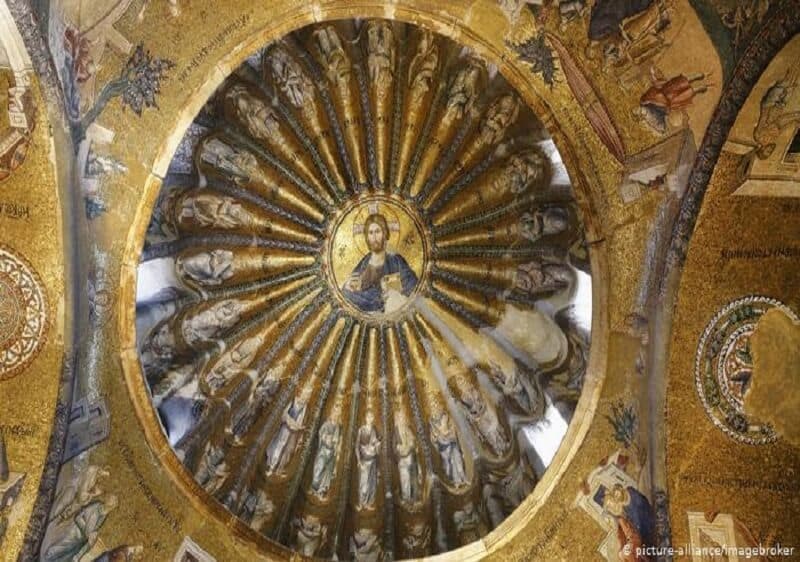
There are two elaborate domes in the inner narthex. The 24-fluted, nine-windowed southern dome measures 3.74 meters in diameter and features an image of Christ as Pantocrator at its pinnacle. For each flute in the set, 39 portraits of ancestors are placed, one for each generation in Christ's lineage from Adam. Some of Christ's miracles are depicted in the pendentives that encircle the Dome of the Ancestors. These range from the healing of a blind man and a dumb man to that of a bleeding woman.
The 3.40-meter-diameter northern dome features two rows of flutes, five windows, and mosaics depicting Mary's ancestors, including sixteen kings of the House of David. The Virgin Mary and the Christ Child are depicted at the peak.
The funerary chapel of the rectangular and single-aisled Chora Church (Kariye Museum) features fresco paintings, figural representations and portraits, lunettes, and four arched tombs, or Arcosolia, vaults placed on either side of the central bays, two in the south wall and two in the north wall. The scenes of resurrection and the afterlife, as well as the intercession of saints, show that Parekklesion was not only built as a shelter for the tombs, including that of Metochites but also used for the performance of rituals related to death and burial.
Christ's and Mary's salvific powers are emphasized in the frescoes that adorn the Parekklesion in the Church of Chora. Each side of the anastasis, which extends over the arch of the bema, depicts a different resurrection miracle performed by Christ, including his role in Adam and Eve's resurrection. The Second Coming of Christ, also known as the Last Judgment, is a salvific event because it features Christ sitting in judgment, conquering death, and redeeming the righteous.
Di medali dari kubah bercabang dodecagonal di sisi barat kapel, tema inkarnasi jelas, dengan Perawan dan Anak dikelilingi oleh sekelompok malaikat dan hymnographers Byzantine duduk di atas pendengaran kubah, menulis lagu-lagu yang dimasukkan ke dalam upacara pemakaman menghormati Perawan dan menekankan perannya dalam proses keselamatan.
Byzantine menganggap orang-orang kudus dan martir yang digambarkan di dinding Periklesia sebagai perantara antara mereka dan Tuhan.
Mozaik pada dasarnya adalah
Enam panel dedikasi atau dedikasi besar di narthex eksternal dan internal
Ancestry of Christ dalam dua kubus dari nartex internal
Siklus Kehidupan Perawan di Tiga Teluk Pertama Narthex
Siklus Masa Kecil Kristus dalam lunet-lunet dari nartex luar
Siklus pelayanan Kristus di dalam kandang-kambing narthex luar dan teluk keempat narthex dalam
Tiga Panel di dalam Kapal
Pertanyaan yang Sering Ditanyakan tentang Museum Gereja Chora
QApa itu Museum Gereja Chora?
a)Museum Gereja Chora adalah gereja Bizantium yang terletak di Istanbul, Turki, yang telah diubah menjadi museum.
QDi mana Museum Gereja Chora berada?
a)Museum Gereja Chora terletak di lingkungan Edirnekapi, Istanbul, Turki.
QApa saja sejarah Museum Gereja Chora?
a)Gereja Chora dibangun pada periode Bizantium awal, dan telah direnovasi beberapa kali selama berabad-abad.Dia telah diubah menjadi masjid pada periode Ottoman dan kemudian menjadi museum pada abad ke-20.
QApa yang menjadi objek wisata populer di Museum Gereja Chora?
a): The Chora Church Museum is known for its well-preserved Byzantine mosaics and frescoes, which are considered some of the finest examples of Byzantine art.
Q: Berapa jam bukaannya Museum Gereja Chora?
a)Museum Gereja Chora buka dari 9:00 pagi hingga 5:00 sore setiap hari kecuali Senin.
QBerapa biaya untuk mengunjungi Museum Gereja Chora?
a)Biaya masuk ke Museum Gereja Chora adalah sekitar 20 lira Turki.
QApa yang dimaksud dengan dress code untuk Museum Gereja Chora?
a)Pengunjung ke Museum Gereja Chora diharapkan berpakaian sederhana dan menutupi bahu dan lutut mereka.
QApakah ada panduan yang tersedia di Museum Gereja Chora?
a)Ya, ada panduan audio yang tersedia untuk pengunjung ke Museum Gereja Chora.
Q: Bagaimana transportasi seperti ke Museum Gereja Chora?
a)Museum Gereja Chora dapat diakses dengan mudah dengan bus atau metro.
QApakah ada batasan untuk mengambil foto di Museum Gereja Chora?
a)Ya, mengambil foto di dalam Museum Gereja Chora dibatasi, dan pengunjung tidak diizinkan mengambil foto flash.
Anda dapat memesan tur kota Istanbul dengan panduan wisata kami yang berlisensi. tautan di bawah ini:
Peta dari Gereja Chora