
 chora church museum Istanbul
CHORA MUSEUM ISTANBUL
What to see in CHORA CHURCH MUSEUM
St. Teodius built the Chora Church in 534, during the reign of Emperor Justinian. The monastery was restored by empress Maria Dukaina in the 11th century. In 1511, the church was converted into a mosque. The Chora Church has many mosaics on the wall, and they are from the 11th and 14th centuries.
Các bức tượng vẫn có thể được nhìn thấy khi chúng được dán khi nhà thờ được chuyển đổi thành nhà thờ Hồi giáo. Các bức tượng cơ bản là về sự ra đời của Chúa Giêsu Kitô, sự ra đời của Đức Trinh Nữ Maria, những phép lạ của Chúa Giêsu Kitô, và các thánh của Kitô giáo. Nhà thờ Chora đã được chuyển đổi thành một bảo tàng vào năm 1949. Với quyết định của nội các, bức tượng của bảo tàng đã được thay đổi và đã trở thành một nhà thờ Hồi giáo một lần nữa. Giống như các nhà thờ Hồi giáo khác ở Thổ Nhĩ Kỳ, mọi người đều được phép đến thăm Hagia Sophia. Bảo tàng nằm ở khu Edirnekapı của quận Fatih.
Nhà thờ Hồi giáo Istanbul Chora là nơi có nhiều bức tượng và bức tranh tường vô giá, làm cho nó trở thành một phần thiết yếu của thế giới nghệ thuật toàn cầu.
Nhà thờ Hồi giáo Chora, còn được gọi là Kariye Camii, chứa nhiều bức tượng mosaic và bức tường phác thảo tinh tế đã được bảo tồn trong nhiều thế kỷ. Nó trưng bày những tác phẩm đẹp nhất và quan trọng nhất của tranh Đông La Mã từ thời kỳ ngay trước khi hình thức nghệ thuật biến mất.Trong thời Trung cổ, các nghệ sĩ bắt đầu sử dụng chiều sâu trong các bức tranh mosaic và vẽ con người theo một cách sống động hơn, đó là một dấu hiệu của những gì sẽ đến trong thời Phục hưng.
Because the original church and monastery were located beyond the city walls of Constantinople, the name "Kariye" was derived from the ancient Greek word "Khora," which means countryside. The construction of Chora Church dates back to the 5th century, during the reign of Emperor Justinian. The original layout has been drastically altered due to repairs and additions. The current structure dates back to the 14th century.
Hãy xem Chúa Giêsu và Mẹ Maria trong ánh sáng của những bức tượng này.
The Chora Church, which had previously served as a palace church and a chapel for major religious ceremonies, kept on operating as a church for some time. During Bayezid II's reign, the grand vizier Atik Ali Pasha transformed it into a mosque in 1511. The minaret in the southwest corner and the niche in the east wall are period details. When it was renovated in 1945, it became a museum.
Một chương trình phục hồi được tài trợ vào năm 1948 bởi Viện Byzantine của Mỹ và Trung tâm Nghiên cứu Byzantine Dumbarton Oaks, tương ứng, và được dẫn dắt bởi Thomas Whittemore và Paul A. Underwood.
The highest administrative court in Turkey, the Turkish Council of State, issued an order on 11/11/2019 for the building to be converted back into a mosque. The building was officially designated as a mosque by presidential decree published in the Official Gazette on August 21, 2020.
Theodoros Metokhites, the treasury administrator, is responsible for the Chora's beautiful frescoes and mosaics from the 14th century. Mosaics depicting scenes from Jesus' life can be found in the outer narthex (the generally western entrance section in eastern Roman basilicas and churches), and scenes from the life of the Virgin Mary can be found in the inner narthex.
Narrative frescoes depict pivotal moments in Christian doctrine. The Chora's floor and wall surfaces, which are decorated with colorful and high-quality marble, are worthy of admiration.
The Kariye Museum in Istanbul is home to some of the most well-known frescoes in the world.
Art historians consider the Kariye Museum (Chora Monastery) in Istanbul's Edirnekapi neighborhood to be a late Byzantine-era monument. The curator, Miray Can Kirkocoglu, was kind enough to answer our questions about the museum, most of whose visitors come from Europe.
Kariye là tên của một nơi nằm ngoài giới hạn thành phố
According to Kirkocoglu, the Chora Monastery/Church in Kariye was constructed in the sixth century. According to Kirkocoglu, "Karye" comes from the Greek word "Chora," which means "outside the city," and the Arabic word "Karye," and the church was given its current form in the 14th century thanks to outstanding repair and maintenance efforts funded by Theodoros Metochites, a statesman and an artist.
Theo Kirkcoglu, sau khi chinh phục Istanbul, Kariye vẫn được sử dụng như một nhà thờ cho đến năm 1511, khi Đại giám mục, Hadim Ali Pasa, biến nó thành một nhà thờ Hồi giáo bằng cách thêm một nhà thờ, một mi-chủ và một tòa tháp ngầm.
The Ministry of Culture and Tourism opened Kariye in 1948 as a museum connected to the Ayasofya Museum. The beautiful frescoes and mosaics in the Kariye Museum are well-known landmarks because of how important they are to history.
Jesus Christ, the Virgin Mary, and her death are depicted in mosaics at Chora Church (Kariye Museum) in Naos.
Above the main entrance on the Naos' western wall is a mosaic known as the Death of the Virgin (Greek: ), which depicts the Virgin dead and lying on a funeral bier, surrounded by the apostles. Standing behind Mary's deathbed, Christ is depicted in a double mandorla (an almond-shaped light encircling the entire figure of a holy person) while holding the swaddled infant who represents Mary's soul being born into eternal life.
Virgin Hodegetria (Greek: "one who shows the way") is depicted on the south side of the temple panel of the bema. Mary, the Virgin Mother, stands on a terrace, her head cocked slightly to one side as she contemplates the Christ Child in her arms.
Có một bức tượng của Chúa Giêsu Kitô hướng về phía bắc trên bảng đền thờ của bema, giữ một Kinh Thánh mở ra cho Ma-thi-ơ 11:28.
The lunettes in the outer narthex of the Chora Church (Kariye Museum) depict stories from the Cycle of the Infancy of Christ. Joseph's dream, in which an angel confirms Mary's miraculous conception; the trip to Bethlehem; Mary and the Holy Family's enrollment for taxation; Elizabeth and John's escape; the birth of Jesus; the Holy Family's return to Egypt; Jesus' presentation in Jerusalem; and Jesus' ascension into heaven.
The biblical account of the Magi's visit to King Herod, who is seated on his throne, and their announcement of their discovery of Christ's birth through astronomical means as well as the Massacre of the Innocents, in which King Herod orders the slaughter of all male children.
Many of Christ's miracles, including the changing of water into wine, are depicted in mosaics that line the outer narthex. Christ's healing of the paralytic at Capernaum and the paralytic at the Pool of Bethesda; Jesus' first public miracle; the multiplication of loaves; a segment from the Miraculous Feeding of the Five Thousand; the Samaritan Woman; Jesus' encounter with and conversation with Lazarus; and more.
Hai cảnh ở cả hai bên của đường phân chia ở nửa nam của vỏ thứ hai của narthex bên ngoài cho thấy hoặc Gioan rửa tội Chúa Kitô hoặc bốn lần ma quỷ thách thức Chúa Kitô để chứng minh rằng ông là thần thánh.
The inner narthex (Greek: v) of Chora Church (Kariye Museum) is a four-by-eighteen-meter rectangle that is perpendicular to the outer narthex. The structure's lunettes and vaults are covered with statues of saints and images of the Virgin Mary and Christ's miracles.
The Virgin's life is depicted in three bays of the inner narthex, beginning with her miraculous conception by her grandparents Joachim and Anna, continuing through her childhood visits to the temple, her birth, her first steps toward Anne at the age of six months, her marriage to Joseph, also an elderly man, and culminating in her miraculous pregnancy.
Trên tường phía đông của narthex, có một bức tượng lớn của Deesis cho thấy Chúa Kitô, Đức Trinh Nữ Maria, Isaac Komnenos và chị Melanie, những người sáng lập tu viện, cúi xuống trước mặt họ.
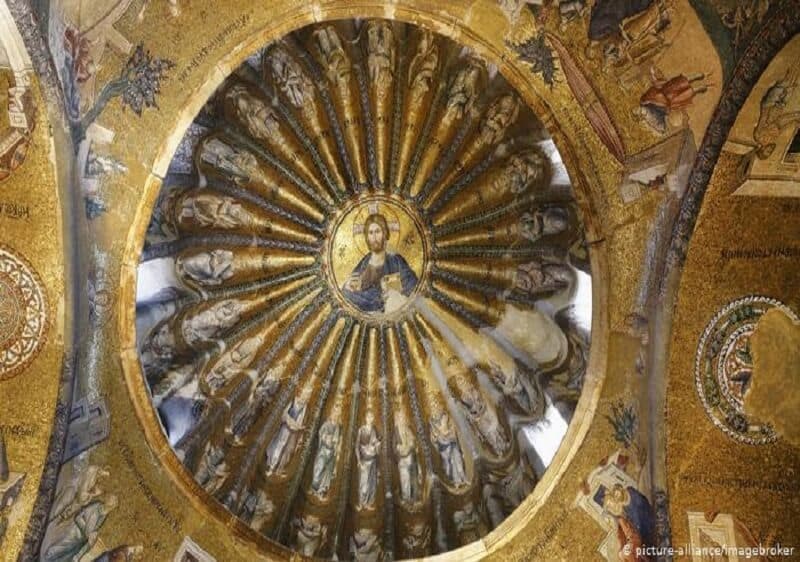
There are two elaborate domes in the inner narthex. The 24-fluted, nine-windowed southern dome measures 3.74 meters in diameter and features an image of Christ as Pantocrator at its pinnacle. For each flute in the set, 39 portraits of ancestors are placed, one for each generation in Christ's lineage from Adam. Some of Christ's miracles are depicted in the pendentives that encircle the Dome of the Ancestors. These range from the healing of a blind man and a dumb man to that of a bleeding woman.
The 3.40-meter-diameter northern dome features two rows of flutes, five windows, and mosaics depicting Mary's ancestors, including sixteen kings of the House of David. The Virgin Mary and the Christ Child are depicted at the peak.
The funerary chapel of the rectangular and single-aisled Chora Church (Kariye Museum) features fresco paintings, figural representations and portraits, lunettes, and four arched tombs, or Arcosolia, vaults placed on either side of the central bays, two in the south wall and two in the north wall. The scenes of resurrection and the afterlife, as well as the intercession of saints, show that Parekklesion was not only built as a shelter for the tombs, including that of Metochites but also used for the performance of rituals related to death and burial.
Christ's and Mary's salvific powers are emphasized in the frescoes that adorn the Parekklesion in the Church of Chora. Each side of the anastasis, which extends over the arch of the bema, depicts a different resurrection miracle performed by Christ, including his role in Adam and Eve's resurrection. The Second Coming of Christ, also known as the Last Judgment, is a salvific event because it features Christ sitting in judgment, conquering death, and redeeming the righteous.
Trong huy chương của cái tháp rìa dodecagonal ở phía tây của nhà nguyện, chủ đề của sự hiện thân là rõ ràng, với Đức Trinh Nữ và Con được bao quanh bởi một loạt các thiên thần và các nhà ca hát Byzantine ngồi trên các góc của cái tháp, viết những bài ca được kết hợp vào các lễ tang tôn vinh Đức Trinh Nữ và nhấn mạnh vai trò của cô trong quá trình cứu rỗi.
Người Byzantine coi các thánh và tử đạo được miêu tả trên các bức tường của Periklesia là những người trung gian giữa họ và Thiên Chúa.
Các mosaic cơ bản là;
Sáu tấm thánh hiến hoặc thánh hiến lớn trong narthex bên ngoài và bên trong
Tổ tiên của Chúa Kitô trong hai cái tháp của narthex bên trong
Vòng đời của Đức Trinh Nữ trong ba vịnh đầu tiên của narthex bên trong
Vòng tròn thời thơ ấu của Chúa Kitô trong các kính của narthex bên ngoài
Vòng tròn của sự phục vụ của Chúa Kitô trong các vòm của narthex bên ngoài và vịnh thứ tư của narthex bên trong
Ba tấm bảng trong tàu
Câu hỏi thường gặp về Bảo tàng Nhà thờ Chora
Q: What is the Chora Church Museum?
a)Bảo tàng Nhà thờ Chora là một nhà thờ Byzantine nằm ở Istanbul, Thổ Nhĩ Kỳ, đã được chuyển đổi thành một bảo tàng.
Q: Bảo tàng Nhà thờ Chora nằm ở đâu?
a)Bảo tàng Nhà thờ Chora nằm ở khu vực Edirnekapi, Istanbul, Thổ Nhĩ Kỳ.
Q: Lịch sử của Bảo tàng Nhà thờ Chora là gì?
a)Nhà thờ Chora được xây dựng trong thời kỳ Byzantine đầu tiên, và nó đã được cải tạo nhiều lần trong nhiều thế kỷ. nó đã được chuyển đổi thành một nhà thờ Hồi giáo trong thời kỳ Ottoman và sau đó thành một bảo tàng trong thế kỷ 20.
Q: Những điểm thu hút khách du lịch phổ biến trong Bảo tàng Nhà thờ Chora là gì?
a): The Chora Church Museum is known for its well-preserved Byzantine mosaics and frescoes, which are considered some of the finest examples of Byzantine art.
Q: Thời gian mở cửa của Bảo tàng Nhà thờ Chora là gì?
a)Bảo tàng Nhà thờ Chora mở cửa từ 9:00 đến 5:00 mỗi ngày trừ thứ Hai.
Q: Bao nhiêu chi phí để ghé thăm Bảo tàng Nhà thờ Chora?
a)Phí nhập cảnh cho Bảo tàng Nhà thờ Chora là khoảng 20 Lira Thổ Nhĩ Kỳ.
Q: Mã trang phục cho Bảo tàng Nhà thờ Chora là gì?
a)Du khách đến Bảo tàng Nhà thờ Chora được mong đợi ăn mặc khiêm tốn và che vai và đầu gối.
Q: Có hướng dẫn viên có sẵn tại Bảo tàng Nhà thờ Chora không?
a): Có, có những hướng dẫn âm thanh có sẵn cho du khách đến Bảo tàng Nhà thờ Chora.
Q: Chuyến đi đến Bảo tàng Nhà thờ Chora như thế nào?
a)Bảo tàng Nhà thờ Chora có thể dễ dàng truy cập bằng xe buýt hoặc tàu điện ngầm.
QCó những hạn chế nào về việc chụp ảnh tại Bảo tàng Nhà thờ Chora không?
a)Có, chụp ảnh bên trong Bảo tàng Nhà thờ Chora bị hạn chế, và du khách không được phép chụp ảnh flash.
Bạn có thể đặt tour du lịch thành phố Istanbul với hướng dẫn viên du lịch được cấp phép của chúng tôi. Các liên kết dưới đây:
Map of Chora Church