
 chora church museum Istanbul
CHORA MUSEUM ISTANBUL
What to see in CHORA CHURCH MUSEUM
St. Teodius built the Chora Church in 534, during the reign of Emperor Justinian. The monastery was restored by empress Maria Dukaina in the 11th century. In 1511, the church was converted into a mosque. The Chora Church has many mosaics on the wall, and they are from the 11th and 14th centuries.
The mosaics can still be seen as they were plastered when the church was converted into a mosque. The mosaics are basically about the birth of Jesus Christ, the birth of the Virgin Mary, the miracles of Jesus Christ, and the saints of Christianity. Chora Church was converted into a museum in 1949. With the cabinet’s decision, the museum’s statue has been changed and has become a mosque once again. Like the other mosques in Turkey, everyone is allowed to visit Hagia Sophia. The museum is located in the Edirnekapı neighborhood of the Fatih district.
Istanbul Chora Mosque er hjemsted for mange uvurderlige mosaikker og fresker, hvilket gør det til en væsentlig del af den globale kunstverden.
Chora Mosque, også kendt som Kariye Camii, indeholder mange udsøgte mosaikker og fresker, der har været omhyggeligt bevaret gennem århundrederne. Det viser de fineste og mest betydningsfulde værker af østromersk maleri fra perioden lige før kunstformen døde ud. I middelalderen begyndte kunstnere at bruge dybde i mosaikker og tegne mennesker på en mere livlig måde, hvilket var et tegn på, hvad der skulle komme i renæssancen.
Because the original church and monastery were located beyond the city walls of Constantinople, the name "Kariye" was derived from the ancient Greek word "Khora," which means countryside. The construction of Chora Church dates back to the 5th century, during the reign of Emperor Justinian. The original layout has been drastically altered due to repairs and additions. The current structure dates back to the 14th century.
Se på Jesus og Maria i lyset af disse mosaikker
The Chora Church, which had previously served as a palace church and a chapel for major religious ceremonies, kept on operating as a church for some time. During Bayezid II's reign, the grand vizier Atik Ali Pasha transformed it into a mosque in 1511. The minaret in the southwest corner and the niche in the east wall are period details. When it was renovated in 1945, it became a museum.
Et program for restaurering blev finansieret i 1948 af det Byzantine Institut of America og Dumbarton Oaks Center for Byzantine Studies, henholdsvis, og ledet af Thomas Whittemore og Paul A. Underwood. Efter det, det blev ikke længere brugt som et sted for tilbedelse.
The highest administrative court in Turkey, the Turkish Council of State, issued an order on 11/11/2019 for the building to be converted back into a mosque. The building was officially designated as a mosque by presidential decree published in the Official Gazette on August 21, 2020.
Theodoros Metokhites, the treasury administrator, is responsible for the Chora's beautiful frescoes and mosaics from the 14th century. Mosaics depicting scenes from Jesus' life can be found in the outer narthex (the generally western entrance section in eastern Roman basilicas and churches), and scenes from the life of the Virgin Mary can be found in the inner narthex.
Narrative frescoes depict pivotal moments in Christian doctrine. The Chora's floor and wall surfaces, which are decorated with colorful and high-quality marble, are worthy of admiration.
The Kariye Museum in Istanbul is home to some of the most well-known frescoes in the world.
Art historians consider the Kariye Museum (Chora Monastery) in Istanbul's Edirnekapi neighborhood to be a late Byzantine-era monument. The curator, Miray Can Kirkocoglu, was kind enough to answer our questions about the museum, most of whose visitors come from Europe.
Kariye er navnet på et sted, der ligger ud over byens grænser
According to Kirkocoglu, the Chora Monastery/Church in Kariye was constructed in the sixth century. According to Kirkocoglu, "Karye" comes from the Greek word "Chora," which means "outside the city," and the Arabic word "Karye," and the church was given its current form in the 14th century thanks to outstanding repair and maintenance efforts funded by Theodoros Metochites, a statesman and an artist.
Ifølge Kirkcoglu blev Kariye stadig brugt som kirke efter erobringen af Istanbul indtil 1511, da den store visir, Hadim Ali Pasa, omdannede den til en moské ved at tilføje en pulpit, en mihrab og en minaret.
The Ministry of Culture and Tourism opened Kariye in 1948 as a museum connected to the Ayasofya Museum. The beautiful frescoes and mosaics in the Kariye Museum are well-known landmarks because of how important they are to history.
Jesus Christ, the Virgin Mary, and her death are depicted in mosaics at Chora Church (Kariye Museum) in Naos.
Above the main entrance on the Naos' western wall is a mosaic known as the Death of the Virgin (Greek: ), which depicts the Virgin dead and lying on a funeral bier, surrounded by the apostles. Standing behind Mary's deathbed, Christ is depicted in a double mandorla (an almond-shaped light encircling the entire figure of a holy person) while holding the swaddled infant who represents Mary's soul being born into eternal life.
Virgin Hodegetria (Greek: "one who shows the way") is depicted on the south side of the temple panel of the bema. Mary, the Virgin Mother, stands on a terrace, her head cocked slightly to one side as she contemplates the Christ Child in her arms.
Der er en mosaik af Jesus Kristus, der vender mod nord på templepanelet i bemaen, og som holder en bibel åben til Mattæus 11:28.
The lunettes in the outer narthex of the Chora Church (Kariye Museum) depict stories from the Cycle of the Infancy of Christ. Joseph's dream, in which an angel confirms Mary's miraculous conception; the trip to Bethlehem; Mary and the Holy Family's enrollment for taxation; Elizabeth and John's escape; the birth of Jesus; the Holy Family's return to Egypt; Jesus' presentation in Jerusalem; and Jesus' ascension into heaven.
The biblical account of the Magi's visit to King Herod, who is seated on his throne, and their announcement of their discovery of Christ's birth through astronomical means as well as the Massacre of the Innocents, in which King Herod orders the slaughter of all male children.
Many of Christ's miracles, including the changing of water into wine, are depicted in mosaics that line the outer narthex. Christ's healing of the paralytic at Capernaum and the paralytic at the Pool of Bethesda; Jesus' first public miracle; the multiplication of loaves; a segment from the Miraculous Feeding of the Five Thousand; the Samaritan Woman; Jesus' encounter with and conversation with Lazarus; and more.
De to scener på hver side af delingslinjen i den sydlige halvdel af den anden hule af den ydre narthex viser enten Johannes Døberen døbt Kristus eller de fire gange Djævelen udfordrede Kristus for at bevise at han var guddommelig.
The inner narthex (Greek: v) of Chora Church (Kariye Museum) is a four-by-eighteen-meter rectangle that is perpendicular to the outer narthex. The structure's lunettes and vaults are covered with statues of saints and images of the Virgin Mary and Christ's miracles.
The Virgin's life is depicted in three bays of the inner narthex, beginning with her miraculous conception by her grandparents Joachim and Anna, continuing through her childhood visits to the temple, her birth, her first steps toward Anne at the age of six months, her marriage to Joseph, also an elderly man, and culminating in her miraculous pregnancy.
På den østlige mur af narthex er der en stor statue af Deesis, der viser Kristus, Jomfru Maria, Isaac Komnenos og Sister Melanie, grundlæggerne af klostret, bøje sig for dem.
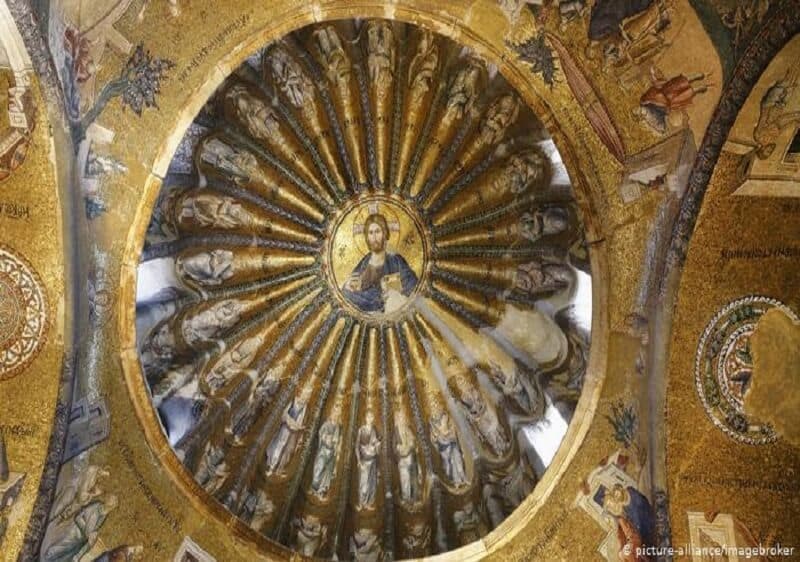
There are two elaborate domes in the inner narthex. The 24-fluted, nine-windowed southern dome measures 3.74 meters in diameter and features an image of Christ as Pantocrator at its pinnacle. For each flute in the set, 39 portraits of ancestors are placed, one for each generation in Christ's lineage from Adam. Some of Christ's miracles are depicted in the pendentives that encircle the Dome of the Ancestors. These range from the healing of a blind man and a dumb man to that of a bleeding woman.
The 3.40-meter-diameter northern dome features two rows of flutes, five windows, and mosaics depicting Mary's ancestors, including sixteen kings of the House of David. The Virgin Mary and the Christ Child are depicted at the peak.
The funerary chapel of the rectangular and single-aisled Chora Church (Kariye Museum) features fresco paintings, figural representations and portraits, lunettes, and four arched tombs, or Arcosolia, vaults placed on either side of the central bays, two in the south wall and two in the north wall. The scenes of resurrection and the afterlife, as well as the intercession of saints, show that Parekklesion was not only built as a shelter for the tombs, including that of Metochites but also used for the performance of rituals related to death and burial.
Christ's and Mary's salvific powers are emphasized in the frescoes that adorn the Parekklesion in the Church of Chora. Each side of the anastasis, which extends over the arch of the bema, depicts a different resurrection miracle performed by Christ, including his role in Adam and Eve's resurrection. The Second Coming of Christ, also known as the Last Judgment, is a salvific event because it features Christ sitting in judgment, conquering death, and redeeming the righteous.
I medaljen af den dodekagonale ribbenede kuppel på den vestlige side af kapellet er temaet for inkarnationen tydeligt, med Jomfruen og Barnet omgivet af en hær af engle og byzantinske hymnografer siddende på kuppelens pendentiver, der skrev hymner, der blev indarbejdet i begravelsesritualer ære Jomfruen og understrege hendes rolle i frelsesprocessen.
Byzantinerne betragtede de hellige og martyrer afbildet på Perikleses vægge som mellemmænd mellem sig selv og Gud.
Mosaikkerne er i det væsentlige
Seks store dedikerede eller devotionelle paneler i de ydre og indre narthexes
Kristi forfædre i to kupler i den indre narthex
Den Blivende Jomfru Livets Cyklus i de første tre bugter af den indre narthex
Kristi barndom i de ydre narthex
Kristi tjeneste i den ydre narthex og den fjerde bugt i den indre narthex
De tre paneler i skibet
Frequently Asked Questions About the Chora Church Museum
Q er: What is the Chora Church Museum?
a): The Chora Church Museum is a Byzantine church located in Istanbul, Turkey, that has been converted into a museum.
Q er: Where is the Chora Church Museum located?
a): The Chora Church Museum is located in the neighborhood of Edirnekapi, Istanbul, Turkey.
Q er: What is the history of the Chora Church Museum?
a): The Chora Church was built in the early Byzantine period, and it has been renovated several times over the centuries. It was converted into a mosque in the Ottoman period and then into a museum in the 20th century.
Q er: What are the popular tourist attractions in the Chora Church Museum?
a): The Chora Church Museum is known for its well-preserved Byzantine mosaics and frescoes, which are considered some of the finest examples of Byzantine art.
Q er: What are the opening hours of the Chora Church Museum?
a): The Chora Church Museum is open from 9:00 a.m. to 5:00 p.m. every day except Monday.
Q er: How much does it cost to visit the Chora Church Museum?
a): The entrance fee for the Chora Church Museum is approximately 20 Turkish Lira.
Q er: What is the dress code for the Chora Church Museum?
a): Visitors to the Chora Church Museum are expected to dress modestly and cover their shoulders and knees.
Q er: Is there a guide available at the Chora Church Museum?
a): Yes, there are audio guides available for visitors to the Chora Church Museum.
Q er: What is the transportation like to the Chora Church Museum?
a): The Chora Church Museum is easily accessible by bus or metro.
Q er: Are there any restrictions on taking photos at the Chora Church Museum?
a): Yes, taking photos inside the Chora Church Museum is restricted, and visitors are not allowed to take flash photos.
Du kan bestille en tur til Istanbul med vores licenserede guider.
Map of Chora Church