
 chora church museum Istanbul
CHORA MUSEUM ISTANBUL
What to see in CHORA CHURCH MUSEUM
St. Theodius bouwde de Chora-kerk in 534, tijdens de heerschappij van keizer Justinianus. Het klooster werd gerestaureerd door keizerin Maria Dukaina in de 11e eeuw. In 1511 werd de kerk omgezet in een moskee. De Chora-kerk heeft veel mozaïeken op de muur, en ze zijn uit de 11e en 14e eeuw.
The mosaics can still be seen as they were plastered when the church was converted into a mosque. The mosaics are basically about the birth of Jesus Christ, the birth of the Virgin Mary, the miracles of Jesus Christ, and the saints of Christianity. Chora Church was converted into a museum in 1949. With the cabinet’s decision, the museum’s statue has been changed and has become a mosque once again. Like the other mosques in Turkey, everyone is allowed to visit Hagia Sophia. The museum is located in the Edirnekapı neighborhood of the Fatih district.
De Istanbul Chora Moskee is de thuisbasis van vele kostbare mozaïeken en fresco's, waardoor het een essentieel onderdeel van de wereldwijde kunstwereld is.
De Chora Moskee, ook bekend als Kariye Camii, bevat vele prachtige mozaïeken en fresco's die door de eeuwen heen zorgvuldig zijn bewaard. Het toont de mooiste en meest significante werken van Oost-Romeinse schilderkunst uit de periode net voordat de kunstvorm uitgestorven was. In de Middeleeuwen begonnen kunstenaars diepte in mozaïeken te gebruiken en mensen op een levendige manier te tekenen, wat een teken was van wat er in de Renaissance zou komen.
Because the original church and monastery were located beyond the city walls of Constantinople, the name "Kariye" was derived from the ancient Greek word "Khora," which means countryside. The construction of Chora Church dates back to the 5th century, during the reign of Emperor Justinian. The original layout has been drastically altered due to repairs and additions. The current structure dates back to the 14th century.
Zie Jezus en Maria in het licht van deze mozaïeken
The Chora Church, which had previously served as a palace church and a chapel for major religious ceremonies, kept on operating as a church for some time. During Bayezid II's reign, the grand vizier Atik Ali Pasha transformed it into a mosque in 1511. The minaret in the southwest corner and the niche in the east wall are period details. When it was renovated in 1945, it became a museum.
Een programma van restauratie werd gefinancierd in 1948 door het Byzantijnse Instituut van Amerika en het Dumbarton Oaks Center for Byzantijnse Studies, respectievelijk, en geleid door Thomas Whittemore en Paul A. Underwood.
The highest administrative court in Turkey, the Turkish Council of State, issued an order on 11/11/2019 for the building to be converted back into a mosque. The building was officially designated as a mosque by presidential decree published in the Official Gazette on August 21, 2020.
Theodoros Metokhites, the treasury administrator, is responsible for the Chora's beautiful frescoes and mosaics from the 14th century. Mosaics depicting scenes from Jesus' life can be found in the outer narthex (the generally western entrance section in eastern Roman basilicas and churches), and scenes from the life of the Virgin Mary can be found in the inner narthex.
Narrative frescoes depict pivotal moments in Christian doctrine. The Chora's floor and wall surfaces, which are decorated with colorful and high-quality marble, are worthy of admiration.
The Kariye Museum in Istanbul is home to some of the most well-known frescoes in the world.
Art historians consider the Kariye Museum (Chora Monastery) in Istanbul's Edirnekapi neighborhood to be a late Byzantine-era monument. The curator, Miray Can Kirkocoglu, was kind enough to answer our questions about the museum, most of whose visitors come from Europe.
Kariye is de naam van een plaats die zich buiten de stadsgrenzen bevindt
According to Kirkocoglu, the Chora Monastery/Church in Kariye was constructed in the sixth century. According to Kirkocoglu, "Karye" comes from the Greek word "Chora," which means "outside the city," and the Arabic word "Karye," and the church was given its current form in the 14th century thanks to outstanding repair and maintenance efforts funded by Theodoros Metochites, a statesman and an artist.
Volgens Kirkcoglu werd Kariye na de verovering van Istanbul nog steeds gebruikt als kerk tot 1511, toen de Grote Vizier, Hadim Ali Pasa, het omvormde in een moskee door een pulpit, een mihrab en een minaret toe te voegen.
The Ministry of Culture and Tourism opened Kariye in 1948 as a museum connected to the Ayasofya Museum. The beautiful frescoes and mosaics in the Kariye Museum are well-known landmarks because of how important they are to history.
Jesus Christ, the Virgin Mary, and her death are depicted in mosaics at Chora Church (Kariye Museum) in Naos.
Above the main entrance on the Naos' western wall is a mosaic known as the Death of the Virgin (Greek: ), which depicts the Virgin dead and lying on a funeral bier, surrounded by the apostles. Standing behind Mary's deathbed, Christ is depicted in a double mandorla (an almond-shaped light encircling the entire figure of a holy person) while holding the swaddled infant who represents Mary's soul being born into eternal life.
Virgin Hodegetria (Greek: "one who shows the way") is depicted on the south side of the temple panel of the bema. Mary, the Virgin Mother, stands on a terrace, her head cocked slightly to one side as she contemplates the Christ Child in her arms.
Er is een mozaïek van Jezus Christus gericht naar het noorden op het tempelpanel van de bema, met een Bijbel open naar Mattheüs 11:28.
The lunettes in the outer narthex of the Chora Church (Kariye Museum) depict stories from the Cycle of the Infancy of Christ. Joseph's dream, in which an angel confirms Mary's miraculous conception; the trip to Bethlehem; Mary and the Holy Family's enrollment for taxation; Elizabeth and John's escape; the birth of Jesus; the Holy Family's return to Egypt; Jesus' presentation in Jerusalem; and Jesus' ascension into heaven.
The biblical account of the Magi's visit to King Herod, who is seated on his throne, and their announcement of their discovery of Christ's birth through astronomical means as well as the Massacre of the Innocents, in which King Herod orders the slaughter of all male children.
Many of Christ's miracles, including the changing of water into wine, are depicted in mosaics that line the outer narthex. Christ's healing of the paralytic at Capernaum and the paralytic at the Pool of Bethesda; Jesus' first public miracle; the multiplication of loaves; a segment from the Miraculous Feeding of the Five Thousand; the Samaritan Woman; Jesus' encounter with and conversation with Lazarus; and more.
De twee scènes aan beide zijden van de scheidingslinie in de zuidelijke helft van de tweede schuur van de buitenste narthex tonen ofwel Johannes de Doper die Christus doopte of de vier keer dat de duivel Christus uitdaagde om te bewijzen dat hij goddelijk was.
The inner narthex (Greek: v) of Chora Church (Kariye Museum) is a four-by-eighteen-meter rectangle that is perpendicular to the outer narthex. The structure's lunettes and vaults are covered with statues of saints and images of the Virgin Mary and Christ's miracles.
The Virgin's life is depicted in three bays of the inner narthex, beginning with her miraculous conception by her grandparents Joachim and Anna, continuing through her childhood visits to the temple, her birth, her first steps toward Anne at the age of six months, her marriage to Joseph, also an elderly man, and culminating in her miraculous pregnancy.
Op de oostelijke muur van de narthex is er een groot standbeeld van Deesis dat Christus, de Maagd Maria, Isaac Komnenos en Zuster Melanie, de oprichters van het klooster, voor hen neerbuigt.
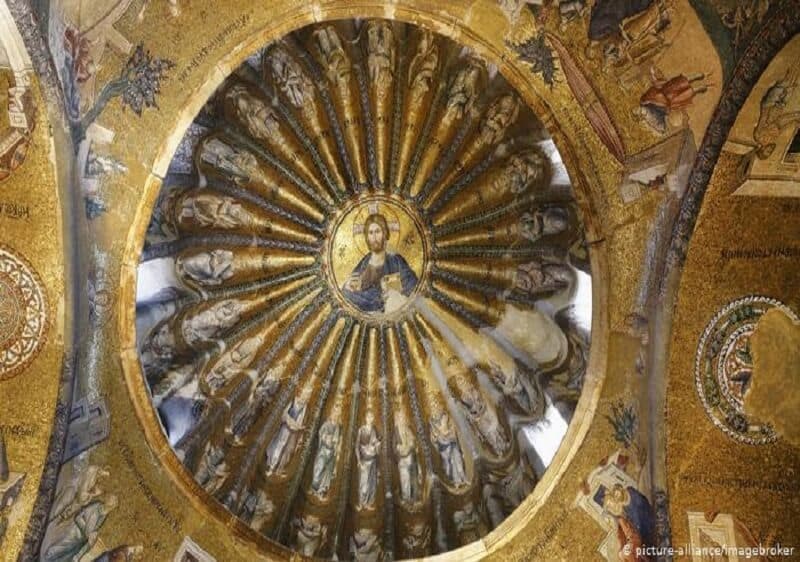
There are two elaborate domes in the inner narthex. The 24-fluted, nine-windowed southern dome measures 3.74 meters in diameter and features an image of Christ as Pantocrator at its pinnacle. For each flute in the set, 39 portraits of ancestors are placed, one for each generation in Christ's lineage from Adam. Some of Christ's miracles are depicted in the pendentives that encircle the Dome of the Ancestors. These range from the healing of a blind man and a dumb man to that of a bleeding woman.
The 3.40-meter-diameter northern dome features two rows of flutes, five windows, and mosaics depicting Mary's ancestors, including sixteen kings of the House of David. The Virgin Mary and the Christ Child are depicted at the peak.
The funerary chapel of the rectangular and single-aisled Chora Church (Kariye Museum) features fresco paintings, figural representations and portraits, lunettes, and four arched tombs, or Arcosolia, vaults placed on either side of the central bays, two in the south wall and two in the north wall. The scenes of resurrection and the afterlife, as well as the intercession of saints, show that Parekklesion was not only built as a shelter for the tombs, including that of Metochites but also used for the performance of rituals related to death and burial.
Christ's and Mary's salvific powers are emphasized in the frescoes that adorn the Parekklesion in the Church of Chora. Each side of the anastasis, which extends over the arch of the bema, depicts a different resurrection miracle performed by Christ, including his role in Adam and Eve's resurrection. The Second Coming of Christ, also known as the Last Judgment, is a salvific event because it features Christ sitting in judgment, conquering death, and redeeming the righteous.
In het medaille van de dodecagonaal geribbelde koepel aan de westkant van de kapel, het thema van de incarnatie is duidelijk, met de Maagd en het Kind omringd door een host van engelen en Byzantijnse hymnografen zitten op de pendentieven van de koepel, het schrijven van hymnes die werden opgenomen in begrafenisdiensten ter ere van de Maagd en benadrukken haar rol in het proces van verlossing.
De Byzantijnen beschouwden de heiligen en martelaren afgebeeld op de muren van Periklesia als tussenpersonen tussen zichzelf en God.
De mozaïeken zijn in principe;
Zes grote toewijdingspaneel of devotionele panelen in de externe en interne narthex
De voorouder van Christus in twee koepels van de innerlijke narthex
De Levenscyclus van de Heilige Maagd in de eerste drie baaien van de innerlijke narthex
De cyclus van de kindertijd van Christus in de lente van de buitenste narthex
De Cyclus van Christus’ bediening in de schuilplaatsen van de buitenste narthex en de vierde baai van de binnenste narthex
De drie panelen in het schip
Frequently Asked Questions About the Chora Church Museum
Q: What is the Chora Church Museum?
a: The Chora Church Museum is a Byzantine church located in Istanbul, Turkey, that has been converted into a museum.
Q: Where is the Chora Church Museum located?
a: The Chora Church Museum is located in the neighborhood of Edirnekapi, Istanbul, Turkey.
Q: What is the history of the Chora Church Museum?
a: The Chora Church was built in the early Byzantine period, and it has been renovated several times over the centuries. It was converted into a mosque in the Ottoman period and then into a museum in the 20th century.
Q: What are the popular tourist attractions in the Chora Church Museum?
a: The Chora Church Museum is known for its well-preserved Byzantine mosaics and frescoes, which are considered some of the finest examples of Byzantine art.
Q: What are the opening hours of the Chora Church Museum?
a: The Chora Church Museum is open from 9:00 a.m. to 5:00 p.m. every day except Monday.
Q: How much does it cost to visit the Chora Church Museum?
a: The entrance fee for the Chora Church Museum is approximately 20 Turkish Lira.
Q: What is the dress code for the Chora Church Museum?
a: Visitors to the Chora Church Museum are expected to dress modestly and cover their shoulders and knees.
Q: Is there a guide available at the Chora Church Museum?
a: Yes, there are audio guides available for visitors to the Chora Church Museum.
Q: What is the transportation like to the Chora Church Museum?
a: The Chora Church Museum is easily accessible by bus or metro.
Q: Are there any restrictions on taking photos at the Chora Church Museum?
a: Yes, taking photos inside the Chora Church Museum is restricted, and visitors are not allowed to take flash photos.
U kunt een Istanbul stadstour boeken met onze gids.
Map of Chora Church