
 chora church museum Istanbul
CHORA MUSEUM ISTANBUL
What to see in CHORA CHURCH MUSEUM
Teodaj zbudował Kościół Chora w 534 roku, podczas panowania cesarza Justyniana. Klasztor został przywrócony przez cesarzową Marię Dukainę w XI wieku. W 1511 roku kościół został przekształcony w meczet. Kościół Chora ma wiele mozaik na ścianie, a pochodzą one z XI i XIV wieku.
Mozaiki można nadal zobaczyć, ponieważ zostały zmyte, gdy kościół został przekształcony w meczet. Mozaiki są zasadniczo o narodzinach Jezusa Chrystusa, narodzinach Maryi Panny, cudach Jezusa Chrystusa i świętych chrześcijaństwa. Kościół Chora został przekształcony w muzeum w 1949 roku. Z decyzją gabinetu, posąg muzeum został zmieniony i ponownie stał się meczetem. Podobnie jak inne meczety w Turcji, każdy może odwiedzić Hagia Sophia. Muzeum znajduje się w dzielnicy Edirnekapı w dzielnicy Fatih.
The Istanbul Chora Mosque is the home of many priceless mosaics and frescoes, making it an essential part of the global art world.
Meczet Chora, znany również jako Kariye Camii, zawiera wiele wyśmienitych mozaik i fresków, które zostały stale zachowane przez wieki. Pokazuje najlepsze i najbardziej znaczące dzieła malarstwa wschodnio-rzymskiego z okresu tuż przed wyginięciem formy sztuki.
Because the original church and monastery were located beyond the city walls of Constantinople, the name "Kariye" was derived from the ancient Greek word "Khora," which means countryside. The construction of Chora Church dates back to the 5th century, during the reign of Emperor Justinian. The original layout has been drastically altered due to repairs and additions. The current structure dates back to the 14th century.
Rozważ Jezusa i Maryję w świetle tych mozaik
The Chora Church, which had previously served as a palace church and a chapel for major religious ceremonies, kept on operating as a church for some time. During Bayezid II's reign, the grand vizier Atik Ali Pasha transformed it into a mosque in 1511. The minaret in the southwest corner and the niche in the east wall are period details. When it was renovated in 1945, it became a museum.
Program odbudowy został sfinansowany w 1948 roku przez Byzantyjski Instytut Ameryki i Centrum Badań Bizantyjskich w Dumbarton Oaks, a następnie prowadzony przez Thomasa Whittemore'a i Paula A. Underwooda.
The highest administrative court in Turkey, the Turkish Council of State, issued an order on 11/11/2019 for the building to be converted back into a mosque. The building was officially designated as a mosque by presidential decree published in the Official Gazette on August 21, 2020.
Theodoros Metokhites, the treasury administrator, is responsible for the Chora's beautiful frescoes and mosaics from the 14th century. Mosaics depicting scenes from Jesus' life can be found in the outer narthex (the generally western entrance section in eastern Roman basilicas and churches), and scenes from the life of the Virgin Mary can be found in the inner narthex.
Narrative frescoes depict pivotal moments in Christian doctrine. The Chora's floor and wall surfaces, which are decorated with colorful and high-quality marble, are worthy of admiration.
The Kariye Museum in Istanbul is home to some of the most well-known frescoes in the world.
Art historians consider the Kariye Museum (Chora Monastery) in Istanbul's Edirnekapi neighborhood to be a late Byzantine-era monument. The curator, Miray Can Kirkocoglu, was kind enough to answer our questions about the museum, most of whose visitors come from Europe.
Kariye to nazwa miejsca, które znajduje się poza granicami miasta
According to Kirkocoglu, the Chora Monastery/Church in Kariye was constructed in the sixth century. According to Kirkocoglu, "Karye" comes from the Greek word "Chora," which means "outside the city," and the Arabic word "Karye," and the church was given its current form in the 14th century thanks to outstanding repair and maintenance efforts funded by Theodoros Metochites, a statesman and an artist.
Według Kirkcoglu, po zdobyciu Stambułu, Kariye nadal służył jako kościół do 1511, kiedy to wielki wizjer, Hadim Ali Pasa, przekształcił go w meczet, dodając pulpit, mihrab i minaret.
The Ministry of Culture and Tourism opened Kariye in 1948 as a museum connected to the Ayasofya Museum. The beautiful frescoes and mosaics in the Kariye Museum are well-known landmarks because of how important they are to history.
Jesus Christ, the Virgin Mary, and her death are depicted in mosaics at Chora Church (Kariye Museum) in Naos.
Above the main entrance on the Naos' western wall is a mosaic known as the Death of the Virgin (Greek: ), which depicts the Virgin dead and lying on a funeral bier, surrounded by the apostles. Standing behind Mary's deathbed, Christ is depicted in a double mandorla (an almond-shaped light encircling the entire figure of a holy person) while holding the swaddled infant who represents Mary's soul being born into eternal life.
Virgin Hodegetria (Greek: "one who shows the way") is depicted on the south side of the temple panel of the bema. Mary, the Virgin Mother, stands on a terrace, her head cocked slightly to one side as she contemplates the Christ Child in her arms.
Na panelu świątyni bema znajduje się mozaika Jezusa Chrystusa z widokiem na północ, trzymając otwartą Biblię do Mateusza 11:28.
The lunettes in the outer narthex of the Chora Church (Kariye Museum) depict stories from the Cycle of the Infancy of Christ. Joseph's dream, in which an angel confirms Mary's miraculous conception; the trip to Bethlehem; Mary and the Holy Family's enrollment for taxation; Elizabeth and John's escape; the birth of Jesus; the Holy Family's return to Egypt; Jesus' presentation in Jerusalem; and Jesus' ascension into heaven.
The biblical account of the Magi's visit to King Herod, who is seated on his throne, and their announcement of their discovery of Christ's birth through astronomical means as well as the Massacre of the Innocents, in which King Herod orders the slaughter of all male children.
Many of Christ's miracles, including the changing of water into wine, are depicted in mosaics that line the outer narthex. Christ's healing of the paralytic at Capernaum and the paralytic at the Pool of Bethesda; Jesus' first public miracle; the multiplication of loaves; a segment from the Miraculous Feeding of the Five Thousand; the Samaritan Woman; Jesus' encounter with and conversation with Lazarus; and more.
Dwie sceny po obu stronach linii rozdzielczej w południowej połowie drugiej klatki narteksu zewnętrznego pokazują albo Jana Chrzciciela chrztującego Chrystusa, albo cztery razy Diabeł stawiał Chrystusowi wyzwanie, aby udowodnić, że jest boski.
The inner narthex (Greek: v) of Chora Church (Kariye Museum) is a four-by-eighteen-meter rectangle that is perpendicular to the outer narthex. The structure's lunettes and vaults are covered with statues of saints and images of the Virgin Mary and Christ's miracles.
The Virgin's life is depicted in three bays of the inner narthex, beginning with her miraculous conception by her grandparents Joachim and Anna, continuing through her childhood visits to the temple, her birth, her first steps toward Anne at the age of six months, her marriage to Joseph, also an elderly man, and culminating in her miraculous pregnancy.
Na wschodniej ścianie nartacheksu znajduje się duży posąg Deesis, który pokazuje Chrystusa, Dziewicę Maryję, Izaaka Komnenosa i Siostrę Melanię, założycieli klasztoru, pokłoniąc się przed nimi.
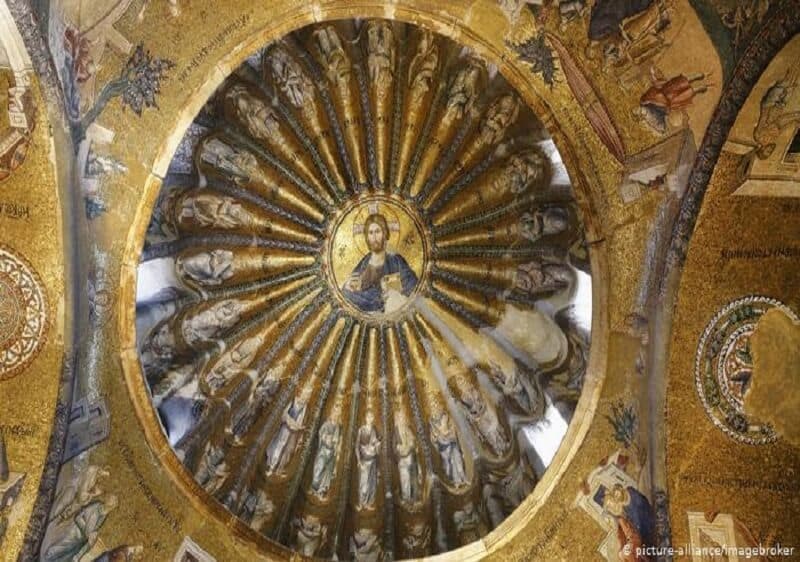
There are two elaborate domes in the inner narthex. The 24-fluted, nine-windowed southern dome measures 3.74 meters in diameter and features an image of Christ as Pantocrator at its pinnacle. For each flute in the set, 39 portraits of ancestors are placed, one for each generation in Christ's lineage from Adam. Some of Christ's miracles are depicted in the pendentives that encircle the Dome of the Ancestors. These range from the healing of a blind man and a dumb man to that of a bleeding woman.
The 3.40-meter-diameter northern dome features two rows of flutes, five windows, and mosaics depicting Mary's ancestors, including sixteen kings of the House of David. The Virgin Mary and the Christ Child are depicted at the peak.
The funerary chapel of the rectangular and single-aisled Chora Church (Kariye Museum) features fresco paintings, figural representations and portraits, lunettes, and four arched tombs, or Arcosolia, vaults placed on either side of the central bays, two in the south wall and two in the north wall. The scenes of resurrection and the afterlife, as well as the intercession of saints, show that Parekklesion was not only built as a shelter for the tombs, including that of Metochites but also used for the performance of rituals related to death and burial.
Christ's and Mary's salvific powers are emphasized in the frescoes that adorn the Parekklesion in the Church of Chora. Each side of the anastasis, which extends over the arch of the bema, depicts a different resurrection miracle performed by Christ, including his role in Adam and Eve's resurrection. The Second Coming of Christ, also known as the Last Judgment, is a salvific event because it features Christ sitting in judgment, conquering death, and redeeming the righteous.
W medalu dodekagonalnego żebrowanego kopuły po zachodniej stronie kaplicy temat wcielenia jest oczywisty, z Dziewicą i Dzieciątkiem otoczonymi przez mnóstwo aniołów i bizantyjskich hymnografów siedzących na zboczach kopuły, pisząc hymny, które zostały włączone do usług pogrzebowych honorując Dziewicy i podkreślając jej rolę w procesie zbawienia.
Byzantyńczycy uważali świętych i męczenników przedstawionych na murach Periklesia za pośredników między sobą a Bogiem.
Mosaiki są w zasadzie
Sześć dużych paneli poświęcających lub poświęcających w zewnętrznych i wewnętrznych nartachachach
Przodkowie Chrystusa w dwóch kopułach wewnętrznego narteksa
Cykl życia Najświętszej Dziewicy w pierwszych trzech zatokach wewnętrznego narteksa
Cykl dzieciństwa Chrystusa w lunetach zewnętrznego narteksa
Cykl posługi Chrystusa w zatoczkach nartek zewnętrznych i czwartej zatoczce nartek wewnętrznych
Trzy panele w Łodzi
Frequently Asked Questions About the Chora Church Museum
Q: What is the Chora Church Museum?
A: The Chora Church Museum is a Byzantine church located in Istanbul, Turkey, that has been converted into a museum.
Q: Where is the Chora Church Museum located?
A: The Chora Church Museum is located in the neighborhood of Edirnekapi, Istanbul, Turkey.
Q: What is the history of the Chora Church Museum?
AKościół Chora został zbudowany we wczesnym okresie bizantyjskim, a w ciągu wieków został kilkakrotnie odnowiony.
Q: What are the popular tourist attractions in the Chora Church Museum?
A: The Chora Church Museum is known for its well-preserved Byzantine mosaics and frescoes, which are considered some of the finest examples of Byzantine art.
Q: What are the opening hours of the Chora Church Museum?
A: The Chora Church Museum is open from 9:00 a.m. to 5:00 p.m. every day except Monday.
Q: How much does it cost to visit the Chora Church Museum?
A: The entrance fee for the Chora Church Museum is approximately 20 Turkish Lira.
Q: What is the dress code for the Chora Church Museum?
A: Visitors to the Chora Church Museum are expected to dress modestly and cover their shoulders and knees.
Q: Is there a guide available at the Chora Church Museum?
A: Yes, there are audio guides available for visitors to the Chora Church Museum.
Q: What is the transportation like to the Chora Church Museum?
A: The Chora Church Museum is easily accessible by bus or metro.
Q: Are there any restrictions on taking photos at the Chora Church Museum?
A: Yes, taking photos inside the Chora Church Museum is restricted, and visitors are not allowed to take flash photos.
Można zarezerwować wycieczkę po Stambule z naszym wykwalifikowanymi przewodniczkami. Linki znajdują się poniżej:
Map of Chora Church