
 chora church museum Istanbul
CHORA MUSEUM ISTANBUL
What to see in CHORA CHURCH MUSEUM
St. Teodius built the Chora Church in 534, during the reign of Emperor Justinian. The monastery was restored by empress Maria Dukaina in the 11th century. In 1511, the church was converted into a mosque. The Chora Church has many mosaics on the wall, and they are from the 11th and 14th centuries.
The mosaics can still be seen as they were plastered when the church was converted into a mosque. The mosaics are basically about the birth of Jesus Christ, the birth of the Virgin Mary, the miracles of Jesus Christ, and the saints of Christianity. Chora Church was converted into a museum in 1949. With the cabinet’s decision, the museum’s statue has been changed and has become a mosque once again. Like the other mosques in Turkey, everyone is allowed to visit Hagia Sophia. The museum is located in the Edirnekapı neighborhood of the Fatih district.
La Moschea di Istanbul Chora è sede di molti mosaici e affreschi inestimabili, rendendola una parte essenziale del mondo dell'arte globale.
La Moschea di Chora, nota anche come Kariye Camii, contiene molti mozaici ed affreschi raffinati che sono stati conservati con cura nel corso dei secoli. Esso mostra le opere più belle e significative della pittura orientale romana dal periodo poco prima che la forma d'arte morisse. Nel Medioevo, gli artisti hanno iniziato a utilizzare la profondità nei mosaici e a disegnare le persone in modo più vivace, che era un segno di ciò che doveva venire nel Rinascimento.
Because the original church and monastery were located beyond the city walls of Constantinople, the name "Kariye" was derived from the ancient Greek word "Khora," which means countryside. The construction of Chora Church dates back to the 5th century, during the reign of Emperor Justinian. The original layout has been drastically altered due to repairs and additions. The current structure dates back to the 14th century.
Considerate Gesù e Maria alla luce di questi mosaici
The Chora Church, which had previously served as a palace church and a chapel for major religious ceremonies, kept on operating as a church for some time. During Bayezid II's reign, the grand vizier Atik Ali Pasha transformed it into a mosque in 1511. The minaret in the southwest corner and the niche in the east wall are period details. When it was renovated in 1945, it became a museum.
Un programma di restauro fu finanziato nel 1948 dal Byzantine Institute of America e dal Dumbarton Oaks Center for Byzantine Studies, rispettivamente, e guidato da Thomas Whittemore e Paul A. Underwood. Dopo di che, non fu più utilizzato come luogo di culto.
The highest administrative court in Turkey, the Turkish Council of State, issued an order on 11/11/2019 for the building to be converted back into a mosque. The building was officially designated as a mosque by presidential decree published in the Official Gazette on August 21, 2020.
Theodoros Metokhites, the treasury administrator, is responsible for the Chora's beautiful frescoes and mosaics from the 14th century. Mosaics depicting scenes from Jesus' life can be found in the outer narthex (the generally western entrance section in eastern Roman basilicas and churches), and scenes from the life of the Virgin Mary can be found in the inner narthex.
Narrative frescoes depict pivotal moments in Christian doctrine. The Chora's floor and wall surfaces, which are decorated with colorful and high-quality marble, are worthy of admiration.
The Kariye Museum in Istanbul is home to some of the most well-known frescoes in the world.
Art historians consider the Kariye Museum (Chora Monastery) in Istanbul's Edirnekapi neighborhood to be a late Byzantine-era monument. The curator, Miray Can Kirkocoglu, was kind enough to answer our questions about the museum, most of whose visitors come from Europe.
Kariye è il nome di un luogo che si trova al di là dei confini della città
According to Kirkocoglu, the Chora Monastery/Church in Kariye was constructed in the sixth century. According to Kirkocoglu, "Karye" comes from the Greek word "Chora," which means "outside the city," and the Arabic word "Karye," and the church was given its current form in the 14th century thanks to outstanding repair and maintenance efforts funded by Theodoros Metochites, a statesman and an artist.
Secondo Kirkcoglu, dopo la conquista di Istanbul, Kariye venne ancora utilizzata come chiesa fino al 1511, quando il Grande Visir, Hadim Ali Pasa, la convertì in moschea aggiungendo una pulpit, un mihrab e un minarete.
The Ministry of Culture and Tourism opened Kariye in 1948 as a museum connected to the Ayasofya Museum. The beautiful frescoes and mosaics in the Kariye Museum are well-known landmarks because of how important they are to history.
Jesus Christ, the Virgin Mary, and her death are depicted in mosaics at Chora Church (Kariye Museum) in Naos.
Above the main entrance on the Naos' western wall is a mosaic known as the Death of the Virgin (Greek: ), which depicts the Virgin dead and lying on a funeral bier, surrounded by the apostles. Standing behind Mary's deathbed, Christ is depicted in a double mandorla (an almond-shaped light encircling the entire figure of a holy person) while holding the swaddled infant who represents Mary's soul being born into eternal life.
Virgin Hodegetria (Greek: "one who shows the way") is depicted on the south side of the temple panel of the bema. Mary, the Virgin Mother, stands on a terrace, her head cocked slightly to one side as she contemplates the Christ Child in her arms.
C'è un mosaico di Gesù Cristo che si rivolge al nord sul pannello del tempio del bema, tenendo una Bibbia aperta a Matteo 11:28.
The lunettes in the outer narthex of the Chora Church (Kariye Museum) depict stories from the Cycle of the Infancy of Christ. Joseph's dream, in which an angel confirms Mary's miraculous conception; the trip to Bethlehem; Mary and the Holy Family's enrollment for taxation; Elizabeth and John's escape; the birth of Jesus; the Holy Family's return to Egypt; Jesus' presentation in Jerusalem; and Jesus' ascension into heaven.
The biblical account of the Magi's visit to King Herod, who is seated on his throne, and their announcement of their discovery of Christ's birth through astronomical means as well as the Massacre of the Innocents, in which King Herod orders the slaughter of all male children.
Many of Christ's miracles, including the changing of water into wine, are depicted in mosaics that line the outer narthex. Christ's healing of the paralytic at Capernaum and the paralytic at the Pool of Bethesda; Jesus' first public miracle; the multiplication of loaves; a segment from the Miraculous Feeding of the Five Thousand; the Samaritan Woman; Jesus' encounter with and conversation with Lazarus; and more.
Le due scene su entrambi i lati della linea di divisione nella metà meridionale del secondo vassoio del narthex esterno mostrano o Giovanni il Battista battezzando Cristo o le quattro volte che il Diavolo sfidò Cristo per dimostrare che era divino.
The inner narthex (Greek: v) of Chora Church (Kariye Museum) is a four-by-eighteen-meter rectangle that is perpendicular to the outer narthex. The structure's lunettes and vaults are covered with statues of saints and images of the Virgin Mary and Christ's miracles.
The Virgin's life is depicted in three bays of the inner narthex, beginning with her miraculous conception by her grandparents Joachim and Anna, continuing through her childhood visits to the temple, her birth, her first steps toward Anne at the age of six months, her marriage to Joseph, also an elderly man, and culminating in her miraculous pregnancy.
Sulla parete orientale del narthex, c'è una grande statua di Deesis che mostra Cristo, la Vergine Maria, Isaac Komnenos e sorella Melanie, i fondatori del convento, prostrandosi davanti a loro.
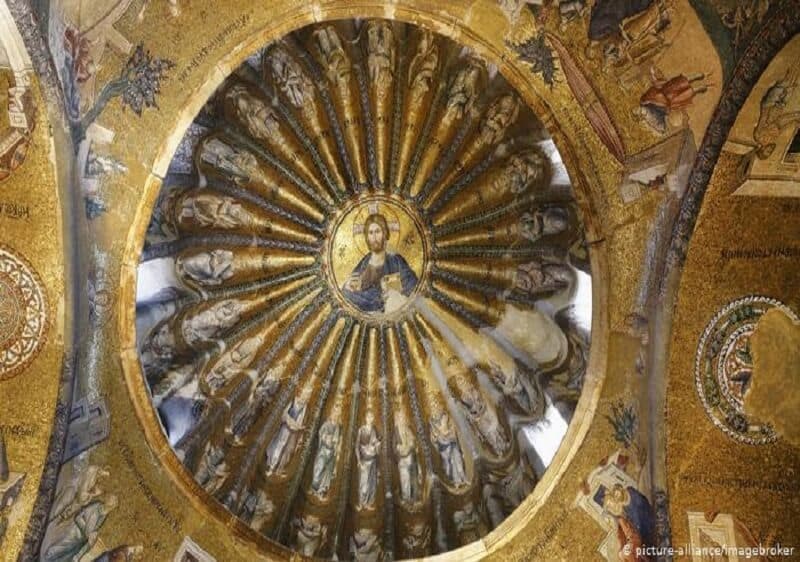
There are two elaborate domes in the inner narthex. The 24-fluted, nine-windowed southern dome measures 3.74 meters in diameter and features an image of Christ as Pantocrator at its pinnacle. For each flute in the set, 39 portraits of ancestors are placed, one for each generation in Christ's lineage from Adam. Some of Christ's miracles are depicted in the pendentives that encircle the Dome of the Ancestors. These range from the healing of a blind man and a dumb man to that of a bleeding woman.
The 3.40-meter-diameter northern dome features two rows of flutes, five windows, and mosaics depicting Mary's ancestors, including sixteen kings of the House of David. The Virgin Mary and the Christ Child are depicted at the peak.
The funerary chapel of the rectangular and single-aisled Chora Church (Kariye Museum) features fresco paintings, figural representations and portraits, lunettes, and four arched tombs, or Arcosolia, vaults placed on either side of the central bays, two in the south wall and two in the north wall. The scenes of resurrection and the afterlife, as well as the intercession of saints, show that Parekklesion was not only built as a shelter for the tombs, including that of Metochites but also used for the performance of rituals related to death and burial.
Christ's and Mary's salvific powers are emphasized in the frescoes that adorn the Parekklesion in the Church of Chora. Each side of the anastasis, which extends over the arch of the bema, depicts a different resurrection miracle performed by Christ, including his role in Adam and Eve's resurrection. The Second Coming of Christ, also known as the Last Judgment, is a salvific event because it features Christ sitting in judgment, conquering death, and redeeming the righteous.
Nel medaglione della cupola a spine dodecagonale sul lato occidentale della cappella, il tema dell’incarnazione è evidente, con la Vergine e il Bambino circondati da un gruppo di angeli e gli hymnografi bizantini seduti sulle pendici della cupola, scrivendo inno che furono incorporati nei servizi funebri onorando la Vergine e sottolineando il suo ruolo nel processo di salvezza.
I Bizantini consideravano i santi e i martiri raffigurati sulle mura di Periklesia come intermediari tra loro e Dio.
I mosaici sono fondamentalmente
Sei grandi pannelli dedicatori o devozionali nei narthex esterni e interni
L'Ancestria di Cristo in due cupole del narthex interno
Il ciclo della vita della Vergine nelle prime tre baie del narthex interiore
Il ciclo dell’infanzia di Cristo nelle lunette del narthex esterno
Il ciclo del ministero di Cristo nei vasi del narthex esterno e nella quarta baia del narthex interno
I tre pannelli della nave
Frequently Asked Questions About the Chora Church Museum
Q di: What is the Chora Church Museum?
a: The Chora Church Museum is a Byzantine church located in Istanbul, Turkey, that has been converted into a museum.
Q di: Where is the Chora Church Museum located?
a: The Chora Church Museum is located in the neighborhood of Edirnekapi, Istanbul, Turkey.
Q di: What is the history of the Chora Church Museum?
a: The Chora Church was built in the early Byzantine period, and it has been renovated several times over the centuries. It was converted into a mosque in the Ottoman period and then into a museum in the 20th century.
Q di: What are the popular tourist attractions in the Chora Church Museum?
a: The Chora Church Museum is known for its well-preserved Byzantine mosaics and frescoes, which are considered some of the finest examples of Byzantine art.
Q di: What are the opening hours of the Chora Church Museum?
a: The Chora Church Museum is open from 9:00 a.m. to 5:00 p.m. every day except Monday.
Q di: How much does it cost to visit the Chora Church Museum?
a: The entrance fee for the Chora Church Museum is approximately 20 Turkish Lira.
Q di: What is the dress code for the Chora Church Museum?
a: Visitors to the Chora Church Museum are expected to dress modestly and cover their shoulders and knees.
Q di: Is there a guide available at the Chora Church Museum?
a: Yes, there are audio guides available for visitors to the Chora Church Museum.
Q di: What is the transportation like to the Chora Church Museum?
a: The Chora Church Museum is easily accessible by bus or metro.
Q di: Are there any restrictions on taking photos at the Chora Church Museum?
a: Yes, taking photos inside the Chora Church Museum is restricted, and visitors are not allowed to take flash photos.
Puoi prenotare un tour della città di Istanbul con le nostre guide turistiche autorizzate.I link sono qui sotto:
Map of Chora Church