
 chora church museum Istanbul
CHORA MUSEUM ISTANBUL
What to see in CHORA CHURCH MUSEUM
Teodio construiu a Igreja de Chora em 534, durante o reinado do imperador Justiniano. O mosteiro foi restaurado pela imperatriz Maria Dukaina no século 11. Em 1511, a igreja foi convertida em uma mesquita. A Igreja de Chora tem muitos mosaicos na parede, e eles são dos séculos 11 e 14.
The mosaics can still be seen as they were plastered when the church was converted into a mosque. The mosaics are basically about the birth of Jesus Christ, the birth of the Virgin Mary, the miracles of Jesus Christ, and the saints of Christianity. Chora Church was converted into a museum in 1949. With the cabinet’s decision, the museum’s statue has been changed and has become a mosque once again. Like the other mosques in Turkey, everyone is allowed to visit Hagia Sophia. The museum is located in the Edirnekapı neighborhood of the Fatih district.
The Istanbul Chora Mosque is the home of many priceless mosaics and frescoes, making it an essential part of the global art world.
A Mesquita de Chora, também conhecida como Kariye Camii, contém muitos mosaicos e frescos exquisitos que foram cuidadosamente preservados ao longo dos séculos. A mesquita apresenta as obras mais finas e significativas da pintura oriental romana do período pouco antes da forma de arte morrer. Na Idade Média, os artistas começaram a usar a profundidade em mosaicos e desenhar pessoas de uma forma mais viva, o que era um sinal do que estava por vir no Renascimento.
Because the original church and monastery were located beyond the city walls of Constantinople, the name "Kariye" was derived from the ancient Greek word "Khora," which means countryside. The construction of Chora Church dates back to the 5th century, during the reign of Emperor Justinian. The original layout has been drastically altered due to repairs and additions. The current structure dates back to the 14th century.
Considere Jesus e Maria à luz destes mosaicos
The Chora Church, which had previously served as a palace church and a chapel for major religious ceremonies, kept on operating as a church for some time. During Bayezid II's reign, the grand vizier Atik Ali Pasha transformed it into a mosque in 1511. The minaret in the southwest corner and the niche in the east wall are period details. When it was renovated in 1945, it became a museum.
Um programa de restauração foi financiado em 1948 pelo Instituto Bizantino da América e pelo Centro de Estudos Bizantinos de Dumbarton Oaks, respectivamente, e liderado por Thomas Whittemore e Paul A. Underwood. Depois disso, ele não foi mais usado como um lugar de culto.
The highest administrative court in Turkey, the Turkish Council of State, issued an order on 11/11/2019 for the building to be converted back into a mosque. The building was officially designated as a mosque by presidential decree published in the Official Gazette on August 21, 2020.
Theodoros Metokhites, the treasury administrator, is responsible for the Chora's beautiful frescoes and mosaics from the 14th century. Mosaics depicting scenes from Jesus' life can be found in the outer narthex (the generally western entrance section in eastern Roman basilicas and churches), and scenes from the life of the Virgin Mary can be found in the inner narthex.
Narrative frescoes depict pivotal moments in Christian doctrine. The Chora's floor and wall surfaces, which are decorated with colorful and high-quality marble, are worthy of admiration.
The Kariye Museum in Istanbul is home to some of the most well-known frescoes in the world.
Art historians consider the Kariye Museum (Chora Monastery) in Istanbul's Edirnekapi neighborhood to be a late Byzantine-era monument. The curator, Miray Can Kirkocoglu, was kind enough to answer our questions about the museum, most of whose visitors come from Europe.
Kariye é o nome de um lugar que está localizado além dos limites da cidade
According to Kirkocoglu, the Chora Monastery/Church in Kariye was constructed in the sixth century. According to Kirkocoglu, "Karye" comes from the Greek word "Chora," which means "outside the city," and the Arabic word "Karye," and the church was given its current form in the 14th century thanks to outstanding repair and maintenance efforts funded by Theodoros Metochites, a statesman and an artist.
De acordo com Kirkcoglu, após a conquista de Istambul, Kariye ainda era usado como uma igreja até 1511, quando o Grande Vizir, Hadim Ali Pasa, converteu-o em uma mesquita, adicionando uma pulpit, um mihrab e um minarete.
The Ministry of Culture and Tourism opened Kariye in 1948 as a museum connected to the Ayasofya Museum. The beautiful frescoes and mosaics in the Kariye Museum are well-known landmarks because of how important they are to history.
Jesus Christ, the Virgin Mary, and her death are depicted in mosaics at Chora Church (Kariye Museum) in Naos.
Above the main entrance on the Naos' western wall is a mosaic known as the Death of the Virgin (Greek: ), which depicts the Virgin dead and lying on a funeral bier, surrounded by the apostles. Standing behind Mary's deathbed, Christ is depicted in a double mandorla (an almond-shaped light encircling the entire figure of a holy person) while holding the swaddled infant who represents Mary's soul being born into eternal life.
Virgin Hodegetria (Greek: "one who shows the way") is depicted on the south side of the temple panel of the bema. Mary, the Virgin Mother, stands on a terrace, her head cocked slightly to one side as she contemplates the Christ Child in her arms.
Há um mosaico de Jesus Cristo com vista para o norte no painel do templo do bema, segurando uma Bíblia aberta para Mateus 11:28.
The lunettes in the outer narthex of the Chora Church (Kariye Museum) depict stories from the Cycle of the Infancy of Christ. Joseph's dream, in which an angel confirms Mary's miraculous conception; the trip to Bethlehem; Mary and the Holy Family's enrollment for taxation; Elizabeth and John's escape; the birth of Jesus; the Holy Family's return to Egypt; Jesus' presentation in Jerusalem; and Jesus' ascension into heaven.
The biblical account of the Magi's visit to King Herod, who is seated on his throne, and their announcement of their discovery of Christ's birth through astronomical means as well as the Massacre of the Innocents, in which King Herod orders the slaughter of all male children.
Many of Christ's miracles, including the changing of water into wine, are depicted in mosaics that line the outer narthex. Christ's healing of the paralytic at Capernaum and the paralytic at the Pool of Bethesda; Jesus' first public miracle; the multiplication of loaves; a segment from the Miraculous Feeding of the Five Thousand; the Samaritan Woman; Jesus' encounter with and conversation with Lazarus; and more.
As duas cenas de ambos os lados da linha de divisão na metade sul do segundo véu do nartex exterior mostram ou João Batista batizando Cristo ou as quatro vezes que o Diabo desafiou Cristo para provar que ele era divino.
The inner narthex (Greek: v) of Chora Church (Kariye Museum) is a four-by-eighteen-meter rectangle that is perpendicular to the outer narthex. The structure's lunettes and vaults are covered with statues of saints and images of the Virgin Mary and Christ's miracles.
The Virgin's life is depicted in three bays of the inner narthex, beginning with her miraculous conception by her grandparents Joachim and Anna, continuing through her childhood visits to the temple, her birth, her first steps toward Anne at the age of six months, her marriage to Joseph, also an elderly man, and culminating in her miraculous pregnancy.
Na parede oriental do narthex, há uma grande estátua de Deesis que mostra Cristo, a Virgem Maria, Isaac Komnenos e Irmã Melanie, os fundadores do convento, prostrando-se diante deles.
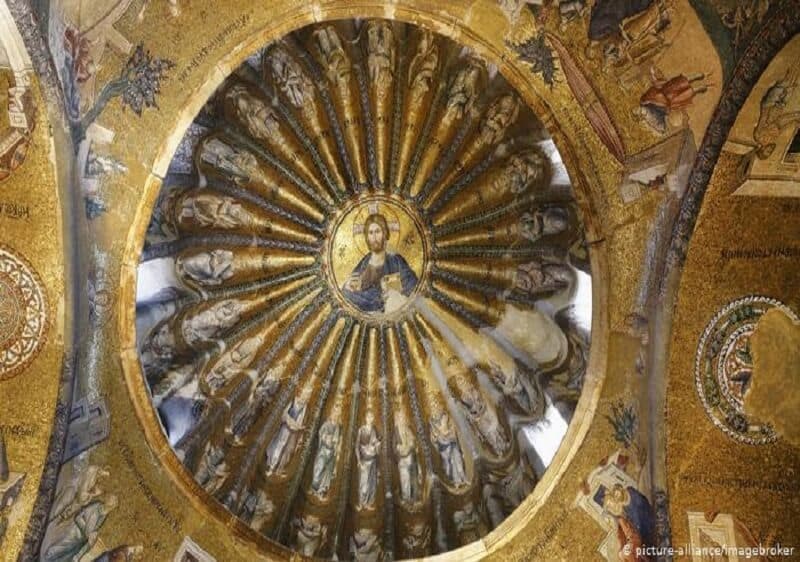
There are two elaborate domes in the inner narthex. The 24-fluted, nine-windowed southern dome measures 3.74 meters in diameter and features an image of Christ as Pantocrator at its pinnacle. For each flute in the set, 39 portraits of ancestors are placed, one for each generation in Christ's lineage from Adam. Some of Christ's miracles are depicted in the pendentives that encircle the Dome of the Ancestors. These range from the healing of a blind man and a dumb man to that of a bleeding woman.
The 3.40-meter-diameter northern dome features two rows of flutes, five windows, and mosaics depicting Mary's ancestors, including sixteen kings of the House of David. The Virgin Mary and the Christ Child are depicted at the peak.
The funerary chapel of the rectangular and single-aisled Chora Church (Kariye Museum) features fresco paintings, figural representations and portraits, lunettes, and four arched tombs, or Arcosolia, vaults placed on either side of the central bays, two in the south wall and two in the north wall. The scenes of resurrection and the afterlife, as well as the intercession of saints, show that Parekklesion was not only built as a shelter for the tombs, including that of Metochites but also used for the performance of rituals related to death and burial.
Christ's and Mary's salvific powers are emphasized in the frescoes that adorn the Parekklesion in the Church of Chora. Each side of the anastasis, which extends over the arch of the bema, depicts a different resurrection miracle performed by Christ, including his role in Adam and Eve's resurrection. The Second Coming of Christ, also known as the Last Judgment, is a salvific event because it features Christ sitting in judgment, conquering death, and redeeming the righteous.
No medalhão da cúpula de cordas dodecagonais no lado ocidental da capela, o tema da encarnação é evidente, com a Virgem e a Criança cercados por uma multidão de anjos e himnografos bizantinos sentados nas pendentes da cúpula, escrevendo hinos que foram incorporados nos serviços funerários honrando a Virgem e enfatizando seu papel no processo de salvação.
Os bizantinos consideravam os santos e mártires retratados nas paredes da Periklesia como intermediários entre si e Deus.
Os mosaicos são basicamente
Seis grandes painéis dedicatórios ou devocionais nos narthexes externos e internos
A Ancestria de Cristo em duas cúpulas do narthex interior
O Ciclo de Vida da Virgem nas três primeiras baías do nartex interior
O Ciclo da Infância de Cristo nas Lunetas do nartex exterior
O Ciclo do ministério de Cristo nos vultos do narthex exterior e da quarta baía do narthex interior
Os três painéis na nave
Perguntas frequentes sobre o Museu da Igreja de Chora
QO que é o Museu da Igreja de Chora?
AO Museu da Igreja de Chora é uma igreja bizantina localizada em Istambul, na Turquia, que foi convertida em um museu.
QOnde está localizado o Museu da Igreja de Chora?
A: The Chora Church Museum is located in the neighborhood of Edirnekapi, Istanbul, Turkey.
QQual é a história do Museu da Igreja de Chora?
AA Igreja de Chora foi construída no início do período bizantino, e foi renovada várias vezes ao longo dos séculos.
Q: What are the popular tourist attractions in the Chora Church Museum?
A: The Chora Church Museum is known for its well-preserved Byzantine mosaics and frescoes, which are considered some of the finest examples of Byzantine art.
Q: Quais são os horários de abertura do Museu da Igreja de Chora?
A: The Chora Church Museum is open from 9:00 a.m. to 5:00 p.m. every day except Monday.
Q: Quanto custa visitar o Museu da Igreja de Chora?
AA entrada para o Museu da Igreja de Chora custa aproximadamente 20 Liras turcas.
QQual é o código de vestimenta para o Museu da Igreja de Chora?
A: Visitors to the Chora Church Museum are expected to dress modestly and cover their shoulders and knees.
Q: Is there a guide available at the Chora Church Museum?
A: Yes, there are audio guides available for visitors to the Chora Church Museum.
Q: Como é o transporte para o Museu da Igreja de Chora?
AO Museu da Igreja de Chora é facilmente acessível de ônibus ou metrô.
QExistem restrições para tirar fotos no Museu da Igreja de Chora?
ASim, a fotografia dentro do Museu da Igreja de Chora é restrita e os visitantes não podem tirar fotos em flash.
Você pode reservar um passeio pela cidade de Istambul com nossos guias de viagem licenciados.
Mapa da Igreja de Chora