
 chora church museum Istanbul
CHORA MUSEUM ISTANBUL
What to see in CHORA CHURCH MUSEUM
St. Teodius built the Chora Church in 534, during the reign of Emperor Justinian. The monastery was restored by empress Maria Dukaina in the 11th century. In 1511, the church was converted into a mosque. The Chora Church has many mosaics on the wall, and they are from the 11th and 14th centuries.
The mosaics can still be seen as they were plastered when the church was converted into a mosque. The mosaics are basically about the birth of Jesus Christ, the birth of the Virgin Mary, the miracles of Jesus Christ, and the saints of Christianity. Chora Church was converted into a museum in 1949. With the cabinet’s decision, the museum’s statue has been changed and has become a mosque once again. Like the other mosques in Turkey, everyone is allowed to visit Hagia Sophia. The museum is located in the Edirnekapı neighborhood of the Fatih district.
伊斯坦布尔霍拉清真寺是许多无价的摩萨克和壁画的所在地,使其成为全球艺术世界的重要组成部分。
霍拉清真寺,也被称为卡里耶卡米,包含许多精致的摩萨克和壁画,这些在几个世纪中被精心保存。它展示了东罗马绘画的最美丽和最重要的作品,从艺术形式消失之前的时期。中世纪,艺术家开始使用深度在摩萨克和绘制人们更活泼的方式,这是一个迹象,在文艺复兴时期将要发生的事情。
Because the original church and monastery were located beyond the city walls of Constantinople, the name "Kariye" was derived from the ancient Greek word "Khora," which means countryside. The construction of Chora Church dates back to the 5th century, during the reign of Emperor Justinian. The original layout has been drastically altered due to repairs and additions. The current structure dates back to the 14th century.
考虑耶稣和玛利亚在这些摩西书的光明
The Chora Church, which had previously served as a palace church and a chapel for major religious ceremonies, kept on operating as a church for some time. During Bayezid II's reign, the grand vizier Atik Ali Pasha transformed it into a mosque in 1511. The minaret in the southwest corner and the niche in the east wall are period details. When it was renovated in 1945, it became a museum.
修复计划于1948年由美国拜占庭研究所和杜巴顿奥克斯拜占庭研究中心分别资助,并由托马斯·惠特莫尔和保罗·阿恩德伍德领导。
The highest administrative court in Turkey, the Turkish Council of State, issued an order on 11/11/2019 for the building to be converted back into a mosque. The building was officially designated as a mosque by presidential decree published in the Official Gazette on August 21, 2020.
Theodoros Metokhites, the treasury administrator, is responsible for the Chora's beautiful frescoes and mosaics from the 14th century. Mosaics depicting scenes from Jesus' life can be found in the outer narthex (the generally western entrance section in eastern Roman basilicas and churches), and scenes from the life of the Virgin Mary can be found in the inner narthex.
Narrative frescoes depict pivotal moments in Christian doctrine. The Chora's floor and wall surfaces, which are decorated with colorful and high-quality marble, are worthy of admiration.
The Kariye Museum in Istanbul is home to some of the most well-known frescoes in the world.
Art historians consider the Kariye Museum (Chora Monastery) in Istanbul's Edirnekapi neighborhood to be a late Byzantine-era monument. The curator, Miray Can Kirkocoglu, was kind enough to answer our questions about the museum, most of whose visitors come from Europe.
卡里耶是位于城市边界之外的地方的名字
According to Kirkocoglu, the Chora Monastery/Church in Kariye was constructed in the sixth century. According to Kirkocoglu, "Karye" comes from the Greek word "Chora," which means "outside the city," and the Arabic word "Karye," and the church was given its current form in the 14th century thanks to outstanding repair and maintenance efforts funded by Theodoros Metochites, a statesman and an artist.
根据Kirkcoglu的说法,在伊斯坦布尔征服后,Kariye仍然被用作教堂,直到1511年,当时大拜察官Hadim Ali Pasa将其改造为清真寺,增加了一座大厦,一座米拉布和一座地雷塔。
The Ministry of Culture and Tourism opened Kariye in 1948 as a museum connected to the Ayasofya Museum. The beautiful frescoes and mosaics in the Kariye Museum are well-known landmarks because of how important they are to history.
Jesus Christ, the Virgin Mary, and her death are depicted in mosaics at Chora Church (Kariye Museum) in Naos.
Above the main entrance on the Naos' western wall is a mosaic known as the Death of the Virgin (Greek: ), which depicts the Virgin dead and lying on a funeral bier, surrounded by the apostles. Standing behind Mary's deathbed, Christ is depicted in a double mandorla (an almond-shaped light encircling the entire figure of a holy person) while holding the swaddled infant who represents Mary's soul being born into eternal life.
Virgin Hodegetria (Greek: "one who shows the way") is depicted on the south side of the temple panel of the bema. Mary, the Virgin Mother, stands on a terrace, her head cocked slightly to one side as she contemplates the Christ Child in her arms.
有耶稣基督的摩西在bema的圣殿板上向北看,持有圣经打开马太福音11:28。
The lunettes in the outer narthex of the Chora Church (Kariye Museum) depict stories from the Cycle of the Infancy of Christ. Joseph's dream, in which an angel confirms Mary's miraculous conception; the trip to Bethlehem; Mary and the Holy Family's enrollment for taxation; Elizabeth and John's escape; the birth of Jesus; the Holy Family's return to Egypt; Jesus' presentation in Jerusalem; and Jesus' ascension into heaven.
The biblical account of the Magi's visit to King Herod, who is seated on his throne, and their announcement of their discovery of Christ's birth through astronomical means as well as the Massacre of the Innocents, in which King Herod orders the slaughter of all male children.
Many of Christ's miracles, including the changing of water into wine, are depicted in mosaics that line the outer narthex. Christ's healing of the paralytic at Capernaum and the paralytic at the Pool of Bethesda; Jesus' first public miracle; the multiplication of loaves; a segment from the Miraculous Feeding of the Five Thousand; the Samaritan Woman; Jesus' encounter with and conversation with Lazarus; and more.
外部 ⁇ 尾的第二层南半部分界线的两面场景显示,约翰洗礼者洗礼基督,或者魔鬼挑战基督四次证明他是神圣的。
The inner narthex (Greek: v) of Chora Church (Kariye Museum) is a four-by-eighteen-meter rectangle that is perpendicular to the outer narthex. The structure's lunettes and vaults are covered with statues of saints and images of the Virgin Mary and Christ's miracles.
The Virgin's life is depicted in three bays of the inner narthex, beginning with her miraculous conception by her grandparents Joachim and Anna, continuing through her childhood visits to the temple, her birth, her first steps toward Anne at the age of six months, her marriage to Joseph, also an elderly man, and culminating in her miraculous pregnancy.
在南极的东墙上,有一个大雕像的Deesis,显示基督,圣母玛利亚,伊萨克科姆尼诺斯和姐姐梅拉尼,修道院的创始人,在他们面前屈服。
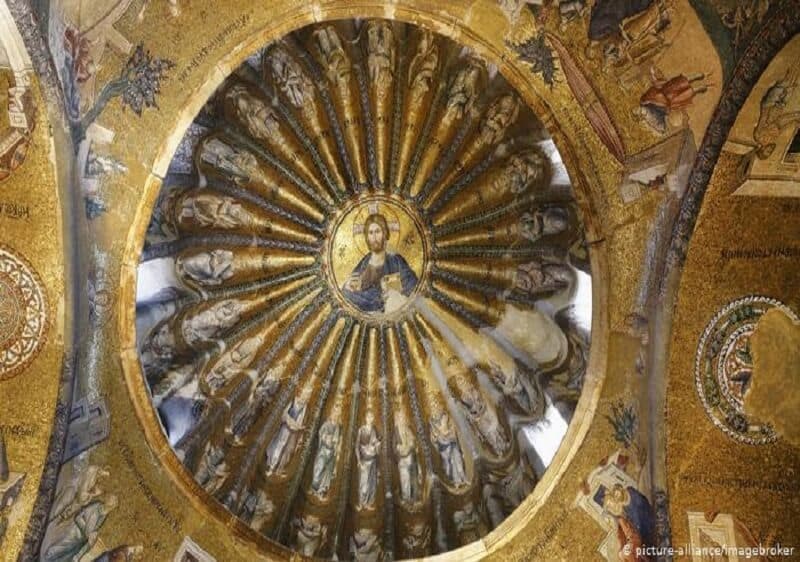
There are two elaborate domes in the inner narthex. The 24-fluted, nine-windowed southern dome measures 3.74 meters in diameter and features an image of Christ as Pantocrator at its pinnacle. For each flute in the set, 39 portraits of ancestors are placed, one for each generation in Christ's lineage from Adam. Some of Christ's miracles are depicted in the pendentives that encircle the Dome of the Ancestors. These range from the healing of a blind man and a dumb man to that of a bleeding woman.
The 3.40-meter-diameter northern dome features two rows of flutes, five windows, and mosaics depicting Mary's ancestors, including sixteen kings of the House of David. The Virgin Mary and the Christ Child are depicted at the peak.
The funerary chapel of the rectangular and single-aisled Chora Church (Kariye Museum) features fresco paintings, figural representations and portraits, lunettes, and four arched tombs, or Arcosolia, vaults placed on either side of the central bays, two in the south wall and two in the north wall. The scenes of resurrection and the afterlife, as well as the intercession of saints, show that Parekklesion was not only built as a shelter for the tombs, including that of Metochites but also used for the performance of rituals related to death and burial.
Christ's and Mary's salvific powers are emphasized in the frescoes that adorn the Parekklesion in the Church of Chora. Each side of the anastasis, which extends over the arch of the bema, depicts a different resurrection miracle performed by Christ, including his role in Adam and Eve's resurrection. The Second Coming of Christ, also known as the Last Judgment, is a salvific event because it features Christ sitting in judgment, conquering death, and redeeming the righteous.
在教堂西侧的 ⁇ 栏大楼的勋章里,受肉体的主题是明显的,圣母和孩子被一群天使和拜占庭歌唱家包围,坐在大楼的斜坡上,写了歌曲,这些歌曲被纳入葬礼仪式,以纪念圣母,并强调她在救赎过程中所起的作用。
拜占庭人认为,佩里克莱西亚的墙壁上描绘的圣人和烈士是他们自己和上帝之间的中介者,烈士是从南向西向东的墙壁上描绘的。
莫扎克基本上是
六大献身或献身面板在外部和内部的narthexes
基督的祖先在内部纳特克斯的两个圆顶
圣母圣母在内 ⁇ 的前三湾的生命周期
基督童年周期在外部 ⁇ 的镜头
基督在外部 ⁇ 的 ⁇ 和内部 ⁇ 的第四湾的循环
船上的三块面板
Frequently Asked Questions About the Chora Church Museum
Q ⁇: What is the Chora Church Museum?
A 是: The Chora Church Museum is a Byzantine church located in Istanbul, Turkey, that has been converted into a museum.
Q ⁇: Where is the Chora Church Museum located?
A 是: The Chora Church Museum is located in the neighborhood of Edirnekapi, Istanbul, Turkey.
Q ⁇: What is the history of the Chora Church Museum?
A 是: The Chora Church was built in the early Byzantine period, and it has been renovated several times over the centuries. It was converted into a mosque in the Ottoman period and then into a museum in the 20th century.
Q ⁇: What are the popular tourist attractions in the Chora Church Museum?
A 是: The Chora Church Museum is known for its well-preserved Byzantine mosaics and frescoes, which are considered some of the finest examples of Byzantine art.
Q ⁇: What are the opening hours of the Chora Church Museum?
A 是: The Chora Church Museum is open from 9:00 a.m. to 5:00 p.m. every day except Monday.
Q ⁇: How much does it cost to visit the Chora Church Museum?
A 是: The entrance fee for the Chora Church Museum is approximately 20 Turkish Lira.
Q ⁇: What is the dress code for the Chora Church Museum?
A 是: Visitors to the Chora Church Museum are expected to dress modestly and cover their shoulders and knees.
Q ⁇: Is there a guide available at the Chora Church Museum?
A 是: Yes, there are audio guides available for visitors to the Chora Church Museum.
Q ⁇: What is the transportation like to the Chora Church Museum?
A 是: The Chora Church Museum is easily accessible by bus or metro.
Q ⁇: Are there any restrictions on taking photos at the Chora Church Museum?
A 是: Yes, taking photos inside the Chora Church Museum is restricted, and visitors are not allowed to take flash photos.
您可以与我们的授权的旅游指南预订伊斯坦布尔市之旅。 链接如下:
Map of Chora Church