
BOSPHORUS & BRIDGES
 cruises bosphorus
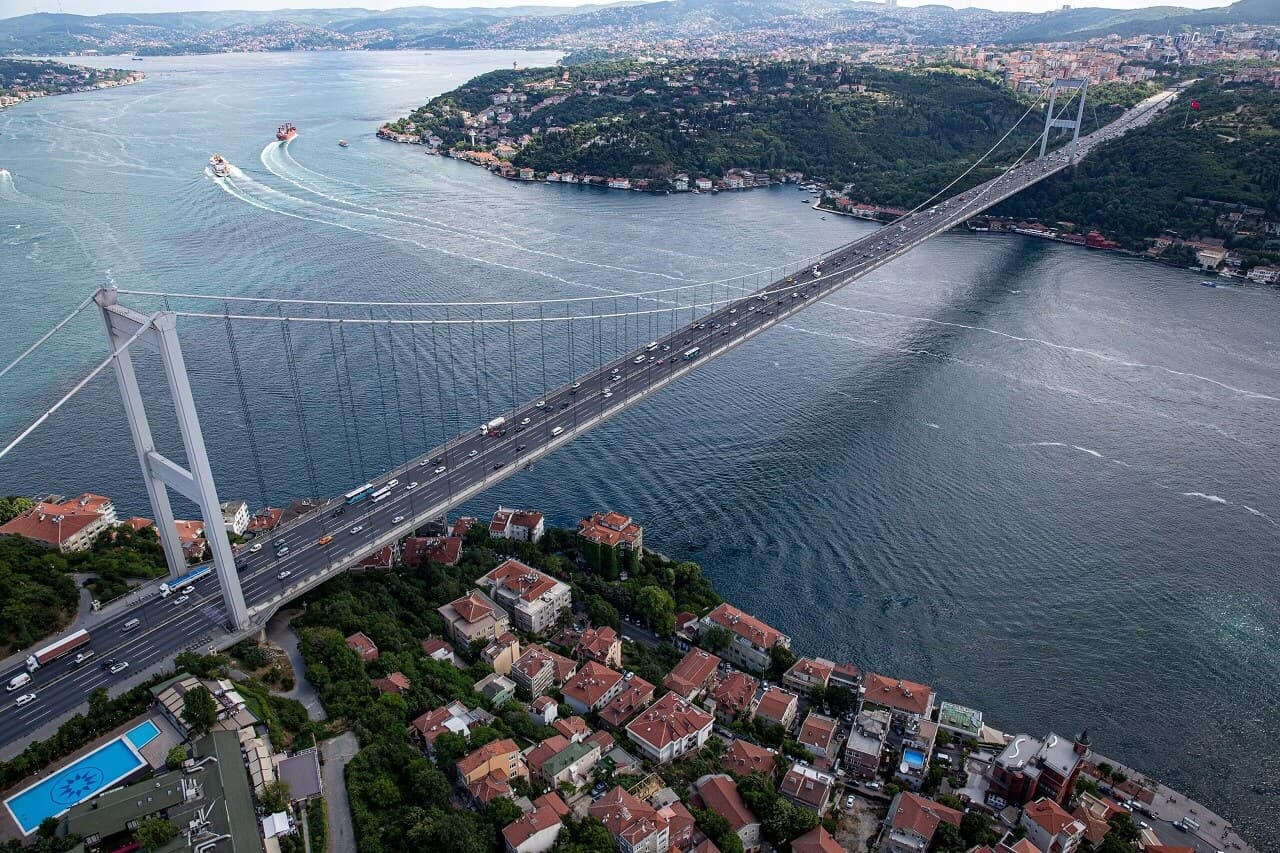
Cầu Bosphorus và một con sông nối châu Âu và châu Á
BOSPHORUS BRIDGES
The Bosphorus Strait, which divides Istanbul and European Turkey, is a natural strait and a major waterway in the world. It separates Anatolia and Thrace in Turkey and is part of the continental boundary between Asia and Europe. When it comes to international shipping, this strait is the narrowest possible passage.
Except for the northernmost part of the Bosporus Strait, both sides are full of people, with 17 million people living in the Istanbul metropolitan area.
The Bosporus Strait and the Dardanelles Strait at the other end of the Sea of Marmara make up the Turkish Straits.
Parts of the Bosporus Strait that tend to get mud on them are periodically dredged, and in some places along Istanbul, the shoreline has been strengthened with concrete or rubble.
Bosphorus Geographical Features
The Bosporus Strait connects the Black Sea to the Sea of Marmara and from there to the Dardanelles Strait, which connects to the Aegean and Mediterranean Seas. The Eastern Mediterranean, Balkan, Near Eastern, and Western Eurasia Seas are all linked by this landmass. So, the Bosporus is an important international waterway, especially for goods coming from Russia. It connects the Black Sea to the Mediterranean Sea, the Atlantic Ocean, and the Indian Ocean through Gibraltar and the Suez Canal.
Located a short distance from Kurucesme in the Bosporus is a single, tiny island. In 1880, Sultan Abdülhamid II presented the island to the Armenian architect Sarkis Balyan, and since then it has become known as Galatasaray Island (Galatasaray Adasi). The island, now home to the Galatasaray Sports Club after having been a walled garden and a water sports center, was once the site of his home. However, it became overbuilt with nightclubs in the 2010s, and many of them were demolished in 2017. In the summer of 2022, it reopened to the public.
The History of the Bosphorus
The Bosporus has been and continues to be a vital passageway for trade and defense because it connects the Black Sea and the Mediterranean. Russia and Ukraine, among others, use this waterway extensively. The Dardanelles Strait has been contested in several modern wars, including the Russo-Turkish War (1877–78) and the Allied Powers' attack on the Dardanelles in World War I's Battle of Gallipoli (1915). The significance of the Bosporus as a grain route to the rest of the world was brought into sharp focus in 2022 when Russia invaded Ukraine.
The Bosphorus in Mythology
In Greek mythology, the Bosphorus is named after the character Io, who was turned into a cow and doomed to wander the Earth until she reached the Bosphorus Strait, where she was finally rescued from the dragonfly that had been pursuing her. There she was comforted by the Titan Prometheus, who told her that Zeus would return her to human form and make her the progenitor of Heracles, the greatest of all heroes (Hercules).
Clashing Rocks, or Symplegades, were enormous floating rocks that were said to have guarded both sides of the Bosporus in Greek mythology and smashed any ship that tried to pass through the strait. Jason, the hero of the Argonauts, was able to pass safely between the rocks. This took away their destructive power and let the Greeks reach the Black Sea.
The Bosphorus Bridges
Three bridge types span the Bosphorus: two suspension bridges and a cable-stayed bridge. The 15th July Martyrs Bridge, originally named the Bosporus Bridge, was completed in 1973 and measures 1,074 meters (3,524 feet) in length. The second bridge, named Fatih Sultan Mehmet (Bosporus II) Bridge, was finished in 1988 and is located about 5 kilometers (3 miles) to the north of the first.
The Fatih Sultan Mehmet Bridge is part of the Trans-European Motorway, while the first Bosporus Bridge is part of the O1 Motorway. The third bridge is the 2,164-meter-long (7,100-foot-long) Yavuz Sultan Selim Bridge, which was finished in 2016. It is part of the "Northern Marmara Motorway," integrated into the already existing Black Sea Coastal Highway, and it allows through traffic to avoid city traffic near the northern end of the Bosporus, between the villages of Garipce on the European side and Poyrazköy on the Asian side.
Cầu Bosphorus
One of three suspension bridges spanning the Bosphorus strait (Turkish: Bogazici) in Istanbul, Turkey, the Bosphorus Bridge (Turkish: Bogazici Köprüsü) is also known as the First Bridge (Turkish: Birinci Köprü) and the 15 July Martyrs Bridge (Turkish: 15 Temmuz Sehitler Köprüsü) (alongside the Fatih Sultan Mehmet Bridge and the Yavuz Sultan Selim; both Ortaköy (in Europe) and Beylerbeyi (in Asia) are connected by this bridge in Asia).
Thép tháp và treo treo tạo ra một cây cầu treo dựa trên trọng lực. Cáp thép hỗ trợ boong khí động học. Nó có chiều dài 1,560 mét (5,118 feet) và chiều rộng 33,40 mét (105 feet; 110 ft). Dải chính là 1,074 mét (3,524 feet) chiều dài, và tháp cao nhất là 165 mét (541 feet) trên mặt đất. Ở 64 mét trên mực nước biển, cây cầu có rất nhiều không gian để vượt qua (210 ft).
Cầu Bosphorus, mở cửa cho giao thông vào năm 1973, tự hào có chiều dài cầu treo dài nhất trên thế giới bên ngoài Hoa Kỳ (chỉ có Cầu Verrazano-Narrows, Cầu Cổng Vàng và Cầu Mackinac có chiều dài dài hơn vào năm 1973).
The Humber Bridge in 1981 surpassed the Bosphorus Bridge as Europe's longest suspension bridge, and the Fatih Sultan Mehmet Bridge (the Second Bosphorus Bridge) in 1988 surpassed it in Asia (which was surpassed by the Minami Bisan-Seto Bridge in 1989). The suspension bridge span of the Bosphorus Bridge is the 42nd longest in the world as of this writing.
Ngày 25 tháng 7 năm 2016, Thủ tướng Binali Yildirim thông báo rằng Chính phủ Thổ Nhĩ Kỳ đã quyết định chính thức đổi tên cầu thành 15 Temmuz Sehitler Koprüsü (Cây cầu tử đạo ngày 15 tháng 7) để vinh danh những người đã chết trong cuộc chiến chống lại cuộc đảo chính quân sự ngày 15 tháng 7 năm 2016.
Cầu Bosphorus nổi tiếng vì nó kết nối các phần khác nhau của châu Âu và Thổ Nhĩ Kỳ.
Cầu Fatih Sultan Mehmet
Located in Istanbul, Turkey, across the Bosphorus strait is the Fatih Sultan Mehmet Bridge (also spelled Fatih Sultan Mehmed Köprüsü, F.S.M. Köprüsü, or 2. Köprü), also known as the Sultan Mehmed the Conqueror Bridge (Turkish: Bogazici). When it first opened in 1988, it had the fifth-longest suspension bridge span in the world.
The Ottoman sultan Mehmed the Conqueror, who in 1453 took control of Constantinople (modern-day Istanbul), named the bridge after himself. Highways 1 and 5 in Asia, as well as Otoyol 2 in Turkey, all converge here from Europe. In addition to the Bosphorus Bridge and the 1915 Canakkale Bridge, Turkey is home to three other bridges that span the continents of Europe and Asia: the Yavuz Sultan Selim Bridge, the 15 July Martyrs Bridge, and the Bosphorus Bridge.
Vị trí
Connecting Istanbul's European district of Hisarüstü to the Asian district of Kavacik is this bridge (Asian side). It uses steel pylons and vertical hangers to create a suspension bridge that is anchored to the ground by gravity. Two vertical steel cables support the aerodynamic deck. It has a deck width of 39 m and is 1,510 m in total length. The main span is 1,090 meters, and the towers rise 105 meters above the surrounding landscape. The bridge has a 64-meter vertical clearance above mean sea level.
Cầu Yavuz Sultan Selim
Located to the north of two existing suspension bridges in Istanbul, Turkey is the Yavuz Sultan Selim Bridge, also known as the Yavuz Sultan Selim Köprüsü. The original name for this bridge was the Third Bosphorus Bridge (with the 15 July Martyrs Bridge being the First Bosphorus Bridge and the Fatih Sultan Mehmet Bridge being the Second Bosphorus Bridge). Garipce in European Sariyer and Poyrazköy in Asian Beykoz is where the bridge connects, and both are close to the Black Sea entrance to the Bosphorus strait.
Ngày 29 tháng 5 năm 2013, lễ đặt nền tảng được tổ chức. Ngày 26 tháng 8 năm 2016, cây cầu được mở cửa cho giao thông xe hơi.
The bridge is 322 meters (1,056 feet) tall, making it one of the world's tallest. As far as bridges go, it comes in at number five on the list of the world's tallest. At 58.4 meters (192 feet), the bridge is also among the widest suspension bridges in the world.
Frequently Asked Questions About the Bosphorus Bridges
Q: What are the Bosphorus Bridges?
a): The Bosphorus Bridges are two bridges that span the Bosphorus Strait in Istanbul, Turkey.
Q: When were the Bosphorus Bridges built?
a): The first Bosphorus Bridge was completed in 1973, the second Bosphorus Bridge was completed in 1988, and the third Bosphorus Bridge was completed in 2017.
Q: What is the purpose of the Bosphorus bridges?
a): The Bosphorus Bridges are an important link between the European and Asian parts of Istanbul. They make it easier to travel and do business between the two parts of the city.
Q: What is the name of the first Bosphorus Bridge?
a): The first Bosphorus Bridge is called the 15 July Martyrs Bridge.
Q: What is the name of the second Bosphorus Bridge?
a): The second Bosphorus Bridge is called the Fatih Sultan Mehmet Bridge.
Q: What is the name of the third Bosphorus Bridge?
a): The third Bosphorus Bridge is called the Yavuz Sultan Selim Bridge.
Q: How long are the Bosphorus Bridges?
a): The 15 July Martyrs Bridge is 1,560 meters long, while the Fatih Sultan Mehmet Bridge is 1,408 meters long.
Q: Can cars drive on the Bosphorus Bridges?
a)Có, cả hai cây cầu đều có đường cho xe hơi cũng như đường đi bộ.
Q: Is there a toll to cross the Bosphorus Bridges?
a): Yes, there is a toll for crossing the Bosphorus Bridges. The toll varies depending on the type of vehicle.
Q: Are the Bosphorus Bridges open 24 hours a day?
a): Yes, the Bosphorus Bridges are open 24 hours a day.
Q: Can the Bosphorus Bridges be seen from a boat tour of the Bosphorus Strait?
a): Yes, boat tours of the Bosphorus Strait typically pass under the Bosphorus Bridges and offer views of the bridges from the water.
Bạn có thể đặt tour du lịch thành phố Istanbul với hướng dẫn viên du lịch được cấp phép của chúng tôi. Các liên kết dưới đây:
Map of Bosphorus