
Die Bosporus & Bridges
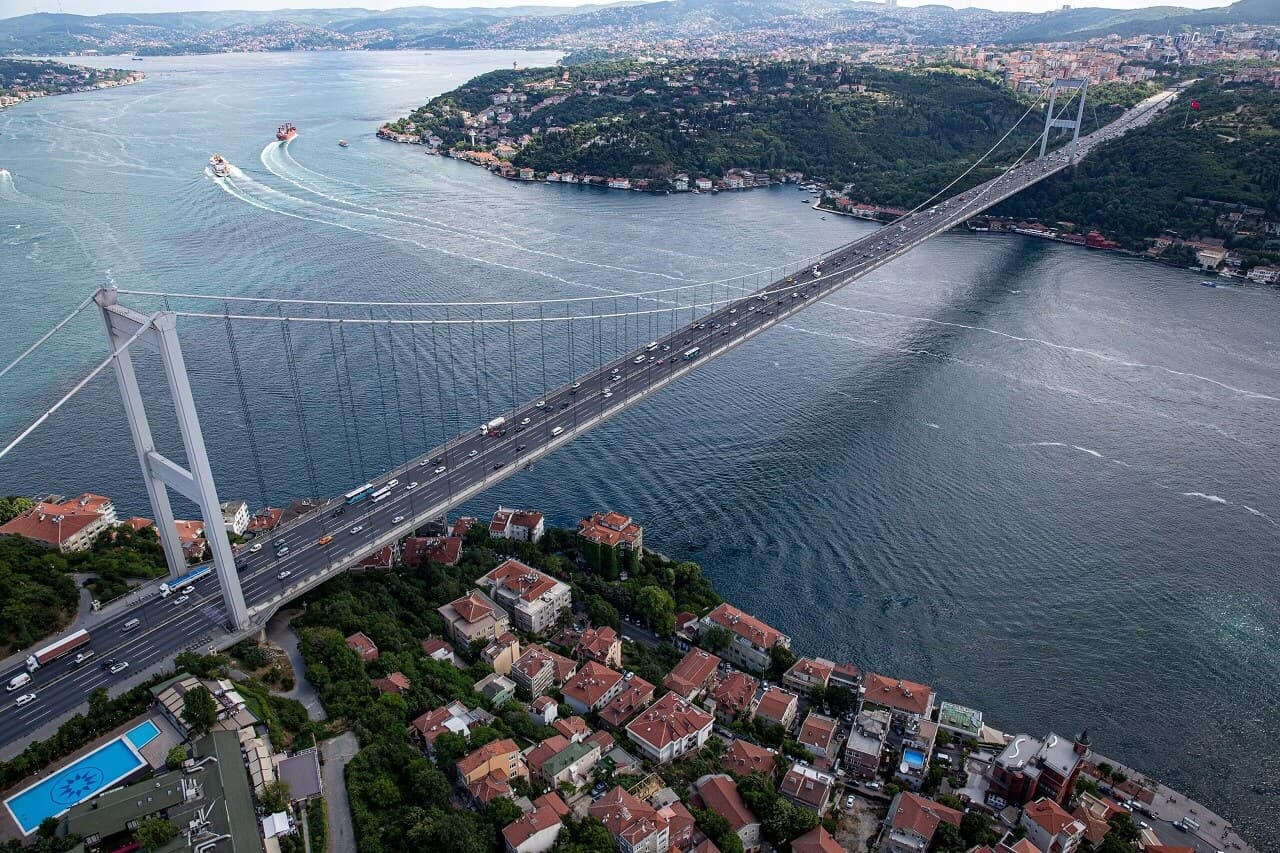 cruises bosphorus
BOSPHORUS BRIDGE AND A RIVER CONNECTS EUROPE AND ASIA
Die Bosporusbrücken
Die Bosporusstraße, die Istanbul und die europäische Türkei teilt, ist eine natürliche Straße und eine wichtige Wasserstraße in der Welt. Es trennt Anatolien und Thrakien in der Türkei und ist Teil der kontinentalen Grenze zwischen Asien und Europa.
Mit Ausnahme des nördlichsten Teils der Bosporusstraße sind beide Seiten voller Menschen, mit 17 Millionen Menschen, die im Metropolregion Istanbul leben.
Die Bosporus-Straße und die Dardanellen-Straße am anderen Ende des Marmarer Meeres bilden die türkischen Straßen.
Teile der Bosporusstraße, die dazu neigen, Schlamm auf sie zu bekommen, werden periodisch getrennt, und an einigen Stellen entlang Istanbul wurde die Küste mit Beton oder Trümmern verstärkt.
Bosporus Geographische Merkmale
The Bosporus Strait connects the Black Sea to the Sea of Marmara and from there to the Dardanelles Strait, which connects to the Aegean and Mediterranean Seas. The Eastern Mediterranean, Balkan, Near Eastern, and Western Eurasia Seas are all linked by this landmass. So, the Bosporus is an important international waterway, especially for goods coming from Russia. It connects the Black Sea to the Mediterranean Sea, the Atlantic Ocean, and the Indian Ocean through Gibraltar and the Suez Canal.
Located a short distance from Kurucesme in the Bosporus is a single, tiny island. In 1880, Sultan Abdülhamid II presented the island to the Armenian architect Sarkis Balyan, and since then it has become known as Galatasaray Island (Galatasaray Adasi). The island, now home to the Galatasaray Sports Club after having been a walled garden and a water sports center, was once the site of his home. However, it became overbuilt with nightclubs in the 2010s, and many of them were demolished in 2017. In the summer of 2022, it reopened to the public.
Die Geschichte des Bosporus
The Bosporus has been and continues to be a vital passageway for trade and defense because it connects the Black Sea and the Mediterranean. Russia and Ukraine, among others, use this waterway extensively. The Dardanelles Strait has been contested in several modern wars, including the Russo-Turkish War (1877–78) and the Allied Powers' attack on the Dardanelles in World War I's Battle of Gallipoli (1915). The significance of the Bosporus as a grain route to the rest of the world was brought into sharp focus in 2022 when Russia invaded Ukraine.
Der Bosporus in der Mythologie
In Greek mythology, the Bosphorus is named after the character Io, who was turned into a cow and doomed to wander the Earth until she reached the Bosphorus Strait, where she was finally rescued from the dragonfly that had been pursuing her. There she was comforted by the Titan Prometheus, who told her that Zeus would return her to human form and make her the progenitor of Heracles, the greatest of all heroes (Hercules).
Die Clashing Rocks oder Symplegades waren riesige schwimmende Felsen, die angeblich beide Seiten des Bosporus in der griechischen Mythologie bewachten und jedes Schiff zerstörten, das versuchte, durch die Straße zu passieren.
Die Bosporusbrücken
Three bridge types span the Bosphorus: two suspension bridges and a cable-stayed bridge. The 15th July Martyrs Bridge, originally named the Bosporus Bridge, was completed in 1973 and measures 1,074 meters (3,524 feet) in length. The second bridge, named Fatih Sultan Mehmet (Bosporus II) Bridge, was finished in 1988 and is located about 5 kilometers (3 miles) to the north of the first.
The Fatih Sultan Mehmet Bridge is part of the Trans-European Motorway, while the first Bosporus Bridge is part of the O1 Motorway. The third bridge is the 2,164-meter-long (7,100-foot-long) Yavuz Sultan Selim Bridge, which was finished in 2016. It is part of the "Northern Marmara Motorway," integrated into the already existing Black Sea Coastal Highway, and it allows through traffic to avoid city traffic near the northern end of the Bosporus, between the villages of Garipce on the European side and Poyrazköy on the Asian side.
The Bosphorus Bridge
One of three suspension bridges spanning the Bosphorus strait (Turkish: Bogazici) in Istanbul, Turkey, the Bosphorus Bridge (Turkish: Bogazici Köprüsü) is also known as the First Bridge (Turkish: Birinci Köprü) and the 15 July Martyrs Bridge (Turkish: 15 Temmuz Sehitler Köprüsü) (alongside the Fatih Sultan Mehmet Bridge and the Yavuz Sultan Selim; both Ortaköy (in Europe) and Beylerbeyi (in Asia) are connected by this bridge in Asia).
Stahlturm und schiefe Hängematten schaffen eine Hängebrücke, die auf Schwerkraft angewiesen ist. Stahlkabels unterstützen das aerodynamische Deck. Es hat eine Länge von 1,560 Metern (5,118 Fuß) und eine Breite von 33,40 Metern (105 Fuß; 110 Fuß). Die Hauptspanne ist 1,074 Meter (3,524 Fuß) lang und der höchste Turm ist 165 Meter (541 Fuß) über dem Boden. Bei 64 Metern über dem Meeresspiegel hat die Brücke viel Platz zu passieren (210 Fuß).
The Bosphorus Bridge, which opened to traffic in 1973, boasted the longest suspension bridge span anywhere in the world outside of the United States (only the Verrazano-Narrows Bridge, the Golden Gate Bridge, and the Mackinac Bridge had a longer span in 1973).
The Humber Bridge in 1981 surpassed the Bosphorus Bridge as Europe's longest suspension bridge, and the Fatih Sultan Mehmet Bridge (the Second Bosphorus Bridge) in 1988 surpassed it in Asia (which was surpassed by the Minami Bisan-Seto Bridge in 1989). The suspension bridge span of the Bosphorus Bridge is the 42nd longest in the world as of this writing.
Am 25. Juli 2016 gab Premierminister Binali Yildirim bekannt, dass das Kabinett der Türkei beschlossen hat, die Brücke offiziell in die 15 Juli Sehitler Koprüsü (Märtyrerbrücke vom 15. Juli) umzubringen, um diejenigen zu ehren, die am 15. Juli 2016 im Kampf gegen den Militärputsch starben.
The Bosphorus Bridge is well-known because it links different parts of Europe and Turkey.
Die Fatih Sultan Mehmet Brücke
In Istanbul, Türkei, über den Bosporusstraß liegt die Fatih Sultan Mehmet Bridge (auch geschrieben Fatih Sultan Mehmed Köprüsü, F.S.M. Köprüsü oder 2. Köprü), auch bekannt als Sultan Mehmed der Eroberer Brücke (türkisch: Bogazici).
The Ottoman sultan Mehmed the Conqueror, who in 1453 took control of Constantinople (modern-day Istanbul), named the bridge after himself. Highways 1 and 5 in Asia, as well as Otoyol 2 in Turkey, all converge here from Europe. In addition to the Bosphorus Bridge and the 1915 Canakkale Bridge, Turkey is home to three other bridges that span the continents of Europe and Asia: the Yavuz Sultan Selim Bridge, the 15 July Martyrs Bridge, and the Bosphorus Bridge.
Standort
Connecting Istanbul's European district of Hisarüstü to the Asian district of Kavacik is this bridge (Asian side). It uses steel pylons and vertical hangers to create a suspension bridge that is anchored to the ground by gravity. Two vertical steel cables support the aerodynamic deck. It has a deck width of 39 m and is 1,510 m in total length. The main span is 1,090 meters, and the towers rise 105 meters above the surrounding landscape. The bridge has a 64-meter vertical clearance above mean sea level.
Die Yavuz Sultan Selim Brücke
Located to the north of two existing suspension bridges in Istanbul, Turkey is the Yavuz Sultan Selim Bridge, also known as the Yavuz Sultan Selim Köprüsü. The original name for this bridge was the Third Bosphorus Bridge (with the 15 July Martyrs Bridge being the First Bosphorus Bridge and the Fatih Sultan Mehmet Bridge being the Second Bosphorus Bridge). Garipce in European Sariyer and Poyrazköy in Asian Beykoz is where the bridge connects, and both are close to the Black Sea entrance to the Bosphorus strait.
Am 29. Mai 2013 fand die Zeremonie zur Gründung des Grundsteins statt.Am 26. August 2016 wurde die Brücke für den Verkehrsverkehr geöffnet.
The bridge is 322 meters (1,056 feet) tall, making it one of the world's tallest. As far as bridges go, it comes in at number five on the list of the world's tallest. At 58.4 meters (192 feet), the bridge is also among the widest suspension bridges in the world.
Häufig gestellte Fragen zu den Bosporusbrücken
QWas sind die Bosporusbrücken?
ADie Bosporusbrücken sind zwei Brücken, die die Bosporusstraße in Istanbul, Türkei, erstrecken.
QWann wurden die Bosporusbrücken gebaut?
A: The first Bosphorus Bridge was completed in 1973, the second Bosphorus Bridge was completed in 1988, and the third Bosphorus Bridge was completed in 2017.
QWas ist der Zweck der Bosporusbrücken?
ADie Bosporusbrücken sind eine wichtige Verbindung zwischen den europäischen und asiatischen Teilen von Istanbul.
QWie heißt die erste Bosporus-Brücke?
A: The first Bosphorus Bridge is called the 15 July Martyrs Bridge.
QWie heißt die zweite Bosporus-Brücke?
A: The second Bosphorus Bridge is called the Fatih Sultan Mehmet Bridge.
QWie heißt die dritte Bosporus-Brücke?
A: The third Bosphorus Bridge is called the Yavuz Sultan Selim Bridge.
QWie lange sind die Bosporusbrücken?
A: The 15 July Martyrs Bridge is 1,560 meters long, while the Fatih Sultan Mehmet Bridge is 1,408 meters long.
QKönnen Autos auf den Bosporusbrücken fahren?
AJa, beide Brücken haben Straßen für Autos sowie Fußgängerstraßen.
QGibt es eine Gebühr, um die Bosporusbrücken zu überqueren?
A: Ja, es gibt eine Gebühr für die Überquerung der Bosporusbrücken. Die Gebühr variiert je nach Fahrzeugtyp.
QSind die Bosporusbrücken 24 Stunden am Tag geöffnet?
AJa, die Bosporusbrücken sind 24 Stunden am Tag geöffnet.
Q: Können die Bosporusbrücken von einer Bootsfahrt durch die Bosporusstraße gesehen werden?
AJa, Bootsfahrten in der Bosporusstraße passieren typischerweise unter den Bosporusbrücken und bieten Ausblicke auf die Brücken vom Wasser aus.
Sie können eine Istanbul City Tour mit unseren lizenzierten Reiseleitern buchen. Die Links sind unten:
Karte des Bosporus