
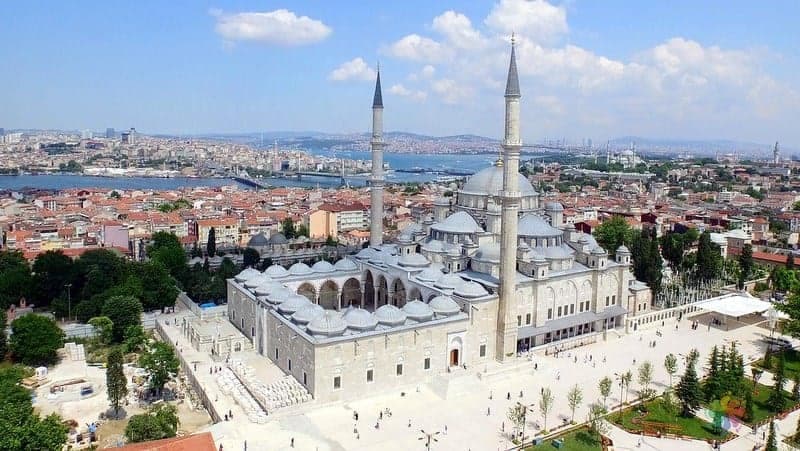
 Τζαμί Fatih στην Κωνσταντινούπολη
Το τζαμί του Μεχμέτ του Κατακτητή
FATIH MOSQUE’S HISTORY
Located on Fevzi Pasa Caddesi in the Fatih neighborhood of Istanbul, Turkey, the massive Fatih Mosque (Turkish: Fatih Camii, "Conqueror's Mosque" in English) is an Ottoman mosque. Between 1463 and 1470, the site that was formerly the Church of the Holy Apostles was converted into the first mosque in the area. After the devastating 1766 earthquake, it was completely rebuilt in 1771. When the Ottoman sultan Mehmed the Conqueror (Fatih Sultan Mehmed in Turkish) took Constantinople in 1453, he was honored with the naming of this district.
Once an integral part of the Fatih Mosque, the Sahn-i Seman Medrese was a major academic institution for the study of theology, law, medicine, astronomy, physics, and mathematics. Ali Qushji set it up. He was a Turkic astronomer whom Mehmed had asked to come to his court in Istanbul.
Το 2009 και πάλι το 2019, ολόκληρο το συγκρότημα του τζαμιού υποβλήθηκε σε εκτεταμένη αποκατάσταση και θα ανοίξει ξανά το 2021 για τους λατρευτές.
The architecture of the Fatih Mosque and Its Background
Between 1463 and 1470, at Fatih Sultan Mehmed's behest, construction began on a religious and social complex in Istanbul that would set new standards for size and complexity.
Αυτό το τζαμί αντικατέστησε μια βυζαντινή εκκλησία που είχε υποστεί αποδιοργάνωση από την Τέταρτη Σταυροφορία και κατεδαφίστηκε για να κάνει χώρο για αυτό.Πριν από την κατασκευή του τζαμιού, ο Ρωμαίος αυτοκράτορας Κωνσταντίνος θάφτηκε στην εκκλησία, με το σαρκοφάγο του να κάθεται στη μέση δώδεκα άλλων σαρκοφάγων που αντιπροσωπεύουν τους δώδεκα αποστόλους, στον συμβολικό τόπο του Χριστού.
In the Ottoman imperial architectural tradition, the Fatih Mosque was the first great building. It was designed and constructed by the Greek architect Atik Sinan.
Eight medreses, a library, a hospital (darüssifa), an inn for dervishes (taphane), a caravanserai, a market, a hamam, a primary school (mektep), a public kitchen (imaret), and a collection of 280 shops were all part of the original complex. Later, many crypts, known as türbes, were constructed. The original complex stretched along the Fevzi Pasa Caddesi side of the Golden Horn for about 325 meters (1,066 feet).
An earthquake in 1509 severely damaged the original mosque. After that, it was fixed, but earthquakes in 1557 and 1754 caused more damage, so it had to be fixed again. In an earthquake on May 22, 1766, the main dome collapsed and the walls were severely damaged, causing the mosque's destruction.
Ο Σουλτάνος Μουσταφά ΙΙΙ ζήτησε από τον αρχιτέκτονα Μεχμέτ Ταχίρ Αγκά να χτίσει το σημερινό τζαμί μεταξύ 1767 και 1771.
Fatih Mosque Architecture
Εξωτερικά
The original Fatih Mosque was built on four arches, with a central dome that was supported by a semi-dome of the same diameter on the qibla side. It had a dome that was 26 meters in diameter. After the devastating earthquake of 1766, a second Baroque mosque was constructed with a square layout. It's topped by one large dome and surrounded by four smaller ones. All that remains of the original design are the courtyard, the portal leading to the main entrance, and the base of the minarets.
Εσωτερικά
The interior features of the Fatih Mosque today are virtually identical to those featured in earlier iterations of the mosque, which Sinan and his successors used extensively throughout Istanbul (this technique is evocative of the Hagia Sophia). Four large marble columns hold up the central dome, which measures 26 meters in diameter.
The twin galleries in each of the two minarets make this structure unique. Though the mosque's interior and mimbar display Baroque influences, the mosque's white tiles lack the opulence of the Iznik tiles used in other mosques like the Rüstem Pasha Mosque.
The Fatih Mosque Complex
The Fatih Mosque, like many other imperial mosques in Istanbul, is part of a larger kulliye, or complex, that includes other buildings to meet the city's religious and cultural needs.
Το Σαχν-ι Σεμάν είναι οκτώ μεγάλα μαδράσα που βρίσκονται στο βόρειο και νότιο τμήμα του τζαμιού. Κάθε μία από αυτές τις συμμετρικές δομές φιλοξενεί 18 κύτταρα, αρκετό χώρο για τέσσερις φοιτητές και ένα δερσάιν. Η κατασκευή δρόμων κατέστρεψε τα περίχωρα πίσω από το μαδράσα. Περίπου χίλιοι φοιτητές θα μπορούσαν να φιλοξενηθούν από το μαδράσα, καθιστώντας το ένα σημαντικό πανεπιστήμιο για την εποχή του.
Έξω από τη νοτιοανατολική γωνία του χώρου του τζαμιού βρίσκεται ένα ντέρβις ξενώνα με μια όμορφη αυλή που κρατάται από 16 διαφορετικές στήλες από πράσινη αρχαιότητα και γρανίτη, πιθανότατα ανακτημένη από την Εκκλησία των Αγίων Αποστόλων.
The massive Baroque tomb of Sultan Mahmud II's mother, Naksidil Sultan, stands opposite the dervish inn (1761–1817).
Υπάρχουν οι τάφοι (τουρμπες) του Σουλτάνου Μεχμέτ Β και της συζύγου του Γκιουλμπαχάρ Χατούν στο νεκροταφείο δίπλα στο τζαμί. Μετά τον σεισμό, έγιναν επισκευές και στα δύο Το εσωτερικό του τουρμπου του Κατακτητή είναι εκλεπτυσμένο, καθιστώντας το δημοφιλές μέρος για επίσημες εκδηλώσεις.
After being given the Sword of Osman at the Eyüp Sultan Mosque, it was traditional for the new sultan to pay a visit to his tomb. Gulbahar's türbe has cleaner, more traditional lines than the original, and it may be remarkably similar to it. Many other notable state officials are buried there as well, such as field marshal Gazi Osman Pasha, whose tomb was designed by Kemaleddin Bey. In 2016, Halil Inalcik, a renowned Ottoman scholar and university professor, was laid to rest in this cemetery.
The mosque is joined to the 1724 dome-topped Carullah Efendi Library on one side. There are three doors: one that leads directly out onto the street, and two that lead into the mosque's inner courtyard. The books in the Suleymaniye Library are safe while the building is being repaired.
In the 1980s, the caravanserai was renovated and joined with adjacent stores to become a place of business. Many of the original building's features, like a hospital, market, kitchens, and hamam, have been taken down.
Frequently Asked Questions About the Fatih Mosque
Ερώτηση: What is the Fatih Mosque?
ΑΤο Τζαμί Fatih είναι ένα ιστορικό τζαμί που βρίσκεται στην Κωνσταντινούπολη, στην Τουρκία.
Ερώτηση: Where is the Fatih Mosque located?
ΑΤο Τζαμί Fatih βρίσκεται στη γειτονιά Fatih της Κωνσταντινούπολης, στην Τουρκία.
Ερώτηση: What is the history of the Fatih Mosque?
Α: The Fatih Mosque was built by the Ottoman Sultan Mehmed II in the 15th century, and it was named after him as the conqueror of Constantinople.
Ερώτηση: What is the significance of the Fatih Mosque?
Α: The Fatih Mosque is one of the largest and most important mosques in Istanbul, and it has played a central role in the history and religious life of the city for centuries.
Ερώτηση: What are the opening hours of the Fatih Mosque?
ΑΤο Τζαμί Fatih είναι ανοιχτό στους επισκέπτες κάθε μέρα από τις 9:00 π.μ. έως τις 17:00 μ.μ.
ΕρώτησηΠόσο κοστίζει η επίσκεψη στο Τζαμί Fatih;
ΑΔεν υπάρχει χρέωση εισόδου για να επισκεφθείτε το Τζαμί Fatih.
Ερώτηση: What is the dress code for the Fatih Mosque?
Α: Visitors to the Fatih Mosque are expected to dress modestly and cover their shoulders and knees.
ΕρώτησηΥπάρχει οδηγός διαθέσιμος στο Τζαμί Fatih;
ΑΝαι, υπάρχει ένας εθελοντής οδηγός που παρέχει πληροφορίες για το Τζαμί Fatih.
Ερώτηση: Ποια είναι η μεταφορά όπως στο Τζαμί Fatih;
ΑΤο Τζαμί Fatih είναι εύκολα προσβάσιμο με ταξί ή δημόσια συγκοινωνία.
ΕρώτησηΥπάρχουν περιορισμοί στη λήψη φωτογραφιών στο Τζαμί Fatih;
Α: Yes, taking photos inside the Fatih Mosque is restricted, but visitors are allowed to take photos in the courtyards and other areas outside of the building.
Μπορείτε να κάνετε κράτηση για μια περιοδεία στην πόλη της Κωνσταντινούπολης με τους άδειους ταξιδιωτικούς οδηγούς μας.
Map of Fatih Mosque