
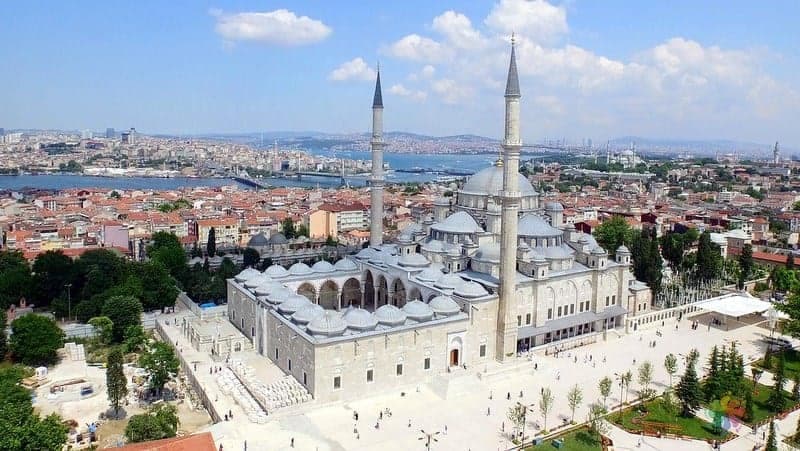
 fatih mosque Istanbul
メハメット征服者(Mehmet the Conqueror)
FATIH MOSQUE’S HISTORY
Located on Fevzi Pasa Caddesi in the Fatih neighborhood of Istanbul, Turkey, the massive Fatih Mosque (Turkish: Fatih Camii, "Conqueror's Mosque" in English) is an Ottoman mosque. Between 1463 and 1470, the site that was formerly the Church of the Holy Apostles was converted into the first mosque in the area. After the devastating 1766 earthquake, it was completely rebuilt in 1771. When the Ottoman sultan Mehmed the Conqueror (Fatih Sultan Mehmed in Turkish) took Constantinople in 1453, he was honored with the naming of this district.
Once an integral part of the Fatih Mosque, the Sahn-i Seman Medrese was a major academic institution for the study of theology, law, medicine, astronomy, physics, and mathematics. Ali Qushji set it up. He was a Turkic astronomer whom Mehmed had asked to come to his court in Istanbul.
2009年、2019年にも再び、モスク全体が大規模な復元に直面し、2021年に礼拝者に再開する予定です。
The architecture of the Fatih Mosque and Its Background
Between 1463 and 1470, at Fatih Sultan Mehmed's behest, construction began on a religious and social complex in Istanbul that would set new standards for size and complexity.
このモスクは、第4十字軍以来、修復されていたビザンチン教会を置き換え、モスクの建設の前に、ローマ皇帝コンスタンティヌスは、その教会に埋葬され、彼のサルコファーは、キリストの象徴的な場所で、12の他のサルコファーグの真ん中に座っていた。
In the Ottoman imperial architectural tradition, the Fatih Mosque was the first great building. It was designed and constructed by the Greek architect Atik Sinan.
Eight medreses, a library, a hospital (darüssifa), an inn for dervishes (taphane), a caravanserai, a market, a hamam, a primary school (mektep), a public kitchen (imaret), and a collection of 280 shops were all part of the original complex. Later, many crypts, known as türbes, were constructed. The original complex stretched along the Fevzi Pasa Caddesi side of the Golden Horn for about 325 meters (1,066 feet).
An earthquake in 1509 severely damaged the original mosque. After that, it was fixed, but earthquakes in 1557 and 1754 caused more damage, so it had to be fixed again. In an earthquake on May 22, 1766, the main dome collapsed and the walls were severely damaged, causing the mosque's destruction.
スルタファ3世は建築家メフメフテ・タヒール・アガに1767年から1771年まで現在のモスクを建設するよう依頼した。
Fatih Mosque Architecture
外部
The original Fatih Mosque was built on four arches, with a central dome that was supported by a semi-dome of the same diameter on the qibla side. It had a dome that was 26 meters in diameter. After the devastating earthquake of 1766, a second Baroque mosque was constructed with a square layout. It's topped by one large dome and surrounded by four smaller ones. All that remains of the original design are the courtyard, the portal leading to the main entrance, and the base of the minarets.
内面
The interior features of the Fatih Mosque today are virtually identical to those featured in earlier iterations of the mosque, which Sinan and his successors used extensively throughout Istanbul (this technique is evocative of the Hagia Sophia). Four large marble columns hold up the central dome, which measures 26 meters in diameter.
The twin galleries in each of the two minarets make this structure unique. Though the mosque's interior and mimbar display Baroque influences, the mosque's white tiles lack the opulence of the Iznik tiles used in other mosques like the Rüstem Pasha Mosque.
Fatihモスクコンプレックス
The Fatih Mosque, like many other imperial mosques in Istanbul, is part of a larger kulliye, or complex, that includes other buildings to meet the city's religious and cultural needs.
サン・イ・セマンは、モスクの北と南に位置する8つの大きなマドラサです。これらのシンメトリックな構造のそれぞれは、18個のセル、4人の学生のための十分なスペース、およびデセハンです。道路建設はマドラサの背後に外部ビルを破壊しました。 マドラサは約1000人の学生を収容することができ、それはその時代のための大きな大学です。
モスクの敷地の南東の隅に、16の異なる緑色の古代とグラニットの柱が抱えている美しい庭のデルビッシュホステルがあり、おそらく聖使徒教会から回収されています。
The massive Baroque tomb of Sultan Mahmud II's mother, Naksidil Sultan, stands opposite the dervish inn (1761–1817).
モスクに隣接する墓地に、スルタン・メハメド2世と妻のグルバハール・ハトン(Gulbahar Hatun)の墓地(türbes)があります。地震の後、両方に修理が行われました。
After being given the Sword of Osman at the Eyüp Sultan Mosque, it was traditional for the new sultan to pay a visit to his tomb. Gulbahar's türbe has cleaner, more traditional lines than the original, and it may be remarkably similar to it. Many other notable state officials are buried there as well, such as field marshal Gazi Osman Pasha, whose tomb was designed by Kemaleddin Bey. In 2016, Halil Inalcik, a renowned Ottoman scholar and university professor, was laid to rest in this cemetery.
The mosque is joined to the 1724 dome-topped Carullah Efendi Library on one side. There are three doors: one that leads directly out onto the street, and two that lead into the mosque's inner courtyard. The books in the Suleymaniye Library are safe while the building is being repaired.
In the 1980s, the caravanserai was renovated and joined with adjacent stores to become a place of business. Many of the original building's features, like a hospital, market, kitchens, and hamam, have been taken down.
Fatihモスクについてよくある質問
Q: What is the Fatih Mosque?
A は: The Fatih Mosque is a historic mosque located in Istanbul, Turkey.
Q: Where is the Fatih Mosque located?
A は: The Fatih Mosque is located in the Fatih neighborhood of Istanbul, Turkey.
Q: What is the history of the Fatih Mosque?
A は: The Fatih Mosque was built by the Ottoman Sultan Mehmed II in the 15th century, and it was named after him as the conqueror of Constantinople.
Q: What is the significance of the Fatih Mosque?
A は: The Fatih Mosque is one of the largest and most important mosques in Istanbul, and it has played a central role in the history and religious life of the city for centuries.
Q: What are the opening hours of the Fatih Mosque?
A は: The Fatih Mosque is open to visitors every day from 9:00 a.m. to 5:00 p.m.
Q: How much does it cost to visit the Fatih Mosque?
A は: There is no admission fee to visit the Fatih Mosque.
Q: What is the dress code for the Fatih Mosque?
A は: Visitors to the Fatih Mosque are expected to dress modestly and cover their shoulders and knees.
Q: Is there a guide available at the Fatih Mosque?
A は: はい、Fatihモスクに関する情報を提供するためのボランティアガイドが利用可能です。
Q: What is the transportation like to the Fatih Mosque?
A は: The Fatih Mosque is easily accessible by taxi or public transportation.
Q: Are there any restrictions on taking photos at the Fatih Mosque?
A は: Yes, taking photos inside the Fatih Mosque is restricted, but visitors are allowed to take photos in the courtyards and other areas outside of the building.
イスタンブールの市内ツアーをライセンス付きのツアーガイドと一緒に予約できます。
Map of Fatih Mosque