
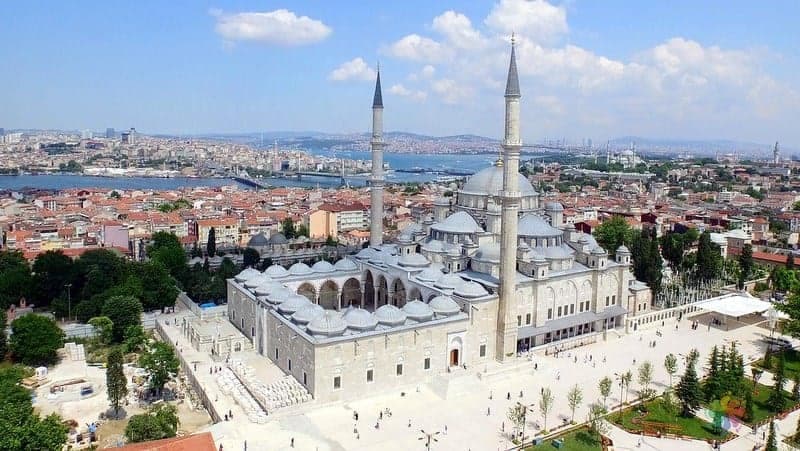
 fatih mosque Istanbul
Moskéen av Mehmet erövraren
FATIH MOSQUE’S HISTORY
Located on Fevzi Pasa Caddesi in the Fatih neighborhood of Istanbul, Turkey, the massive Fatih Mosque (Turkish: Fatih Camii, "Conqueror's Mosque" in English) is an Ottoman mosque. Between 1463 and 1470, the site that was formerly the Church of the Holy Apostles was converted into the first mosque in the area. After the devastating 1766 earthquake, it was completely rebuilt in 1771. When the Ottoman sultan Mehmed the Conqueror (Fatih Sultan Mehmed in Turkish) took Constantinople in 1453, he was honored with the naming of this district.
Once an integral part of the Fatih Mosque, the Sahn-i Seman Medrese was a major academic institution for the study of theology, law, medicine, astronomy, physics, and mathematics. Ali Qushji set it up. He was a Turkic astronomer whom Mehmed had asked to come to his court in Istanbul.
Under 2009 och igen 2019 genomgick hela moskékomplexet omfattande restaurering.
The architecture of the Fatih Mosque and Its Background
Between 1463 and 1470, at Fatih Sultan Mehmed's behest, construction began on a religious and social complex in Istanbul that would set new standards for size and complexity.
Denna moské ersatte en bysantinsk kyrka som hade varit i underbyggnad sedan det fjärde korståget och rivits ner för att göra plats för den.För byggandet av moskén begravdes den romerske kejsaren Konstantin i kyrkan, med hans sarkofag sitter mitt i tolv andra sarkofager som representerar de tolv apostlarna, på den symboliska platsen för Kristus.
In the Ottoman imperial architectural tradition, the Fatih Mosque was the first great building. It was designed and constructed by the Greek architect Atik Sinan.
Åtta medreses, ett bibliotek, ett sjukhus (darüssifa), ett vandrarhem för dervishes (taphane), en caravanserai, en marknad, en hamam, en grundskola (mektep), ett offentligt kök (imaret), och en samling av 280 butiker var alla en del av det ursprungliga komplexet. Senare byggdes många krypter, kända som türbes. Det ursprungliga komplexet sträckte sig längs Fevzi Pasa Caddesi sida av Gyllene hornet för cirka 325 meter (1,066 fot).
An earthquake in 1509 severely damaged the original mosque. After that, it was fixed, but earthquakes in 1557 and 1754 caused more damage, so it had to be fixed again. In an earthquake on May 22, 1766, the main dome collapsed and the walls were severely damaged, causing the mosque's destruction.
Sultan Mustafa III bad arkitekten Mehmet Tahir Aga att bygga den nuvarande moskén mellan 1767 och 1771.
Fatih Mosque Architecture
Exteriör
The original Fatih Mosque was built on four arches, with a central dome that was supported by a semi-dome of the same diameter on the qibla side. It had a dome that was 26 meters in diameter. After the devastating earthquake of 1766, a second Baroque mosque was constructed with a square layout. It's topped by one large dome and surrounded by four smaller ones. All that remains of the original design are the courtyard, the portal leading to the main entrance, and the base of the minarets.
Inre
The interior features of the Fatih Mosque today are virtually identical to those featured in earlier iterations of the mosque, which Sinan and his successors used extensively throughout Istanbul (this technique is evocative of the Hagia Sophia). Four large marble columns hold up the central dome, which measures 26 meters in diameter.
The twin galleries in each of the two minarets make this structure unique. Though the mosque's interior and mimbar display Baroque influences, the mosque's white tiles lack the opulence of the Iznik tiles used in other mosques like the Rüstem Pasha Mosque.
The Fatih Mosque Complex
The Fatih Mosque, like many other imperial mosques in Istanbul, is part of a larger kulliye, or complex, that includes other buildings to meet the city's religious and cultural needs.
Sahn-i Seman är åtta stora madrasser belägna norr och söder om moskén. Var och en av dessa symmetriska strukturer rymmer 18 celler, tillräckligt med utrymme för fyra studenter och en dershane. Vägkonstruktion förstörde utbyggnaderna bakom madrassen. Ungefär tusen studenter kunde rymmas av madrassen, vilket gjorde det till ett betydande universitet för sin tid.
Utanför sydöstra hörnet av moskén är en dervisch vandrarhem med en vacker innergård hålls upp av 16 olika kolumner av grönsaker och granit, troligen återvunna från kyrkan av de heliga apostlarna.
The massive Baroque tomb of Sultan Mahmud II's mother, Naksidil Sultan, stands opposite the dervish inn (1761–1817).
Det finns gravar (turbar) av Sultan Mehmed II och hans fru Gülbahar Hatun på kyrkogården intill moskén. Efter jordbävningen gjordes reparationer till båda Interiören i Turban av erövraren är utförligt dekorerad, vilket gör den till en populär plats för formella evenemang.
After being given the Sword of Osman at the Eyüp Sultan Mosque, it was traditional for the new sultan to pay a visit to his tomb. Gulbahar's türbe has cleaner, more traditional lines than the original, and it may be remarkably similar to it. Many other notable state officials are buried there as well, such as field marshal Gazi Osman Pasha, whose tomb was designed by Kemaleddin Bey. In 2016, Halil Inalcik, a renowned Ottoman scholar and university professor, was laid to rest in this cemetery.
The mosque is joined to the 1724 dome-topped Carullah Efendi Library on one side. There are three doors: one that leads directly out onto the street, and two that lead into the mosque's inner courtyard. The books in the Suleymaniye Library are safe while the building is being repaired.
In the 1980s, the caravanserai was renovated and joined with adjacent stores to become a place of business. Many of the original building's features, like a hospital, market, kitchens, and hamam, have been taken down.
Frequently Asked Questions About the Fatih Mosque
Q är: What is the Fatih Mosque?
a är: The Fatih Mosque is a historic mosque located in Istanbul, Turkey.
Q är: Where is the Fatih Mosque located?
a är: The Fatih Mosque is located in the Fatih neighborhood of Istanbul, Turkey.
Q är: What is the history of the Fatih Mosque?
a är: The Fatih Mosque was built by the Ottoman Sultan Mehmed II in the 15th century, and it was named after him as the conqueror of Constantinople.
Q är: What is the significance of the Fatih Mosque?
a är: The Fatih Mosque is one of the largest and most important mosques in Istanbul, and it has played a central role in the history and religious life of the city for centuries.
Q är: What are the opening hours of the Fatih Mosque?
a är: The Fatih Mosque is open to visitors every day from 9:00 a.m. to 5:00 p.m.
Q är: How much does it cost to visit the Fatih Mosque?
a är: There is no admission fee to visit the Fatih Mosque.
Q är: What is the dress code for the Fatih Mosque?
a är: Visitors to the Fatih Mosque are expected to dress modestly and cover their shoulders and knees.
Q är: Is there a guide available at the Fatih Mosque?
a är: Yes, there is a volunteer guide available to provide information about the Fatih Mosque.
Q är: What is the transportation like to the Fatih Mosque?
a är: The Fatih Mosque is easily accessible by taxi or public transportation.
Q är: Are there any restrictions on taking photos at the Fatih Mosque?
a är: Yes, taking photos inside the Fatih Mosque is restricted, but visitors are allowed to take photos in the courtyards and other areas outside of the building.
Du kan boka en Istanbul stadsrundtur med våra licensierade guider. Länkarna är nedan:
Map of Fatih Mosque