
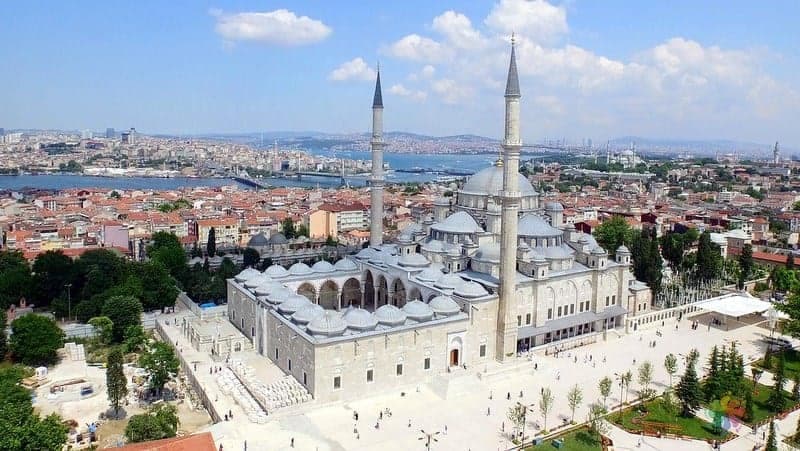
 fatih mosque Istanbul
메흐메트 정복자의 모스크
Fatih 모스크의 역사
Located on Fevzi Pasa Caddesi in the Fatih neighborhood of Istanbul, Turkey, the massive Fatih Mosque (Turkish: Fatih Camii, "Conqueror's Mosque" in English) is an Ottoman mosque. Between 1463 and 1470, the site that was formerly the Church of the Holy Apostles was converted into the first mosque in the area. After the devastating 1766 earthquake, it was completely rebuilt in 1771. When the Ottoman sultan Mehmed the Conqueror (Fatih Sultan Mehmed in Turkish) took Constantinople in 1453, he was honored with the naming of this district.
Fatih 모스크의 필수적인 부분이었던 Sahn-i Seman Medrese는 신학, 법률, 의학, 천문학, 물리학 및 수학을 연구하는 주요 학술 기관이었습니다.Ali Qushji는 이스탄불의 법정에 와달라고 Mehmed가 요청한 터키 천문학자였습니다.
2009년과 2019년에는 전체 모스크 복합체가 광범위한 복원을 거쳤으며, 2021년에는 예배자들에게 다시 개장할 예정이다.
The architecture of the Fatih Mosque and Its Background
Between 1463 and 1470, at Fatih Sultan Mehmed's behest, construction began on a religious and social complex in Istanbul that would set new standards for size and complexity.
이 모스크는 4 차 십자군 전쟁 이후에 썩어 있었던 비잔틴 교회를 대체했고, 그곳에 공간을 마련하기 위해 찢어졌습니다.이 모스크를 건설하기 전에 로마 황제 콘스탄틴은 그 교회에 묻혔고, 그의 사막은 12명의 사도들을 대표하는 12개의 다른 사막들 사이에 앉아있었습니다.
In the Ottoman imperial architectural tradition, the Fatih Mosque was the first great building. It was designed and constructed by the Greek architect Atik Sinan.
Eight medreses, a library, a hospital (darüssifa), an inn for dervishes (taphane), a caravanserai, a market, a hamam, a primary school (mektep), a public kitchen (imaret), and a collection of 280 shops were all part of the original complex. Later, many crypts, known as türbes, were constructed. The original complex stretched along the Fevzi Pasa Caddesi side of the Golden Horn for about 325 meters (1,066 feet).
An earthquake in 1509 severely damaged the original mosque. After that, it was fixed, but earthquakes in 1557 and 1754 caused more damage, so it had to be fixed again. In an earthquake on May 22, 1766, the main dome collapsed and the walls were severely damaged, causing the mosque's destruction.
Sultan Mustafa III는 건축가 Mehmet Tahir Aga에게 1767년과 1771년 사이에 현재의 모스크를 건설하라고 요청했습니다.
Fatih Mosque Architecture
외부
The original Fatih Mosque was built on four arches, with a central dome that was supported by a semi-dome of the same diameter on the qibla side. It had a dome that was 26 meters in diameter. After the devastating earthquake of 1766, a second Baroque mosque was constructed with a square layout. It's topped by one large dome and surrounded by four smaller ones. All that remains of the original design are the courtyard, the portal leading to the main entrance, and the base of the minarets.
내부
The interior features of the Fatih Mosque today are virtually identical to those featured in earlier iterations of the mosque, which Sinan and his successors used extensively throughout Istanbul (this technique is evocative of the Hagia Sophia). Four large marble columns hold up the central dome, which measures 26 meters in diameter.
The twin galleries in each of the two minarets make this structure unique. Though the mosque's interior and mimbar display Baroque influences, the mosque's white tiles lack the opulence of the Iznik tiles used in other mosques like the Rüstem Pasha Mosque.
The Fatih Mosque Complex
The Fatih Mosque, like many other imperial mosques in Istanbul, is part of a larger kulliye, or complex, that includes other buildings to meet the city's religious and cultural needs.
Sahn-i Seman은 모스크의 북쪽과 남쪽에 위치한 8 개의 큰 매드라사입니다.이 대칭 구조물 각각 18 개의 셀, 4 명의 학생을위한 충분한 공간, 그리고 dershane를 수용합니다. 도로 건설은 매드라사 뒤의 외부 건물을 파괴했습니다.
모스크 토지의 남동쪽 구석 밖에는 16 개의 다른 녹색 고대와 그라이트 기둥이 펼쳐진 아름다운 정원과 함께있는 다비시 호스텔이 있으며, 가장 가능성이 성 사도 교회에서 회수되었습니다.
The massive Baroque tomb of Sultan Mahmud II's mother, Naksidil Sultan, stands opposite the dervish inn (1761–1817).
묘지에 옆에있는 Sultan Mehmed II와 그의 아내 Gülbahar Hatun의 무덤 (탑)이 있습니다. 지진 후, 두 개의 수리 작업이 이루어졌습니다 정복자의 탑의 내부는 정교한 장소로 구성되어 공식 행사에 대한 인기있는 장소입니다.
After being given the Sword of Osman at the Eyüp Sultan Mosque, it was traditional for the new sultan to pay a visit to his tomb. Gulbahar's türbe has cleaner, more traditional lines than the original, and it may be remarkably similar to it. Many other notable state officials are buried there as well, such as field marshal Gazi Osman Pasha, whose tomb was designed by Kemaleddin Bey. In 2016, Halil Inalcik, a renowned Ottoman scholar and university professor, was laid to rest in this cemetery.
The mosque is joined to the 1724 dome-topped Carullah Efendi Library on one side. There are three doors: one that leads directly out onto the street, and two that lead into the mosque's inner courtyard. The books in the Suleymaniye Library are safe while the building is being repaired.
In the 1980s, the caravanserai was renovated and joined with adjacent stores to become a place of business. Many of the original building's features, like a hospital, market, kitchens, and hamam, have been taken down.
Frequently Asked Questions About the Fatih Mosque
Q: What is the Fatih Mosque?
A: The Fatih Mosque is a historic mosque located in Istanbul, Turkey.
Q: Where is the Fatih Mosque located?
A: The Fatih Mosque is located in the Fatih neighborhood of Istanbul, Turkey.
Q: Fatih 모스크의 역사는 무엇입니까?
AFatih 모스크는 15 세기에 오스만 Sultan Mehmed II에 의해 지어졌으며, 콘스탄티노폴리스의 정복자로 그의 이름을 따서 명명되었습니다.
Q: What is the significance of the Fatih Mosque?
AFatih 모스크는 이스탄불에서 가장 크고 가장 중요한 모스크 중 하나이며 수세기 동안 도시의 역사와 종교 생활에서 중앙 역할을 해 왔습니다.
Q: Fatih 모스크의 개방 시간은 무엇입니까?
A: Fatih 모스크는 매일 오전 9시부터 오후 5시까지 방문객에게 열려 있습니다.
Q: Fatih 모스크를 방문하는 데 비용이 얼마나 들까요?
A: Fatih 모스크를 방문하는 입장료가 없습니다.
Q: Fatih 모스크의 드레스 코드는 무엇입니까?
AFatih 모스크 방문자는 겸손하게 옷을 입고 어깨와 무릎을 덮는 것으로 예상됩니다.
Q: Fatih 모스크에 가이드가 있습니까?
A: 예, Fatih 모스크에 대한 정보를 제공하는 자원봉사자 가이드가 있습니다.
Q: What is the transportation like to the Fatih Mosque?
A: Fatih 모스크는 택시 또는 대중 교통으로 쉽게 접근 할 수 있습니다.
Q: Fatih 모스크에서 사진을 찍는 것에 제한이 있습니까?
A: Yes, taking photos inside the Fatih Mosque is restricted, but visitors are allowed to take photos in the courtyards and other areas outside of the building.
당신은 우리의 라이센스 투어 가이드와 함께 이스탄불 도시 투어를 예약할 수 있습니다.
Map of Fatih Mosque