
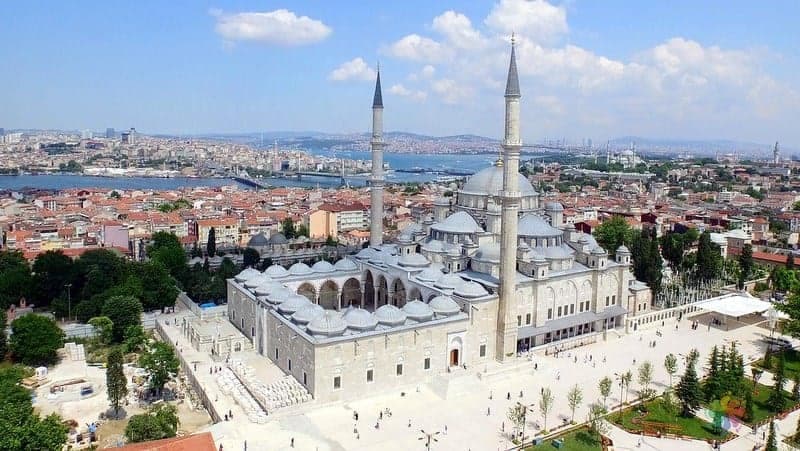
 fatih mosque Istanbul
Mehmet Şövalye’nin mezarlığı
FATIH MOSQUE’S HISTORY
Located on Fevzi Pasa Caddesi in the Fatih neighborhood of Istanbul, Turkey, the massive Fatih Mosque (Turkish: Fatih Camii, "Conqueror's Mosque" in English) is an Ottoman mosque. Between 1463 and 1470, the site that was formerly the Church of the Holy Apostles was converted into the first mosque in the area. After the devastating 1766 earthquake, it was completely rebuilt in 1771. When the Ottoman sultan Mehmed the Conqueror (Fatih Sultan Mehmed in Turkish) took Constantinople in 1453, he was honored with the naming of this district.
Fatih Camii’nin ayrılmaz bir parçası olan Sahn-i Seman Medrese, teoloji, hukuk, tıp, astronomi, fizik ve matematik çalışmaları için önemli bir akademik kurumdu. Ali Qushji, İstanbul’da mahkemesine gelmesini istediği bir Türk astronom idi.
2009 yılında ve 2019 yılında da bütün cemaat kompleksinin geniş bir restorasyon geçirdiği ve 2021 yılında tapınaklara yeniden açılacağı belirtildi.
Fatih Camii'nin mimarisi ve arka planı
Between 1463 and 1470, at Fatih Sultan Mehmed's behest, construction began on a religious and social complex in Istanbul that would set new standards for size and complexity.
Bu caminin yerine, Dördüncü Haçlı Seferinden bu yana arızalanmış olan bir Bizans kilisesini yerleştirdi ve yerini bulmak için yıkıldı.
Osmanlı İmparatorluğu mimari geleneğinde Fatih Camii, Yunan mimar Atik Sinan tarafından tasarlanmış ve inşa edilmiş ilk büyük binadır.
Eight medreses, a library, a hospital (darüssifa), an inn for dervishes (taphane), a caravanserai, a market, a hamam, a primary school (mektep), a public kitchen (imaret), and a collection of 280 shops were all part of the original complex. Later, many crypts, known as türbes, were constructed. The original complex stretched along the Fevzi Pasa Caddesi side of the Golden Horn for about 325 meters (1,066 feet).
An earthquake in 1509 severely damaged the original mosque. After that, it was fixed, but earthquakes in 1557 and 1754 caused more damage, so it had to be fixed again. In an earthquake on May 22, 1766, the main dome collapsed and the walls were severely damaged, causing the mosque's destruction.
Sultan Mustafa III, mimar Mehmet Tahir Aga’ya 1767 ve 1771 yılları arasında mevcut camiyi inşa etmesini istedi.
Fatih Camii Arşivi
Dışarıda
The original Fatih Mosque was built on four arches, with a central dome that was supported by a semi-dome of the same diameter on the qibla side. It had a dome that was 26 meters in diameter. After the devastating earthquake of 1766, a second Baroque mosque was constructed with a square layout. It's topped by one large dome and surrounded by four smaller ones. All that remains of the original design are the courtyard, the portal leading to the main entrance, and the base of the minarets.
içeriği
The interior features of the Fatih Mosque today are virtually identical to those featured in earlier iterations of the mosque, which Sinan and his successors used extensively throughout Istanbul (this technique is evocative of the Hagia Sophia). Four large marble columns hold up the central dome, which measures 26 meters in diameter.
The twin galleries in each of the two minarets make this structure unique. Though the mosque's interior and mimbar display Baroque influences, the mosque's white tiles lack the opulence of the Iznik tiles used in other mosques like the Rüstem Pasha Mosque.
Fatih Camii Kompleksi
The Fatih Mosque, like many other imperial mosques in Istanbul, is part of a larger kulliye, or complex, that includes other buildings to meet the city's religious and cultural needs.
Sahn-i Seman, mezarlığın kuzey ve güneyinde bulunan sekiz büyük madrasadır. Bu simetrik yapıların her biri 18 hücreye ev sahipliği yapar, dört öğrenciye ve bir dershan için yeterli alan. Yol inşaatı madrasanın arkasındaki dış binaları yok etti. Madrasah yaklaşık bin öğrenciye ev sahipliği yapabilir, bu da zamanında büyük bir üniversite haline getirir.
Mezarın güney doğu köşesinde, 16 farklı yeşil antik ve granit sütunları tarafından tutulan güzel bir bahçe ile bir derviş pansiyonu vardır, muhtemelen Kutsal Apostollar Kilisesi'nden geri alınmıştır.
The massive Baroque tomb of Sultan Mahmud II's mother, Naksidil Sultan, stands opposite the dervish inn (1761–1817).
Sultan Mehmed II ve karısı Gülbahar Hatun'un mezarlıkta mezarlıkları (turbasları) bulunmaktadır. depremden sonra, her ikisine de onarımlar yapıldı.
After being given the Sword of Osman at the Eyüp Sultan Mosque, it was traditional for the new sultan to pay a visit to his tomb. Gulbahar's türbe has cleaner, more traditional lines than the original, and it may be remarkably similar to it. Many other notable state officials are buried there as well, such as field marshal Gazi Osman Pasha, whose tomb was designed by Kemaleddin Bey. In 2016, Halil Inalcik, a renowned Ottoman scholar and university professor, was laid to rest in this cemetery.
The mosque is joined to the 1724 dome-topped Carullah Efendi Library on one side. There are three doors: one that leads directly out onto the street, and two that lead into the mosque's inner courtyard. The books in the Suleymaniye Library are safe while the building is being repaired.
In the 1980s, the caravanserai was renovated and joined with adjacent stores to become a place of business. Many of the original building's features, like a hospital, market, kitchens, and hamam, have been taken down.
Fatih Camii Hakkında Sıkça Sorulan Sorular
Q ile: What is the Fatih Mosque?
A AFatih Camii, Türkiye’nin İstanbul kentinde bulunan tarihi bir cemaattir.
Q ile: Where is the Fatih Mosque located?
A A: The Fatih Mosque is located in the Fatih neighborhood of Istanbul, Turkey.
Q ileFatih Camii’nin tarihi nedir?
A AFatih Camii, 15. yüzyılda Osmanlı Sultan Mehmed II tarafından inşa edilmiş ve onun adıyla, Konstantinopolis'in fethici olarak adlandırılmıştır.
Q ileFatih Camii’nin önemi nedir?
A A: The Fatih Mosque is one of the largest and most important mosques in Istanbul, and it has played a central role in the history and religious life of the city for centuries.
Q ileFatih Camii’nin açılış saatleri nedir?
A A: The Fatih Mosque is open to visitors every day from 9:00 a.m. to 5:00 p.m.
Q ileFatih Camii’ni ziyaret etmek ne kadar pahalı?
A AFatih Camii’ni ziyaret etmek için giriş ücreti yoktur.
Q ileFatih Camii için giyim kodu nedir?
A AFatih Camii’ne gelen ziyaretçiler mütevazı giyinmek ve omuzlarını ve dizlerini kaplamak için bekleniyor.
Q ileFatih Camii’nde bir rehber var mı?
A AEvet, Fatih Camii hakkında bilgi vermek için gönüllü bir rehber mevcuttur.
Q ileFatih Camii’ne ulaşım nasıl?
A AFatih Camii, taksi veya toplu taşıma aracılığıyla kolayca ulaşılabilir.
Q ileFatih Camii’nde fotoğraf çekmek için herhangi bir kısıtlama var mı?
A AEvet, Fatih Camii’nin içindeki fotoğraf çekimi sınırlıdır, ancak ziyaretçilerin bahçelerde ve binanın dışında başka alanlarda fotoğraf çekmelerine izin verilir.
İstanbul şehrinde gezilecek yerleri lisanslı rehberimizle rezervasyon yapabilirsiniz.Aşağıdaki bağlantılar:
Fatih Camii Haritası