
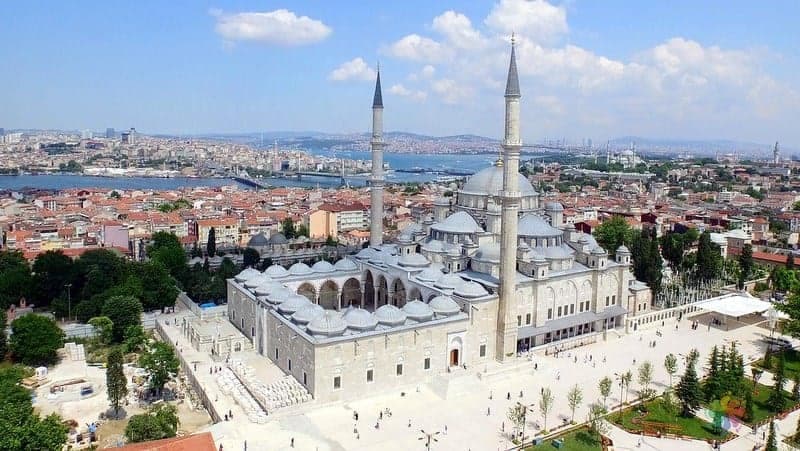
 fatih mosque Istanbul
La mezquita de Mahoma el Conquistador
FATIH MOSQUE’S HISTORY
Located on Fevzi Pasa Caddesi in the Fatih neighborhood of Istanbul, Turkey, the massive Fatih Mosque (Turkish: Fatih Camii, "Conqueror's Mosque" in English) is an Ottoman mosque. Between 1463 and 1470, the site that was formerly the Church of the Holy Apostles was converted into the first mosque in the area. After the devastating 1766 earthquake, it was completely rebuilt in 1771. When the Ottoman sultan Mehmed the Conqueror (Fatih Sultan Mehmed in Turkish) took Constantinople in 1453, he was honored with the naming of this district.
Once an integral part of the Fatih Mosque, the Sahn-i Seman Medrese was a major academic institution for the study of theology, law, medicine, astronomy, physics, and mathematics. Ali Qushji set it up. He was a Turkic astronomer whom Mehmed had asked to come to his court in Istanbul.
En 2009 y nuevamente en 2019, todo el complejo de mezquita se ha sometido a una amplia restauración. Se reabrirá en 2021 para los adoradores.
The architecture of the Fatih Mosque and Its Background
Between 1463 and 1470, at Fatih Sultan Mehmed's behest, construction began on a religious and social complex in Istanbul that would set new standards for size and complexity.
Esta mezquita reemplazó a una iglesia bizantina que había estado en descomposición desde la Cuarta Cruzada y fue demolida para hacer lugar a ella.Antes de la construcción de la mezquita, el emperador romano Constantino fue enterrado en la iglesia, con su sarcófago sentado en medio de otros doce sarcófagos que representan a los doce apóstoles, en el lugar simbólico de Cristo.
In the Ottoman imperial architectural tradition, the Fatih Mosque was the first great building. It was designed and constructed by the Greek architect Atik Sinan.
Ocho medreses, una biblioteca, un hospital (darüssifa), una casa de alojamiento para dervishes (taphane), un caravanserai, un mercado, un hamam, una escuela primaria (mektep), una cocina pública (imaret), y una colección de 280 tiendas fueron todos parte del complejo original. Más tarde, se construyeron muchas cripta, conocidas como turbes. El complejo original se extendió a lo largo del lado de Fevzi Pasa Caddesi del Cuerno de Oro por unos 325 metros (1,066 pies).
An earthquake in 1509 severely damaged the original mosque. After that, it was fixed, but earthquakes in 1557 and 1754 caused more damage, so it had to be fixed again. In an earthquake on May 22, 1766, the main dome collapsed and the walls were severely damaged, causing the mosque's destruction.
El sultán Mustafa III pidió al arquitecto Mehmet Tahir Aga que construyera la mezquita actual entre 1767 y 1771.
Fatih Mosque Architecture
Exterior
The original Fatih Mosque was built on four arches, with a central dome that was supported by a semi-dome of the same diameter on the qibla side. It had a dome that was 26 meters in diameter. After the devastating earthquake of 1766, a second Baroque mosque was constructed with a square layout. It's topped by one large dome and surrounded by four smaller ones. All that remains of the original design are the courtyard, the portal leading to the main entrance, and the base of the minarets.
Interior
The interior features of the Fatih Mosque today are virtually identical to those featured in earlier iterations of the mosque, which Sinan and his successors used extensively throughout Istanbul (this technique is evocative of the Hagia Sophia). Four large marble columns hold up the central dome, which measures 26 meters in diameter.
The twin galleries in each of the two minarets make this structure unique. Though the mosque's interior and mimbar display Baroque influences, the mosque's white tiles lack the opulence of the Iznik tiles used in other mosques like the Rüstem Pasha Mosque.
The Fatih Mosque Complex
The Fatih Mosque, like many other imperial mosques in Istanbul, is part of a larger kulliye, or complex, that includes other buildings to meet the city's religious and cultural needs.
El Sahn-i Seman son ocho grandes madrasas situadas al norte y al sur de la mezquita. Cada una de estas estructuras simétricas alberga 18 células, espacio suficiente para cuatro estudiantes, y un dershane. La construcción de carreteras destruyó los edificios traseros detrás de la madrasah. Aproximadamente un millar de estudiantes podrían ser alojados por la madrasah, haciendo de ella una universidad considerable para su tiempo.
Fuera del rincón sureste de los terrenos de la mezquita se encuentra una albergue de dervis con un hermoso patio sostenido por 16 columnas diferentes de antigüedad verde y granito, probablemente recuperadas de la Iglesia de los Santos Apóstoles.
The massive Baroque tomb of Sultan Mahmud II's mother, Naksidil Sultan, stands opposite the dervish inn (1761–1817).
Hay las tumbas (turbas) del sultán Mehmed II y su esposa Gülbahar Hatun en el cementerio adyacente a la mezquita.Después del terremoto, se hicieron reparaciones a ambos El interior de la turba del Conquistador está elaboradamente decorado, convirtiéndolo en un lugar popular para eventos formales.
After being given the Sword of Osman at the Eyüp Sultan Mosque, it was traditional for the new sultan to pay a visit to his tomb. Gulbahar's türbe has cleaner, more traditional lines than the original, and it may be remarkably similar to it. Many other notable state officials are buried there as well, such as field marshal Gazi Osman Pasha, whose tomb was designed by Kemaleddin Bey. In 2016, Halil Inalcik, a renowned Ottoman scholar and university professor, was laid to rest in this cemetery.
The mosque is joined to the 1724 dome-topped Carullah Efendi Library on one side. There are three doors: one that leads directly out onto the street, and two that lead into the mosque's inner courtyard. The books in the Suleymaniye Library are safe while the building is being repaired.
In the 1980s, the caravanserai was renovated and joined with adjacent stores to become a place of business. Many of the original building's features, like a hospital, market, kitchens, and hamam, have been taken down.
Frequently Asked Questions About the Fatih Mosque
q: What is the Fatih Mosque?
a: The Fatih Mosque is a historic mosque located in Istanbul, Turkey.
q: Where is the Fatih Mosque located?
a: The Fatih Mosque is located in the Fatih neighborhood of Istanbul, Turkey.
q: What is the history of the Fatih Mosque?
a: The Fatih Mosque was built by the Ottoman Sultan Mehmed II in the 15th century, and it was named after him as the conqueror of Constantinople.
q: What is the significance of the Fatih Mosque?
a: The Fatih Mosque is one of the largest and most important mosques in Istanbul, and it has played a central role in the history and religious life of the city for centuries.
q: What are the opening hours of the Fatih Mosque?
a: The Fatih Mosque is open to visitors every day from 9:00 a.m. to 5:00 p.m.
q: How much does it cost to visit the Fatih Mosque?
a: There is no admission fee to visit the Fatih Mosque.
q: What is the dress code for the Fatih Mosque?
a: Visitors to the Fatih Mosque are expected to dress modestly and cover their shoulders and knees.
q: Is there a guide available at the Fatih Mosque?
a: Yes, there is a volunteer guide available to provide information about the Fatih Mosque.
q: What is the transportation like to the Fatih Mosque?
a: The Fatih Mosque is easily accessible by taxi or public transportation.
q: Are there any restrictions on taking photos at the Fatih Mosque?
a: Yes, taking photos inside the Fatih Mosque is restricted, but visitors are allowed to take photos in the courtyards and other areas outside of the building.
Puedes reservar un tour de la ciudad de Estambul con nuestras guías de viaje licenciadas.
Mapa de la Mezquita de Fatih