
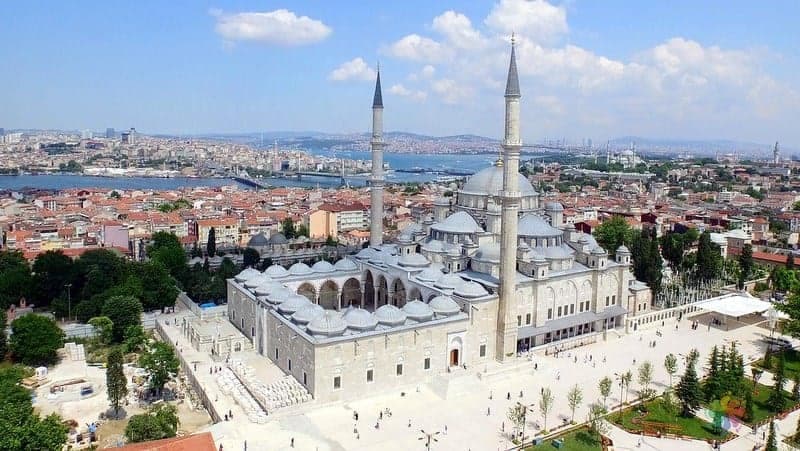
 fatih mosque Istanbul
मेहमान विजय के मस्जिद
Fatih मस्जिद का इतिहास
Located on Fevzi Pasa Caddesi in the Fatih neighborhood of Istanbul, Turkey, the massive Fatih Mosque (Turkish: Fatih Camii, "Conqueror's Mosque" in English) is an Ottoman mosque. Between 1463 and 1470, the site that was formerly the Church of the Holy Apostles was converted into the first mosque in the area. After the devastating 1766 earthquake, it was completely rebuilt in 1771. When the Ottoman sultan Mehmed the Conqueror (Fatih Sultan Mehmed in Turkish) took Constantinople in 1453, he was honored with the naming of this district.
Once an integral part of the Fatih Mosque, the Sahn-i Seman Medrese was a major academic institution for the study of theology, law, medicine, astronomy, physics, and mathematics. Ali Qushji set it up. He was a Turkic astronomer whom Mehmed had asked to come to his court in Istanbul.
2009 में और फिर 2019 में, पूरे मस्जिद परिसर को व्यापक पुनर्वास किया गया था. यह 2021 में पूजा करने वालों के लिए फिर से खोला जाएगा.
The architecture of the Fatih Mosque and Its Background
Between 1463 and 1470, at Fatih Sultan Mehmed's behest, construction began on a religious and social complex in Istanbul that would set new standards for size and complexity.
यह मस्जिद एक विज़ेंटियन चर्च को बदलती है जो चौथी क्रूज की लड़ाई के बाद से खराब हो गई थी और इसके लिए जगह बनाने के लिए टूट गई थी. मस्जिद के निर्माण से पहले, रोमन सम्राट कस्टिनन को चर्च में दफनाया गया था, जिसमें उनके सार्कोफाग 12 अन्य सार्कोफाग के बीच बैठे थे जो 12 दूतों को दर्शाते थे, मसीह के प्रतीकात्मक स्थान पर।
In the Ottoman imperial architectural tradition, the Fatih Mosque was the first great building. It was designed and constructed by the Greek architect Atik Sinan.
आठ मेडरेस, एक पुस्तकालय, एक अस्पताल (दूरश्फा), डर्विश (टाफैन), एक कारवां, एक बाजार, एक हैम, एक प्राथमिक विद्यालय (मेकटेप), एक सार्वजनिक रसोई (इमारेट), और 280 दुकानें का एक संग्रह मूल परिसर का हिस्सा थे। बाद में, कई क्रिप्ट, जिन्हें टर्ब्स के रूप में जाना जाता था, बनाया गया था। मूल परिसर गोल्डन हॉर्न के फ्यूज़ी पैस कैडेसी पक्ष के साथ लगभग 325 मीटर (1,066 फीट) तक फैल गया।
An earthquake in 1509 severely damaged the original mosque. After that, it was fixed, but earthquakes in 1557 and 1754 caused more damage, so it had to be fixed again. In an earthquake on May 22, 1766, the main dome collapsed and the walls were severely damaged, causing the mosque's destruction.
Sultan Mustafa III ने आर्किटेक्ट Mehmet Tahir Aga को 1767 और 1771 के बीच वर्तमान मस्जिद का निर्माण करने के लिए कहा था।
Fatih मस्जिद का निर्माण
बाहरी
The original Fatih Mosque was built on four arches, with a central dome that was supported by a semi-dome of the same diameter on the qibla side. It had a dome that was 26 meters in diameter. After the devastating earthquake of 1766, a second Baroque mosque was constructed with a square layout. It's topped by one large dome and surrounded by four smaller ones. All that remains of the original design are the courtyard, the portal leading to the main entrance, and the base of the minarets.
अंदरूनी
The interior features of the Fatih Mosque today are virtually identical to those featured in earlier iterations of the mosque, which Sinan and his successors used extensively throughout Istanbul (this technique is evocative of the Hagia Sophia). Four large marble columns hold up the central dome, which measures 26 meters in diameter.
The twin galleries in each of the two minarets make this structure unique. Though the mosque's interior and mimbar display Baroque influences, the mosque's white tiles lack the opulence of the Iznik tiles used in other mosques like the Rüstem Pasha Mosque.
Fatih मस्जिद परिसर
The Fatih Mosque, like many other imperial mosques in Istanbul, is part of a larger kulliye, or complex, that includes other buildings to meet the city's religious and cultural needs.
सैन्-इ सेमन आठ बड़े मैड्रासास हैं जो मस्जिद के उत्तर और दक्षिण में स्थित हैं. इन समान संरचनाओं में से प्रत्येक में 18 सेल्स, चार छात्रों के लिए पर्याप्त जगह, और एक dershane है. सड़क निर्माण ने मैड्रासा के पीछे बाहरी इमारतों को नष्ट कर दिया. लगभग एक हजार छात्रों को मैड्रासा द्वारा आवास किया जा सकता है, जिससे यह अपने समय के लिए एक बड़ा विश्वविद्यालय बन गया।
मस्जिद के मैदान के दक्षिण-पूर्व कोने के बाहर एक सुंदर बाग के साथ एक डर्वीश हॉस्टल है जो 16 अलग-अलग हरे रंग के प्राचीन और ग्रेनाइट स्तंभों द्वारा बनाया जाता है, जो शायद पवित्र दूतों के चर्च से वापस लिया गया था।
The massive Baroque tomb of Sultan Mahmud II's mother, Naksidil Sultan, stands opposite the dervish inn (1761–1817).
मंदिर के बगल में सल्तान मेहमान द्वितीय और उनकी पत्नी ग्यूलबहार हैटन के कब्र (टर्बे) हैं. भूकंप के बाद दोनों में मरम्मत की गई है. विजय के टर्ब का इंटीरियर विस्तृत रूप से सजाया गया है, जिससे यह औपचारिक घटनाओं के लिए एक लोकप्रिय जगह बन गई है.
After being given the Sword of Osman at the Eyüp Sultan Mosque, it was traditional for the new sultan to pay a visit to his tomb. Gulbahar's türbe has cleaner, more traditional lines than the original, and it may be remarkably similar to it. Many other notable state officials are buried there as well, such as field marshal Gazi Osman Pasha, whose tomb was designed by Kemaleddin Bey. In 2016, Halil Inalcik, a renowned Ottoman scholar and university professor, was laid to rest in this cemetery.
The mosque is joined to the 1724 dome-topped Carullah Efendi Library on one side. There are three doors: one that leads directly out onto the street, and two that lead into the mosque's inner courtyard. The books in the Suleymaniye Library are safe while the building is being repaired.
In the 1980s, the caravanserai was renovated and joined with adjacent stores to become a place of business. Many of the original building's features, like a hospital, market, kitchens, and hamam, have been taken down.
Fatih मस्जिद के बारे में अक्सर पूछे जाने वाले प्रश्न
प्रश्न: What is the Fatih Mosque?
ए: The Fatih Mosque is a historic mosque located in Istanbul, Turkey.
प्रश्न: Where is the Fatih Mosque located?
ए: The Fatih Mosque is located in the Fatih neighborhood of Istanbul, Turkey.
प्रश्न: What is the history of the Fatih Mosque?
ए: The Fatih Mosque was built by the Ottoman Sultan Mehmed II in the 15th century, and it was named after him as the conqueror of Constantinople.
प्रश्न: What is the significance of the Fatih Mosque?
ए: The Fatih Mosque is one of the largest and most important mosques in Istanbul, and it has played a central role in the history and religious life of the city for centuries.
प्रश्न: Fatih मस्जिद के खुलने के समय क्या हैं?
ए: The Fatih Mosque is open to visitors every day from 9:00 a.m. to 5:00 p.m.
प्रश्न: Fatih मस्जिद का दौरा करने के लिए कितना खर्च होता है?
ए: There is no admission fee to visit the Fatih Mosque.
प्रश्न: What is the dress code for the Fatih Mosque?
ए: Visitors to the Fatih Mosque are expected to dress modestly and cover their shoulders and knees.
प्रश्न: Is there a guide available at the Fatih Mosque?
ए: Yes, there is a volunteer guide available to provide information about the Fatih Mosque.
प्रश्न: What is the transportation like to the Fatih Mosque?
ए: The Fatih Mosque is easily accessible by taxi or public transportation.
प्रश्न: Are there any restrictions on taking photos at the Fatih Mosque?
ए: Yes, taking photos inside the Fatih Mosque is restricted, but visitors are allowed to take photos in the courtyards and other areas outside of the building.
आप हमारे लाइसेंस प्राप्त पर्यटन गाइड के साथ इस्तांबुल शहर दौरे बुक कर सकते हैं. लिंक नीचे हैं:
Fatih मस्जिद का नक्शा