
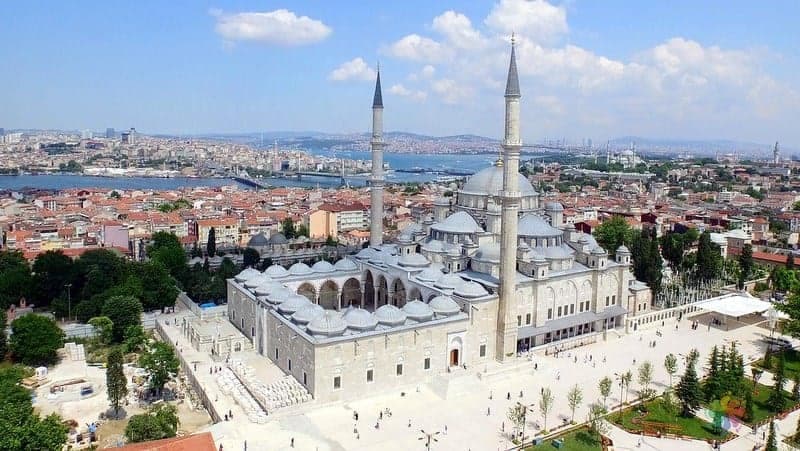
 fatih mosque Istanbul
Die Moschee von Mehmet der Eroberer
Geschichte der Fatih-Moschee
Located on Fevzi Pasa Caddesi in the Fatih neighborhood of Istanbul, Turkey, the massive Fatih Mosque (Turkish: Fatih Camii, "Conqueror's Mosque" in English) is an Ottoman mosque. Between 1463 and 1470, the site that was formerly the Church of the Holy Apostles was converted into the first mosque in the area. After the devastating 1766 earthquake, it was completely rebuilt in 1771. When the Ottoman sultan Mehmed the Conqueror (Fatih Sultan Mehmed in Turkish) took Constantinople in 1453, he was honored with the naming of this district.
Once an integral part of the Fatih Mosque, the Sahn-i Seman Medrese was a major academic institution for the study of theology, law, medicine, astronomy, physics, and mathematics. Ali Qushji set it up. He was a Turkic astronomer whom Mehmed had asked to come to his court in Istanbul.
2009 und 2019 wurde der gesamte Moscheekomplex umfangreich restauriert und wird 2021 für die Anbetenden wieder geöffnet.
Die Architektur der Fatih-Moschee und ihr Hintergrund
Between 1463 and 1470, at Fatih Sultan Mehmed's behest, construction began on a religious and social complex in Istanbul that would set new standards for size and complexity.
Diese Moschee ersetzte eine byzantinische Kirche, die seit dem vierten Kreuzzug in Unreife war und wurde abgerissen, um Platz für sie zu machen.Vor dem Bau der Moschee wurde der römische Kaiser Konstantin in der Kirche begraben, mit seinem Sarkofagus in der Mitte von zwölf anderen Sarkofagen, die die zwölf Apostel repräsentieren, am symbolischen Ort Christi.
In der osmanischen kaiserlichen Architekturtradition war die Fatih-Moschee das erste große Gebäude, das vom griechischen Architekten Atik Sinan entworfen und gebaut wurde.
Eight medreses, a library, a hospital (darüssifa), an inn for dervishes (taphane), a caravanserai, a market, a hamam, a primary school (mektep), a public kitchen (imaret), and a collection of 280 shops were all part of the original complex. Later, many crypts, known as türbes, were constructed. The original complex stretched along the Fevzi Pasa Caddesi side of the Golden Horn for about 325 meters (1,066 feet).
An earthquake in 1509 severely damaged the original mosque. After that, it was fixed, but earthquakes in 1557 and 1754 caused more damage, so it had to be fixed again. In an earthquake on May 22, 1766, the main dome collapsed and the walls were severely damaged, causing the mosque's destruction.
Sultan Mustafa III. bat den Architekten Mehmet Tahir Aga, die heutige Moschee zwischen 1767 und 1771 zu bauen.
Fatih Mosque Architecture
Außen
The original Fatih Mosque was built on four arches, with a central dome that was supported by a semi-dome of the same diameter on the qibla side. It had a dome that was 26 meters in diameter. After the devastating earthquake of 1766, a second Baroque mosque was constructed with a square layout. It's topped by one large dome and surrounded by four smaller ones. All that remains of the original design are the courtyard, the portal leading to the main entrance, and the base of the minarets.
Innen
The interior features of the Fatih Mosque today are virtually identical to those featured in earlier iterations of the mosque, which Sinan and his successors used extensively throughout Istanbul (this technique is evocative of the Hagia Sophia). Four large marble columns hold up the central dome, which measures 26 meters in diameter.
The twin galleries in each of the two minarets make this structure unique. Though the mosque's interior and mimbar display Baroque influences, the mosque's white tiles lack the opulence of the Iznik tiles used in other mosques like the Rüstem Pasha Mosque.
The Fatih Mosque Complex
The Fatih Mosque, like many other imperial mosques in Istanbul, is part of a larger kulliye, or complex, that includes other buildings to meet the city's religious and cultural needs.
Die Sahn-i Seman sind acht große Madrasas im Norden und Süden der Moschee. Jede dieser symmetrischen Strukturen beherbergt 18 Zellen, genug Platz für vier Studenten und eine dershane. Straßenbau zerstört Außengebäude hinter der Madrasah. Ungefähr tausend Studenten konnten von der Madrasah untergebracht werden, was es zu einer beträchtlichen Universität für seine Zeit machte.
Außerhalb der südöstlichen Ecke des Moscheegebiets befindet sich eine dervische Hütte mit einem schönen Hof, der von 16 verschiedenen Säulen aus grünem Antiquität und Granit gehalten wird, die wahrscheinlich aus der Kirche der Heiligen Apostel zurückgeholt wurden.
The massive Baroque tomb of Sultan Mahmud II's mother, Naksidil Sultan, stands opposite the dervish inn (1761–1817).
Es gibt die Gräber (Türbe) des Sultan Mehmed II. und seiner Frau Gülbahar Hatun auf dem Friedhof neben der Moschee.Nach dem Erdbeben wurden Reparaturen an beiden durchgeführt Das Innere der Türbe des Eroberers ist ausführlich dekoriert, was es zu einem beliebten Ort für formale Veranstaltungen macht.
After being given the Sword of Osman at the Eyüp Sultan Mosque, it was traditional for the new sultan to pay a visit to his tomb. Gulbahar's türbe has cleaner, more traditional lines than the original, and it may be remarkably similar to it. Many other notable state officials are buried there as well, such as field marshal Gazi Osman Pasha, whose tomb was designed by Kemaleddin Bey. In 2016, Halil Inalcik, a renowned Ottoman scholar and university professor, was laid to rest in this cemetery.
The mosque is joined to the 1724 dome-topped Carullah Efendi Library on one side. There are three doors: one that leads directly out onto the street, and two that lead into the mosque's inner courtyard. The books in the Suleymaniye Library are safe while the building is being repaired.
In the 1980s, the caravanserai was renovated and joined with adjacent stores to become a place of business. Many of the original building's features, like a hospital, market, kitchens, and hamam, have been taken down.
Häufig gestellte Fragen zur Fatih-Moschee
Q: What is the Fatih Mosque?
ADie Fatih-Moschee ist eine historische Moschee in Istanbul, Türkei.
QWo befindet sich die Fatih-Moschee?
ADie Fatih-Moschee befindet sich im Fatih-Viertel Istanbul, Türkei.
QWas ist die Geschichte der Fatih-Moschee?
ADie Fatih-Moschee wurde im 15. Jahrhundert vom osmanischen Sultan Mehmed II. erbaut und nach ihm als Eroberer von Konstantinopel benannt.
QWas ist die Bedeutung der Fatih-Moschee?
ADie Fatih-Moschee ist eine der größten und wichtigsten Moscheen in Istanbul und spielt seit Jahrhunderten eine zentrale Rolle in der Geschichte und im religiösen Leben der Stadt.
Q: Wie sind die Öffnungszeiten der Fatih-Moschee?
ADie Fatih-Moschee ist täglich von 9:00 Uhr bis 17:00 Uhr für Besucher geöffnet.
Q: How much does it cost to visit the Fatih Mosque?
A: Es gibt keine Eintrittsgebühr für den Besuch der Fatih-Moschee.
QWas ist der Kleidercode für die Fatih-Moschee?
ABesucher der Fatih-Moschee werden erwartet, sich bescheiden zu kleiden und ihre Schultern und Knie zu bedecken.
QGibt es einen Führer in der Fatih-Moschee?
A: Ja, es gibt einen freiwilligen Leitfaden zur Verfügung, um Informationen über die Fatih-Moschee zu liefern.
Q: Wie ist der Transport wie zur Fatih-Moschee?
A: Die Fatih-Moschee ist mit Taxi oder öffentlichen Verkehrsmitteln leicht zu erreichen.
QGibt es Einschränkungen für das Fotografieren in der Fatih-Moschee?
AJa, die Fotografierung innerhalb der Fatih-Moschee ist eingeschränkt, aber Besucher dürfen Fotos in den Höfen und anderen Bereichen außerhalb des Gebäudes machen.
Sie können eine Istanbul City Tour mit unseren lizenzierten Reiseleitern buchen. Die Links sind unten:
Map of Fatih Mosque