
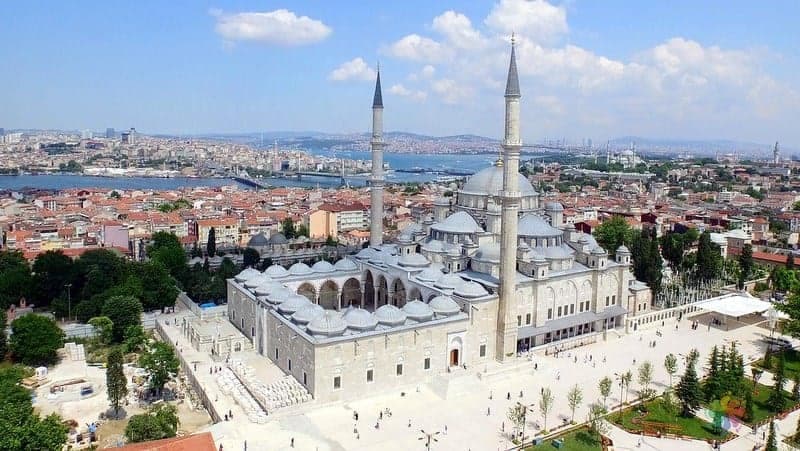
 fatih mosque Istanbul
Mehmet valloittajan moskeija
FATIH MOSQUE’S HISTORY
Located on Fevzi Pasa Caddesi in the Fatih neighborhood of Istanbul, Turkey, the massive Fatih Mosque (Turkish: Fatih Camii, "Conqueror's Mosque" in English) is an Ottoman mosque. Between 1463 and 1470, the site that was formerly the Church of the Holy Apostles was converted into the first mosque in the area. After the devastating 1766 earthquake, it was completely rebuilt in 1771. When the Ottoman sultan Mehmed the Conqueror (Fatih Sultan Mehmed in Turkish) took Constantinople in 1453, he was honored with the naming of this district.
Once an integral part of the Fatih Mosque, the Sahn-i Seman Medrese was a major academic institution for the study of theology, law, medicine, astronomy, physics, and mathematics. Ali Qushji set it up. He was a Turkic astronomer whom Mehmed had asked to come to his court in Istanbul.
Vuonna 2009 ja uudelleen vuonna 2019 koko moskeijan kompleksin laajamittainen kunnostus.
Fatih-moskeijan arkkitehtuuri ja sen tausta
Between 1463 and 1470, at Fatih Sultan Mehmed's behest, construction began on a religious and social complex in Istanbul that would set new standards for size and complexity.
Tämä moskeija korvasi bysanttilaisen kirkon, joka oli ollut korjaamatta jo neljännen ristiretken jälkeen ja hajotettiin sen tilalle. ennen moskeijan rakentamista, Rooman keisari Konstantinus haudattiin kirkkoon, jossa hänen sarkofagi istui keskellä kaksitoista muuta sarkofagia, joka edustaa kaksitoista apostolia, Kristuksen symbolisessa paikassa.
Ottomaanien valtakunnallisessa arkkitehtuuriperinteessä Fatih-moskeija oli ensimmäinen suuri rakennus, jonka suunnitteli ja rakensi kreikkalainen arkkitehti Atik Sinan.
Eight medreses, a library, a hospital (darüssifa), an inn for dervishes (taphane), a caravanserai, a market, a hamam, a primary school (mektep), a public kitchen (imaret), and a collection of 280 shops were all part of the original complex. Later, many crypts, known as türbes, were constructed. The original complex stretched along the Fevzi Pasa Caddesi side of the Golden Horn for about 325 meters (1,066 feet).
An earthquake in 1509 severely damaged the original mosque. After that, it was fixed, but earthquakes in 1557 and 1754 caused more damage, so it had to be fixed again. In an earthquake on May 22, 1766, the main dome collapsed and the walls were severely damaged, causing the mosque's destruction.
Sultan Mustafa III pyysi arkkitehti Mehmet Tahir Aga rakentaa nykyisen moskeijan välillä 1767 ja 1771.
Fatih Mosque Architecture
Ulkoinen
The original Fatih Mosque was built on four arches, with a central dome that was supported by a semi-dome of the same diameter on the qibla side. It had a dome that was 26 meters in diameter. After the devastating earthquake of 1766, a second Baroque mosque was constructed with a square layout. It's topped by one large dome and surrounded by four smaller ones. All that remains of the original design are the courtyard, the portal leading to the main entrance, and the base of the minarets.
Sisäpuoli
The interior features of the Fatih Mosque today are virtually identical to those featured in earlier iterations of the mosque, which Sinan and his successors used extensively throughout Istanbul (this technique is evocative of the Hagia Sophia). Four large marble columns hold up the central dome, which measures 26 meters in diameter.
The twin galleries in each of the two minarets make this structure unique. Though the mosque's interior and mimbar display Baroque influences, the mosque's white tiles lack the opulence of the Iznik tiles used in other mosques like the Rüstem Pasha Mosque.
Fatih-moskeijan kompleksin rakennukset
The Fatih Mosque, like many other imperial mosques in Istanbul, is part of a larger kulliye, or complex, that includes other buildings to meet the city's religious and cultural needs.
Sahn-i Seman on kahdeksan suurta madrasaa sijaitsee moskeijan pohjois- ja eteläosassa. Kukin näistä symmetrinen rakenteet talon 18 solua, riittävästi tilaa neljälle opiskelijalle, ja dershane. tie rakentaminen tuhoutui ulkotiloja madrasah. Noin tuhat opiskelijaa voitaisiin majoittaa madrasah, mikä tekee siitä merkittävän yliopiston sen ajan.
Moskeijan eteläosassa on derviis-majoituspaikka, jossa on kaunis pihapiiri, jota ylläpitää 16 erilaista vihreää antiikkia ja graniittia, jotka todennäköisesti on palautettu Pyhien Apostolien kirkosta.
The massive Baroque tomb of Sultan Mahmud II's mother, Naksidil Sultan, stands opposite the dervish inn (1761–1817).
Sultan Mehmed II: n ja hänen vaimonsa Gülbahar Hatunin hautausmaalla, joka on moskeijan vieressä, on hautoja (turbeja). Maanjäristyksen jälkeen molemmille tehtiin korjauksia Valloittajan turpeen sisätilat on koristeltu perusteellisesti, mikä tekee siitä suositun paikan virallisille tapahtumille.
After being given the Sword of Osman at the Eyüp Sultan Mosque, it was traditional for the new sultan to pay a visit to his tomb. Gulbahar's türbe has cleaner, more traditional lines than the original, and it may be remarkably similar to it. Many other notable state officials are buried there as well, such as field marshal Gazi Osman Pasha, whose tomb was designed by Kemaleddin Bey. In 2016, Halil Inalcik, a renowned Ottoman scholar and university professor, was laid to rest in this cemetery.
The mosque is joined to the 1724 dome-topped Carullah Efendi Library on one side. There are three doors: one that leads directly out onto the street, and two that lead into the mosque's inner courtyard. The books in the Suleymaniye Library are safe while the building is being repaired.
In the 1980s, the caravanserai was renovated and joined with adjacent stores to become a place of business. Many of the original building's features, like a hospital, market, kitchens, and hamam, have been taken down.
Frequently Asked Questions About the Fatih Mosque
K: What is the Fatih Mosque?
A onFatih-moskeija on historiallinen moskeija, joka sijaitsee Istanbulissa, Turkissa.
KMissä Fatih-moskeija sijaitsee?
A onFatih-moskeija sijaitsee Fatih-alueella Istanbulissa, Turkissa.
KMikä on Fatih-moskeijan historia?
A onFatih-moskeija rakennettiin Osmanien sulttaani Mehmed II: n 1500-luvulla, ja se nimettiin hänen mukaansa Konstantinopolin valloittajana.
KMikä on Fatih-moskeijan merkitys?
A onFatih-moskeija on yksi Istanbulin suurimmista ja tärkeimmistä moskeijoista, ja se on ollut keskeinen rooli kaupungin historiassa ja uskonnollisessa elämässä vuosisatojen ajan.
K: What are the opening hours of the Fatih Mosque?
A onFatih-moskeija on avoinna vierailijoille joka päivä klo 9.00 - 17.00 välisenä aikana.
KMitä maksaa Fatih-moskeijan vierailu?
A on: Fatih-moskeijan vierailulle ei ole sisäänpääsymaksua.
KMikä on Fatih-moskeijan pukeutumissääntö?
A onFatih-moskeijan vierailijoiden odotetaan pukeutuvan vaatimattomasti ja peittävän olkapäät ja polvet.
KOnko Fatih-moskeijassa käytettävissä oppaita?
A on: Kyllä, vapaaehtoinen opas on saatavilla, joka tarjoaa tietoa Fatih-moskeijasta.
K: What is the transportation like to the Fatih Mosque?
A onFatih-moskeija on helposti saavutettavissa taksilla tai julkisella liikenteellä.
KOnko Fatih-moskeijassa valokuvien ottamiselle rajoituksia?
A on: Kyllä, Fatih-moskeijan sisällä on rajoitettu valokuvaaminen, mutta kävijät saavat ottaa valokuvia pihalla ja muilla alueilla rakennuksen ulkopuolella.
Voit varata Istanbulin kaupungin kiertueen lisensoiduilla oppaillamme.
Map of Fatih Mosque