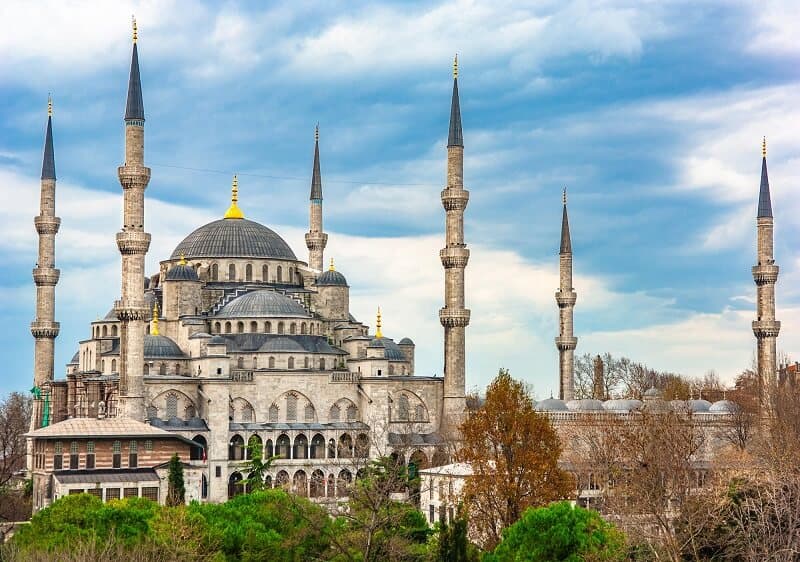
 イスタンブールブルーモスク
BLUE MOSQUE (Sultanahmet Mosque)
The Sultan Ahmed Mosque (Turkish: Sultan Ahmet Camii), or the Blue Mosque, is a historical imperial mosque from the Ottoman era that can be found in Istanbul, Turkey. It is both a working mosque and a major tourist destination. During Ahmed I's reign (1609–1616), its construction began. The Külliye is home to a madrasah, a hospice, and the tomb of Ahmed. Inside, the walls are covered in hand-painted blue tiles, and at night, the mosque's five main domes, six minarets, and eight secondary domes are illuminated, bathing the entire structure in a calming blue glow. Until the construction of the Blue Mosque, the Hagia Sophia was the most important mosque in Istanbul. In 1985, UNESCO designated the "Historic Areas of Istanbul," which included the Blue Mosque, as a World Heritage Site.
ブルーモスクの歴史
スルタン・アフメド、私は、ジシタトロク和平とペルシャとの戦争で破壊的な損失の後、オスマン政権を再確認するためにイスタンブールで大規模なモスクを建設することを決意しました1603-18年以上後に、これは建てられる最初の帝国モスクになるでしょう。彼の先祖はモスク建設の資金調達のために戦争ボートを使用していたが、アフマド私は、その代わりに、彼の顕著な軍事勝利の欠如のために財務省から金を借りた。 1609年に始まり、この構造の建設は1616年まで続いた。
Infuriating the Muslim scholars known as ulama was the fact that the sultan's army had been paid for out of the general budget rather than the spoils of war. The mosque was constructed on the site of the former palace of the Byzantine emperors and faces the Hagia Sophia, the city's primary imperial mosque at the time, and the hippodrome, a prominent symbolic location in the city's southern skyline. The south side of the mosque is built on the foundations and vaults of the previous Grand Palace.
The Blue Mosque's Architecture
The Blue Mosque represents two centuries of development in Ottoman mosque architecture and Byzantine church architecture. It is the last great mosque from the classical period of the Ottoman Empire and combines traditional Islamic architecture with some Byzantine features from the nearby Hagia Sophia. By remembering what his teacher, Sinan, had taught him, the architect made a building of the epic size and opulent beauty.
Blue Mosque's Minarets
トルコ全土のモスクは2つしかなく、そのうちの1つがブルーモスクです。
The Sabanci Mosque in Adana is the second. The Sultan took some heat for his arrogance after the number of minarets was made public, as they matched the number at the Ka'aba Mosque in Mecca. To solve this issue, he had a seventh minaret added to the Mecca mosque.
The Blue Mosque has four minarets, one at each of its four corners. These minarets, called Serefe, are fluted and pencil-shaped; they each have three balconies supported by stalactite corbels, whereas the other two minarets at the end of the forecourt have only two. Once upon a time, the muezzin, or prayer caller, had to make the ascent of a steep, narrow spiral staircase five times each day to make the call to prayer.
呼びかけは現在、公共の発表システムを介して放送され、市の歴史地区全体で聞こえ、その地域の他のモスクによって再び再生される。太陽が沈み、モスクはカラーの洪水灯によって輝かしく照らされ、トルコ人と観光客の大群が公園に集まり、夕方祈りの呼びかけを聞く。
The Blue Mosque's Interior
More than 20,000 hand-made ceramic tiles, made in Iznik (Nicaea), in more than fifty different tulip designs, line the lower levels and piers of the Blue Mosque's interior. Even though the tiles on the ground floor have a classic look, the ones in the upper galleries are more ornate and feature bright colors and elaborate patterns of flowers, fruit, and cypresses. Iznik master potters Kasap Haci and Avanos and Cappadocia native Baris Efendi oversaw the production of over 20,000 tiles. Since the cost of tiles in general went up over time, the sultan issued a decree setting a standard price for them. The building's tiles gradually became of lower quality as time went on. The glazes have dulled, and the colors have faded. The tiles on the rear wall of the balcony are originals that were salvaged from the harem of the Topkapi Palace after it burned down in 1574.
Blue is the predominant color used on the upper levels of the mosque's interior. The building has over two hundred stained-glass windows, many of which feature elaborate designs. Ostrich eggs were hung from the chandeliers to keep spiders out of the mosque and prevent the buildup of cobwebs. Many of the Qur'anic verses adorning the walls were written by Seyyid Kasim Gubari, widely considered the greatest calligrapher of his era.
信仰する人々によって提供され、着替えられた絨毯は、床を覆い、広い窓の豊富さは、広々としたインテリアの幻想を創造します。モスクの各エクセードラには5つの窓があり、その一部は、盲点で覆われています。
中央のドームには28の窓があり、それぞれの2つの外のドーム(そのうち4つは盲目)には14があります。ヴェネツィア当局は、この色彩の高いガラス板のほとんどを、より創造的な新しいバージョンで置き換えました。
The mihrab is the most important part of the mosque's interior. It is made of marble and has intricate carvings, a stalactite niche, and two panels with writing on them.
ケラミックのタイルは隣接する壁を覆います。しかし、その地域の窓の多さは効果を減らします。イマームは金曜日や他の聖なる日々で昼間に、ミンバーと呼ばれる布団から説教を提供し、ミイラブの右側に位置し、精細に装飾されています。モスクが容量にあっても、誰もがイマームを見たり聞いたりすることができるので、慎重な配置のおかげです。
The southeast corner is home to the royal kiosk, which features a platform, loggia, and two small private rooms for the king and queen. You can use it to enter the Blue Mosque's royal loge, which is located in the southeast corner of the mosque's upper gallery. During the 1826 crackdown on the defiant Janissary Corps, the Grand Vizier set up headquarters in these private quarters. In Turkey, this section of the palace is known as the hünkâr mahfil, and it is surrounded by ten marble columns.
Once adorned with gold and precious stones, the Blue Mosque's many lamps are now plain white. Ostrich eggs and crystal balls were hidden in the various glass jars. All of these ornaments were stolen or removed to be displayed in Istanbul museums.
最初は17世紀の偉大なカリグラフのアメトリ・カシム・グバリムによって書かれたもので、カリフの名前とコーランの詩は、壁を並べる大きなテーブルを飾っています。
The Blue Mosque's Exterior
The large forecourt's facade was inspired by Istanbul's Süleymaniye Mosque but features turrets instead of minarets on the four corner domes. The court, which is enclosed by a continuous vaulted arcade, is roughly the same size as the mosque. The courtyard is quite large for its diminutive central hexagonal fountain. The architectural highlight of the courtyard is the monumental but narrow gateway that leads to it through the arcade. The small ribbed dome atop the tall lobate is topped by a fine stalactite structure.
When entering the Mosque's western court, you'll notice a heavy iron chain hanging from the ceiling. The sultan was the only person permitted to ride a horse into the Blue Mosque's courtyard. To avoid being struck by the chain, the sultan must bend over slightly whenever he enters the court. Symbolically, it served to show the ruler's respect for the divine.
ブルーモスクについてよくある質問
Qブルーモスクって何?
A は: The Blue Mosque is an old mosque in Istanbul, Turkey. It is also called the Sultan Ahmed Mosque.
Qブルーモスクはいつ建てられたのか。
A はモスクは1609年から1616年にかけて建てられた。
Qブルーモスクを建てたのは誰?
A は: Ahmed I, the Ottoman Sultan, was the one who built the Blue Mosque.
Q: Why is it called the Blue Mosque?
A はモスクは、内部装飾に使用された青いタイルのためにブルーモスクと呼ばれています。
Qブルーモスクの主な特徴は何ですか?
A はブルーモスクには6つのミナレット、大きな中央のドーム、そしてそれを囲む小さなドーム、複雑なカリグラフィーとタイル作業があります。
Qブルーモスクには何つの神殿があるのか。
A はブルーモスクには中央のドームと8つの小さなドームがあります。
Qブルーモスクの能力は?
A はブルーモスクは、一度に10,000人の崇拝者を収容することができます。
Qブルーモスクは訪問者に開かれているのでしょうか。
A ははい、ブルーモスクは、祈りの時間以外は、訪問者や観光客に開かれています。
Q◎ ブルーモスクの訪問時間は?
A は: ブルーモスクの訪問時間は通常、午前9時から午後12時、午後2時から午後4時までです。
Qブルーモスクに入るのにいくらかかるの?
A はブルーモスクに入るには入場料はありませんが、寄付は有効です。
イスタンブール・シティ・ツアーをライセンス付きのツアーガイドと一緒に予約できます。 リンクは以下の通りです。
イスタンブールの市内ツアーをライセンス付きのツアーガイドと一緒に予約できます。
ブルーモスクの地図