
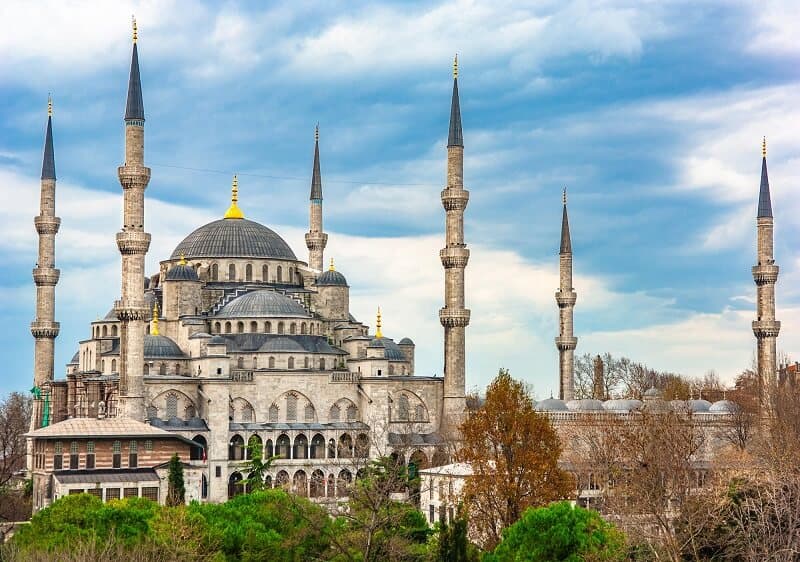
 Голубая мечеть Стамбул
BLUE MOSQUE (Sultanahmet Mosque)
The Sultan Ahmed Mosque (Turkish: Sultan Ahmet Camii), or the Blue Mosque, is a historical imperial mosque from the Ottoman era that can be found in Istanbul, Turkey. It is both a working mosque and a major tourist destination. During Ahmed I's reign (1609–1616), its construction began. The Külliye is home to a madrasah, a hospice, and the tomb of Ahmed. Inside, the walls are covered in hand-painted blue tiles, and at night, the mosque's five main domes, six minarets, and eight secondary domes are illuminated, bathing the entire structure in a calming blue glow. Until the construction of the Blue Mosque, the Hagia Sophia was the most important mosque in Istanbul. In 1985, UNESCO designated the "Historic Areas of Istanbul," which included the Blue Mosque, as a World Heritage Site.
History of the Blue Mosque
Султан Ахмед, я решил построить массивную мечеть в Стамбуле, чтобы вновь утвердить османскую власть после мира в Житатороке и разрушительной потери в войне 1603-18 с Персией. После более чем сорока лет это будет первая имперская мечеть, которая будет построена. В то время как его предки использовали военные боты для финансирования строительства мечети, Ахмед I вместо этого заимствовал деньги из казначейства из-за его отсутствия заметных военных побед. Начиная с 1609 года, строительство на этой структуре продолжалось до 1616 года.
Infuriating the Muslim scholars known as ulama was the fact that the sultan's army had been paid for out of the general budget rather than the spoils of war. The mosque was constructed on the site of the former palace of the Byzantine emperors and faces the Hagia Sophia, the city's primary imperial mosque at the time, and the hippodrome, a prominent symbolic location in the city's southern skyline. The south side of the mosque is built on the foundations and vaults of the previous Grand Palace.
The Blue Mosque's Architecture
The Blue Mosque represents two centuries of development in Ottoman mosque architecture and Byzantine church architecture. It is the last great mosque from the classical period of the Ottoman Empire and combines traditional Islamic architecture with some Byzantine features from the nearby Hagia Sophia. By remembering what his teacher, Sinan, had taught him, the architect made a building of the epic size and opulent beauty.
Blue Mosque's Minarets
Только в двух мечетях по всей Турции есть как минимум шесть минаретов, и одна из них — Голубая мечеть.
The Sabanci Mosque in Adana is the second. The Sultan took some heat for his arrogance after the number of minarets was made public, as they matched the number at the Ka'aba Mosque in Mecca. To solve this issue, he had a seventh minaret added to the Mecca mosque.
The Blue Mosque has four minarets, one at each of its four corners. These minarets, called Serefe, are fluted and pencil-shaped; they each have three balconies supported by stalactite corbels, whereas the other two minarets at the end of the forecourt have only two. Once upon a time, the muezzin, or prayer caller, had to make the ascent of a steep, narrow spiral staircase five times each day to make the call to prayer.
Звонок теперь транслируется через систему общественного объявления и может быть услышан по всему историческому району города и отзвучен другими мечетями в районе.Поскольку солнце заходит и мечеть блестяще освещается цветными потопами, огромные толпы турок и туристов собираются в парке перед ним, чтобы услышать призыв к вечерним молитвам.
The Blue Mosque's Interior
More than 20,000 hand-made ceramic tiles, made in Iznik (Nicaea), in more than fifty different tulip designs, line the lower levels and piers of the Blue Mosque's interior. Even though the tiles on the ground floor have a classic look, the ones in the upper galleries are more ornate and feature bright colors and elaborate patterns of flowers, fruit, and cypresses. Iznik master potters Kasap Haci and Avanos and Cappadocia native Baris Efendi oversaw the production of over 20,000 tiles. Since the cost of tiles in general went up over time, the sultan issued a decree setting a standard price for them. The building's tiles gradually became of lower quality as time went on. The glazes have dulled, and the colors have faded. The tiles on the rear wall of the balcony are originals that were salvaged from the harem of the Topkapi Palace after it burned down in 1574.
Blue is the predominant color used on the upper levels of the mosque's interior. The building has over two hundred stained-glass windows, many of which feature elaborate designs. Ostrich eggs were hung from the chandeliers to keep spiders out of the mosque and prevent the buildup of cobwebs. Many of the Qur'anic verses adorning the walls were written by Seyyid Kasim Gubari, widely considered the greatest calligrapher of his era.
Ковры, предоставленные верующими и заменяемые по мере их износа, покрывают полы. Обилие высоких, широких окон создает иллюзию просторного интерьера. В каждой экзедре мечети есть пять окон, а некоторые из них покрыты ослеплениями.
В центральном куполе есть 28 окон, в каждом из двух наружных куполов (четыре из которых слепые).Венецианские власти подарили султану стеклянные окна в качестве подарка.
The mihrab is the most important part of the mosque's interior. It is made of marble and has intricate carvings, a stalactite niche, and two panels with writing on them.
Керамические плитки покрывают прилегающие стены. Однако обилие окон в районе уменьшает эффект. Имам дает свою проповедь в полдень по пятницам и другим святым дням из пулпита, называемого минбер, который расположен справа от михраба и тщательно украшен. Даже когда мечеть находится в состоянии, каждый сможет увидеть и услышать имама благодаря продуманному расположению.
The southeast corner is home to the royal kiosk, which features a platform, loggia, and two small private rooms for the king and queen. You can use it to enter the Blue Mosque's royal loge, which is located in the southeast corner of the mosque's upper gallery. During the 1826 crackdown on the defiant Janissary Corps, the Grand Vizier set up headquarters in these private quarters. In Turkey, this section of the palace is known as the hünkâr mahfil, and it is surrounded by ten marble columns.
Once adorned with gold and precious stones, the Blue Mosque's many lamps are now plain white. Ostrich eggs and crystal balls were hidden in the various glass jars. All of these ornaments were stolen or removed to be displayed in Istanbul museums.
Первоначально написанный великим каллиграфом 17-го века Аметли Касим Губаримом, имена халифов и стихи из Корана украшают большие таблицы, которые выстраивают стены.
The Blue Mosque's Exterior
The large forecourt's facade was inspired by Istanbul's Süleymaniye Mosque but features turrets instead of minarets on the four corner domes. The court, which is enclosed by a continuous vaulted arcade, is roughly the same size as the mosque. The courtyard is quite large for its diminutive central hexagonal fountain. The architectural highlight of the courtyard is the monumental but narrow gateway that leads to it through the arcade. The small ribbed dome atop the tall lobate is topped by a fine stalactite structure.
When entering the Mosque's western court, you'll notice a heavy iron chain hanging from the ceiling. The sultan was the only person permitted to ride a horse into the Blue Mosque's courtyard. To avoid being struck by the chain, the sultan must bend over slightly whenever he enters the court. Symbolically, it served to show the ruler's respect for the divine.
Frequently Asked Questions About the Blue Mosque
ВопросЧто такое Голубая мечеть?
А: The Blue Mosque is an old mosque in Istanbul, Turkey. It is also called the Sultan Ahmed Mosque.
ВопросКогда была построена Голубая мечеть?
АМечеть была построена между 1609 и 1616 годами.
Вопрос: Who built the Blue Mosque?
А: Ahmed I, the Ottoman Sultan, was the one who built the Blue Mosque.
Вопрос: Why is it called the Blue Mosque?
А: The mosque is called the Blue Mosque because of the blue tiles used in its interior decoration.
Вопрос: What are the main features of the Blue Mosque?
АГолубая мечеть имеет шесть минаретов, большой центральный купол и более мелкие куполы, окружающие ее, а также сложные каллиграфические и плиточные работы.
ВопросСколько куполов имеет Голубая мечеть?
АГолубая мечеть имеет один центральный купол и восемь более мелких куполов.
Вопрос: What is the capacity of the Blue Mosque?
АГолубая мечеть может вместить до 10 000 поклонников одновременно.
ВопросОткрыта ли Голубая мечеть для посетителей?
АДа, Голубая мечеть открыта для посетителей и туристов, за исключением молитвенных часов.
Вопрос: What are the visiting hours for the Blue Mosque?
А: Visiting hours for the Blue Mosque are typically from 9:00 a.m. to 12:00 p.m. and from 2:00 p.m. to 4:00 p.m.
Вопрос: How much does it cost to enter the Blue Mosque?
А: There is no admission fee to enter the Blue Mosque, but donations are appreciated.
Вы можете забронировать тур по Стамбулу с нашими лицензированными турами.
Вы можете забронировать тур по Стамбулу с нашими лицензированными турами.
Map of Blue Mosque