
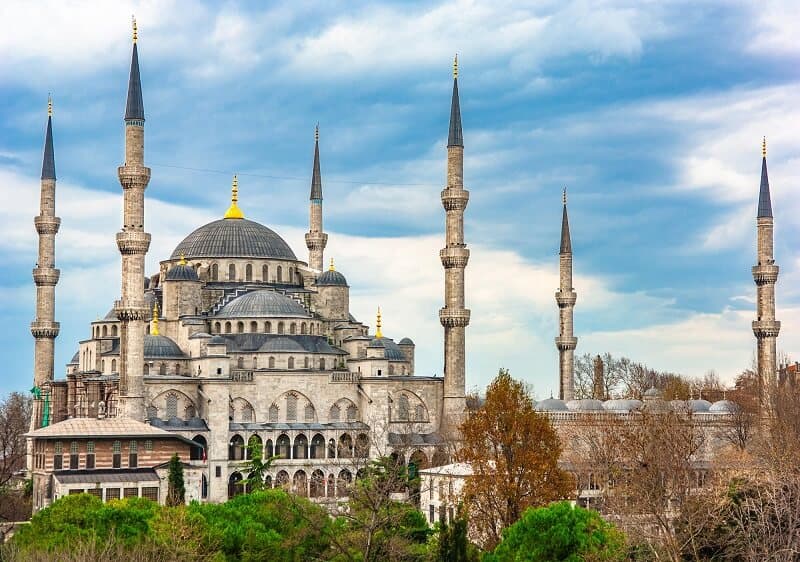
 De Blauwe Moskee van Istanbul
BLUE MOSQUE (Sultanahmet Mosque)
The Sultan Ahmed Mosque (Turkish: Sultan Ahmet Camii), or the Blue Mosque, is a historical imperial mosque from the Ottoman era that can be found in Istanbul, Turkey. It is both a working mosque and a major tourist destination. During Ahmed I's reign (1609–1616), its construction began. The Külliye is home to a madrasah, a hospice, and the tomb of Ahmed. Inside, the walls are covered in hand-painted blue tiles, and at night, the mosque's five main domes, six minarets, and eight secondary domes are illuminated, bathing the entire structure in a calming blue glow. Until the construction of the Blue Mosque, the Hagia Sophia was the most important mosque in Istanbul. In 1985, UNESCO designated the "Historic Areas of Istanbul," which included the Blue Mosque, as a World Heritage Site.
Geschiedenis van de Blauwe Moskee
Sultan Ahmed, ik besloot om een enorme moskee te bouwen in Istanbul om de Ottomaanse macht te herbevestigen na de vrede van Zsitvatorok en de verpletterende verliezen in de oorlog van 1603-18 met Perzië. Na meer dan veertig jaar zou dit de eerste keizerlijke moskee zijn die werd gebouwd. Terwijl zijn voorouders oorlogsboot hadden gebruikt om moskee-bouw te financieren, Ahmed I in plaats daarvan geld geleend van de schatkist vanwege zijn gebrek aan opmerkelijke militaire overwinningen. Beginnend in 1609, de bouw op deze structuur duurde tot 1616.
Infuriating the Muslim scholars known as ulama was the fact that the sultan's army had been paid for out of the general budget rather than the spoils of war. The mosque was constructed on the site of the former palace of the Byzantine emperors and faces the Hagia Sophia, the city's primary imperial mosque at the time, and the hippodrome, a prominent symbolic location in the city's southern skyline. The south side of the mosque is built on the foundations and vaults of the previous Grand Palace.
The Blue Mosque's Architecture
De Blauwe Moskee vertegenwoordigt twee eeuwen van ontwikkeling in de Ottomaanse moskee-architectuur en Byzantijnse kerkarchitectuur. Het is de laatste grote moskee uit de klassieke periode van het Ottomaanse Rijk en combineert traditionele islamitische architectuur met een aantal Byzantijnse kenmerken van de nabijgelegen Hagia Sophia. Door te onthouden wat zijn leraar, Sinan, hem had geleerd, maakte de architect een gebouw van de epische grootte en weelderige schoonheid.
Blue Mosque's Minarets
In Turkije zijn er slechts twee moskeeën met zes minaretten, waarvan de Blauwe Moskee één is.
The Sabanci Mosque in Adana is the second. The Sultan took some heat for his arrogance after the number of minarets was made public, as they matched the number at the Ka'aba Mosque in Mecca. To solve this issue, he had a seventh minaret added to the Mecca mosque.
The Blue Mosque has four minarets, one at each of its four corners. These minarets, called Serefe, are fluted and pencil-shaped; they each have three balconies supported by stalactite corbels, whereas the other two minarets at the end of the forecourt have only two. Once upon a time, the muezzin, or prayer caller, had to make the ascent of a steep, narrow spiral staircase five times each day to make the call to prayer.
De oproep wordt nu uitgezonden via een openbaar aankondigingssysteem en kan worden gehoord in het historische district van de stad en geëchoceerd door andere moskeeën in het gebied.Naarmate de zon ondergaat en de moskee briljant wordt verlicht door kleurrijke overstromingslichten, verzamelen enorme menigte Turken en toeristen zich in het park voor het om de oproep tot avondgebeden te horen.
The Blue Mosque's Interior
More than 20,000 hand-made ceramic tiles, made in Iznik (Nicaea), in more than fifty different tulip designs, line the lower levels and piers of the Blue Mosque's interior. Even though the tiles on the ground floor have a classic look, the ones in the upper galleries are more ornate and feature bright colors and elaborate patterns of flowers, fruit, and cypresses. Iznik master potters Kasap Haci and Avanos and Cappadocia native Baris Efendi oversaw the production of over 20,000 tiles. Since the cost of tiles in general went up over time, the sultan issued a decree setting a standard price for them. The building's tiles gradually became of lower quality as time went on. The glazes have dulled, and the colors have faded. The tiles on the rear wall of the balcony are originals that were salvaged from the harem of the Topkapi Palace after it burned down in 1574.
Blue is the predominant color used on the upper levels of the mosque's interior. The building has over two hundred stained-glass windows, many of which feature elaborate designs. Ostrich eggs were hung from the chandeliers to keep spiders out of the mosque and prevent the buildup of cobwebs. Many of the Qur'anic verses adorning the walls were written by Seyyid Kasim Gubari, widely considered the greatest calligrapher of his era.
Tapijten, geleverd door gelovige personen en vervangen als ze uit elkaar vallen, bedekken de vloeren. De overvloed aan hoge, brede ramen creëert de illusie van een ruim interieur. Er zijn vijf ramen in elke exedra van de moskee, en sommige van hen zijn bedekt met blinds.
Er zijn in totaal 28 ramen in de centrale koepel, met 14 in elk van de twee buitenste koepels (vier van hen zijn blind). Venetiaanse autoriteiten gaven de sultan met glas-gepakte ramen als een geschenk.
The mihrab is the most important part of the mosque's interior. It is made of marble and has intricate carvings, a stalactite niche, and two panels with writing on them.
De keramische tegels bedekken de aangrenzende muren. De overvloed aan ramen in het gebied vermindert echter het effect. De imam levert zijn prediking op vrijdag en andere heilige dagen op de middag van een pulpit genaamd een minber, die zich aan de rechterkant van de mihrab bevindt en grondig is versierd. Zelfs wanneer de moskee in staat is, zal iedereen de imam kunnen zien en horen dankzij de doordachte lay-out.
The southeast corner is home to the royal kiosk, which features a platform, loggia, and two small private rooms for the king and queen. You can use it to enter the Blue Mosque's royal loge, which is located in the southeast corner of the mosque's upper gallery. During the 1826 crackdown on the defiant Janissary Corps, the Grand Vizier set up headquarters in these private quarters. In Turkey, this section of the palace is known as the hünkâr mahfil, and it is surrounded by ten marble columns.
Once adorned with gold and precious stones, the Blue Mosque's many lamps are now plain white. Ostrich eggs and crystal balls were hidden in the various glass jars. All of these ornaments were stolen or removed to be displayed in Istanbul museums.
Oorspronkelijk geschreven door de grote 17e-eeuwse calligraaf Ametli Kasim Gubarim, de namen van de kalifen en verzen uit de Koran versieren de grote tafels die de muren lijnen.
The Blue Mosque's Exterior
The large forecourt's facade was inspired by Istanbul's Süleymaniye Mosque but features turrets instead of minarets on the four corner domes. The court, which is enclosed by a continuous vaulted arcade, is roughly the same size as the mosque. The courtyard is quite large for its diminutive central hexagonal fountain. The architectural highlight of the courtyard is the monumental but narrow gateway that leads to it through the arcade. The small ribbed dome atop the tall lobate is topped by a fine stalactite structure.
When entering the Mosque's western court, you'll notice a heavy iron chain hanging from the ceiling. The sultan was the only person permitted to ride a horse into the Blue Mosque's courtyard. To avoid being struck by the chain, the sultan must bend over slightly whenever he enters the court. Symbolically, it served to show the ruler's respect for the divine.
Veelgestelde vragen over de Blauwe Moskee
QWat is de Blauwe Moskee?
a: The Blue Mosque is an old mosque in Istanbul, Turkey. It is also called the Sultan Ahmed Mosque.
QWanneer werd de Blauwe Moskee gebouwd?
aDe moskee werd gebouwd tussen 1609 en 1616.
QWie bouwde de Blauwe Moskee?
aAhmed I, de Ottomaanse sultan, was degene die de Blauwe Moskee bouwde.
QWaarom wordt het de Blauwe Moskee genoemd?
aDe moskee wordt de Blauwe Moskee genoemd vanwege de blauwe tegels die worden gebruikt in de interieurdecoratie.
QWat zijn de belangrijkste kenmerken van de Blauwe Moskee?
aDe Blauwe Moskee heeft zes minaretten, een grote centrale koepel en kleinere koepels om het heen, evenals ingewikkelde calligrafietechniek en tegels.
QHoeveel koepels heeft de Blauwe Moskee?
aDe Blauwe Moskee heeft één centrale koepel en acht kleinere koepels.
QWat is de capaciteit van de Blauwe Moskee?
aDe Blauwe Moskee kan maximaal 10.000 aanbidders tegelijk opnemen.
QIs de Blauwe Moskee open voor bezoekers?
aJa, de Blauwe Moskee is open voor bezoekers en toeristen, behalve tijdens gebedstijden.
Q: Wat zijn de bezoeken tijden voor de Blauwe Moskee?
a: Bezoektijden voor de Blauwe Moskee zijn meestal van 9:00 uur tot 12:00 uur en van 2:00 uur tot 4:00 uur.
QHoeveel kost het om de Blauwe Moskee te betreden?
aEr is geen toegangsprijs voor het betreden van de Blauwe Moskee, maar donaties worden gewaardeerd.
U kunt een Istanbul City Tour boeken met onze gids.
U kunt een Istanbul stadstour boeken met onze gids.
Kaart van de Blauwe Moskee