
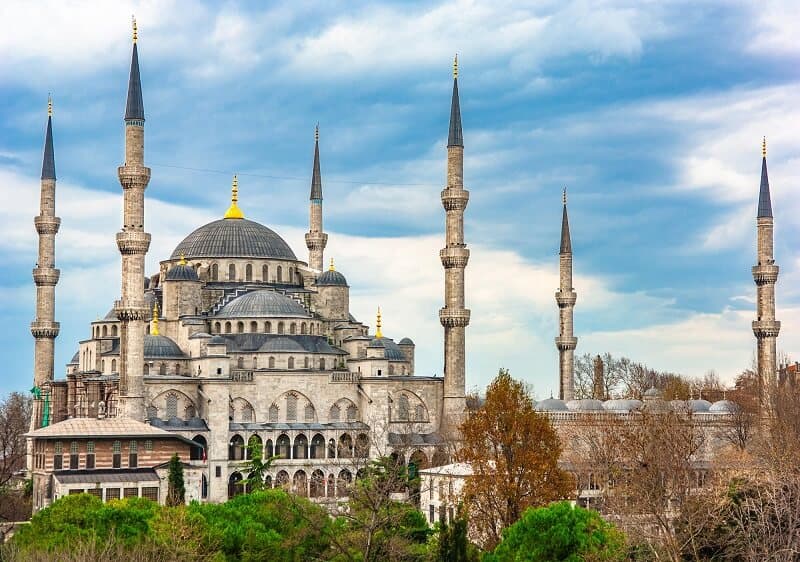
 Modrá mešita v Istanbule
BLUE MOSQUE (Sultanahmet Mosque)
The Sultan Ahmed Mosque (Turkish: Sultan Ahmet Camii), or the Blue Mosque, is a historical imperial mosque from the Ottoman era that can be found in Istanbul, Turkey. It is both a working mosque and a major tourist destination. During Ahmed I's reign (1609–1616), its construction began. The Külliye is home to a madrasah, a hospice, and the tomb of Ahmed. Inside, the walls are covered in hand-painted blue tiles, and at night, the mosque's five main domes, six minarets, and eight secondary domes are illuminated, bathing the entire structure in a calming blue glow. Until the construction of the Blue Mosque, the Hagia Sophia was the most important mosque in Istanbul. In 1985, UNESCO designated the "Historic Areas of Istanbul," which included the Blue Mosque, as a World Heritage Site.
History of the Blue Mosque
Sultan Ahmed, rozhodol som sa postaviť masívnu mešitu v Istanbule, aby som znovu potvrdil osmanskú moc po mieri v Zsitvatoroku a drvajúcej strate v vojne 1603-18 s Perziou. Po viac ako štyridsiatich rokoch to bude prvá cisárska mešita, ktorá sa bude stavať. Zatiaľ čo jeho predkovia použili vojnovú booty na financovanie výstavby mešity, Ahmed I namiesto toho požičal peniaze od pokladnice kvôli jeho nedostatku významných vojenských víťazstiev. Od roku 1609 výstavba tejto štruktúry trvala až do roku 1616.
Infuriating the Muslim scholars known as ulama was the fact that the sultan's army had been paid for out of the general budget rather than the spoils of war. The mosque was constructed on the site of the former palace of the Byzantine emperors and faces the Hagia Sophia, the city's primary imperial mosque at the time, and the hippodrome, a prominent symbolic location in the city's southern skyline. The south side of the mosque is built on the foundations and vaults of the previous Grand Palace.
The Blue Mosque's Architecture
The Blue Mosque represents two centuries of development in Ottoman mosque architecture and Byzantine church architecture. It is the last great mosque from the classical period of the Ottoman Empire and combines traditional Islamic architecture with some Byzantine features from the nearby Hagia Sophia. By remembering what his teacher, Sinan, had taught him, the architect made a building of the epic size and opulent beauty.
Blue Mosque's Minarets
Len dve mešity v Turecku majú až šesť minaretov, z ktorých jedna je Modrá mešita.
The Sabanci Mosque in Adana is the second. The Sultan took some heat for his arrogance after the number of minarets was made public, as they matched the number at the Ka'aba Mosque in Mecca. To solve this issue, he had a seventh minaret added to the Mecca mosque.
The Blue Mosque has four minarets, one at each of its four corners. These minarets, called Serefe, are fluted and pencil-shaped; they each have three balconies supported by stalactite corbels, whereas the other two minarets at the end of the forecourt have only two. Once upon a time, the muezzin, or prayer caller, had to make the ascent of a steep, narrow spiral staircase five times each day to make the call to prayer.
Volanie je teraz vysielané prostredníctvom verejného oznámenia a môže byť počuť po celom historickom okrese mesta a odznievajú od iných mešít v oblasti.Keď slnko zapadá a mešita je brilantne osvetlená farebnými povodňovými svetlami, obrovské davy Turkov a turistov sa zhromažďujú v parku pred ním, aby počuli výzvu na večerné modlitby.
The Blue Mosque's Interior
More than 20,000 hand-made ceramic tiles, made in Iznik (Nicaea), in more than fifty different tulip designs, line the lower levels and piers of the Blue Mosque's interior. Even though the tiles on the ground floor have a classic look, the ones in the upper galleries are more ornate and feature bright colors and elaborate patterns of flowers, fruit, and cypresses. Iznik master potters Kasap Haci and Avanos and Cappadocia native Baris Efendi oversaw the production of over 20,000 tiles. Since the cost of tiles in general went up over time, the sultan issued a decree setting a standard price for them. The building's tiles gradually became of lower quality as time went on. The glazes have dulled, and the colors have faded. The tiles on the rear wall of the balcony are originals that were salvaged from the harem of the Topkapi Palace after it burned down in 1574.
Blue is the predominant color used on the upper levels of the mosque's interior. The building has over two hundred stained-glass windows, many of which feature elaborate designs. Ostrich eggs were hung from the chandeliers to keep spiders out of the mosque and prevent the buildup of cobwebs. Many of the Qur'anic verses adorning the walls were written by Seyyid Kasim Gubari, widely considered the greatest calligrapher of his era.
Koberce, ktoré poskytujú verní jednotlivci a nahradené, keď sa vyzliekajú, pokrývajú podlahy. Hojnosť vysokých, širokých okien vytvára ilúziu priestranného interiéru. V každej exedre mešity je päť okien a niektoré z nich sú pokryté slepicami.
V centrálnej kupole je celkovo 28 okien, pričom v každej z dvoch vonkajších kupolí je 14 (z ktorých sú štyri slepé).Benátske úrady darovali sultánovi sfarbené sklenené okná.
The mihrab is the most important part of the mosque's interior. It is made of marble and has intricate carvings, a stalactite niche, and two panels with writing on them.
Keramické dlaždice pokrývajú susedné steny. Avšak množstvo okien v oblasti znižuje účinok. Imám dodáva svoje kázanie v poludnie v piatok a v iné sväté dni z pulpity nazývanej minber, ktorá sa nachádza vpravo od mihrab a je dôkladne zdobená. Dokonca aj keď je mešita v kapacite, každý bude môcť vidieť a počuť imáma vďaka premyslenému rozloženiu.
The southeast corner is home to the royal kiosk, which features a platform, loggia, and two small private rooms for the king and queen. You can use it to enter the Blue Mosque's royal loge, which is located in the southeast corner of the mosque's upper gallery. During the 1826 crackdown on the defiant Janissary Corps, the Grand Vizier set up headquarters in these private quarters. In Turkey, this section of the palace is known as the hünkâr mahfil, and it is surrounded by ten marble columns.
Once adorned with gold and precious stones, the Blue Mosque's many lamps are now plain white. Ostrich eggs and crystal balls were hidden in the various glass jars. All of these ornaments were stolen or removed to be displayed in Istanbul museums.
Pôvodne napísaný veľkým 17. storočia kaligrafom Ametli Kasim Gubarim, mená kalifov a verše z Koránu zdobia veľké tabule, ktoré vyrovnávajú steny.
The Blue Mosque's Exterior
The large forecourt's facade was inspired by Istanbul's Süleymaniye Mosque but features turrets instead of minarets on the four corner domes. The court, which is enclosed by a continuous vaulted arcade, is roughly the same size as the mosque. The courtyard is quite large for its diminutive central hexagonal fountain. The architectural highlight of the courtyard is the monumental but narrow gateway that leads to it through the arcade. The small ribbed dome atop the tall lobate is topped by a fine stalactite structure.
When entering the Mosque's western court, you'll notice a heavy iron chain hanging from the ceiling. The sultan was the only person permitted to ride a horse into the Blue Mosque's courtyard. To avoid being struck by the chain, the sultan must bend over slightly whenever he enters the court. Symbolically, it served to show the ruler's respect for the divine.
Frequently Asked Questions About the Blue Mosque
QČo je to Modrá mešita?
A: The Blue Mosque is an old mosque in Istanbul, Turkey. It is also called the Sultan Ahmed Mosque.
QKedy bola postavená Modrá mešita?
AMešita bola postavená v rokoch 1609 až 1616.
Q: Who built the Blue Mosque?
A: Ahmed I, the Ottoman Sultan, was the one who built the Blue Mosque.
QPrečo sa nazýva Modrá mešita?
AMešita sa nazýva Modrá mešita kvôli modrej dlažbe používané v jej interiéri.
Q: What are the main features of the Blue Mosque?
AModrá mešita má šesť minaretov, veľkú centrálnu kupolu a menšie kupoly, ktoré ju obklopujú, ako aj zložité kaligrafie a dlažby.
QKoľko kopulí má Modrá mešita?
AModrá mešita má jednu centrálnu kupolu a osem menších kupolí.
Q: What is the capacity of the Blue Mosque?
AModrá mešita môže ubytovať až 10 000 veriacich naraz.
QJe Modrá mešita otvorená pre návštevníkov?
AModrá mešita je otvorená pre návštevníkov a turistov okrem modlitebných hodín.
Q: What are the visiting hours for the Blue Mosque?
A: Visiting hours for the Blue Mosque are typically from 9:00 a.m. to 12:00 p.m. and from 2:00 p.m. to 4:00 p.m.
Q: How much does it cost to enter the Blue Mosque?
A: There is no admission fee to enter the Blue Mosque, but donations are appreciated.
Môžete si rezervovať Istanbul City Tour s našimi licencovanými sprievodcami.
Môžete si rezervovať prehliadku mesta Istanbul s našimi licencovanými sprievodcami.
Map of Blue Mosque