
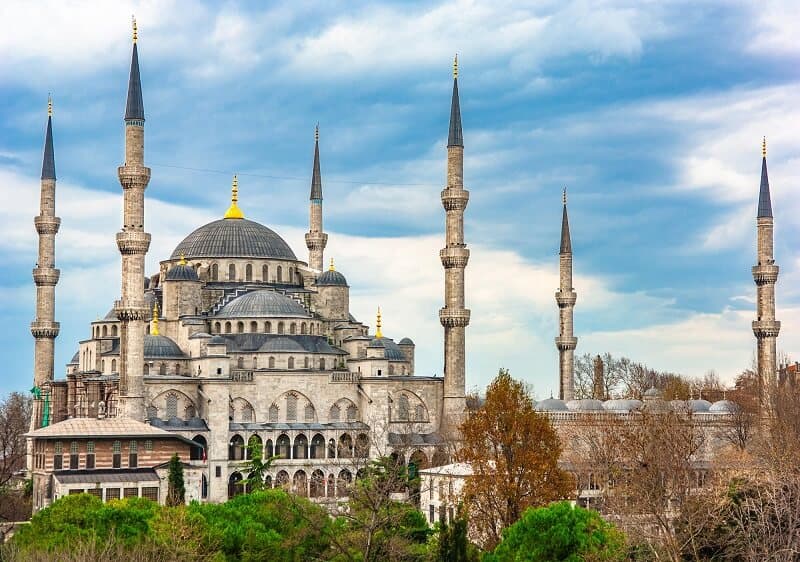
 Mesquita Azul de Istambul
A Mesquita Azul de Istambul
BLUE MOSQUE (Sultanahmet Mosque)
The Sultan Ahmed Mosque (Turkish: Sultan Ahmet Camii), or the Blue Mosque, is a historical imperial mosque from the Ottoman era that can be found in Istanbul, Turkey. It is both a working mosque and a major tourist destination. During Ahmed I's reign (1609–1616), its construction began. The Külliye is home to a madrasah, a hospice, and the tomb of Ahmed. Inside, the walls are covered in hand-painted blue tiles, and at night, the mosque's five main domes, six minarets, and eight secondary domes are illuminated, bathing the entire structure in a calming blue glow. Until the construction of the Blue Mosque, the Hagia Sophia was the most important mosque in Istanbul. In 1985, UNESCO designated the "Historic Areas of Istanbul," which included the Blue Mosque, as a World Heritage Site.
História da Mesquita Azul
Sultão Ahmed, decidi construir uma mesquita maciça em Istambul para reafirmar o poder otomano após a Paz de Zsitvatorok e a perda esmagadora na guerra de 1603-18 com a Pérsia. Depois de mais de quarenta anos, esta seria a primeira mesquita imperial a ser construída. Enquanto seus antepassados tinham usado botijas de guerra para financiar a construção da mesquita, Ahmed I em vez disso emprestou dinheiro do Tesouro devido à sua falta de vitórias militares notáveis. A partir de 1609, a construção desta estrutura durou até 1616.
Infuriating the Muslim scholars known as ulama was the fact that the sultan's army had been paid for out of the general budget rather than the spoils of war. The mosque was constructed on the site of the former palace of the Byzantine emperors and faces the Hagia Sophia, the city's primary imperial mosque at the time, and the hippodrome, a prominent symbolic location in the city's southern skyline. The south side of the mosque is built on the foundations and vaults of the previous Grand Palace.
The Blue Mosque's Architecture
The Blue Mosque represents two centuries of development in Ottoman mosque architecture and Byzantine church architecture. It is the last great mosque from the classical period of the Ottoman Empire and combines traditional Islamic architecture with some Byzantine features from the nearby Hagia Sophia. By remembering what his teacher, Sinan, had taught him, the architect made a building of the epic size and opulent beauty.
Blue Mosque's Minarets
Apenas duas mesquitas em toda a Turquia têm seis minaretes, e uma delas é a Mesquita Azul.
The Sabanci Mosque in Adana is the second. The Sultan took some heat for his arrogance after the number of minarets was made public, as they matched the number at the Ka'aba Mosque in Mecca. To solve this issue, he had a seventh minaret added to the Mecca mosque.
The Blue Mosque has four minarets, one at each of its four corners. These minarets, called Serefe, are fluted and pencil-shaped; they each have three balconies supported by stalactite corbels, whereas the other two minarets at the end of the forecourt have only two. Once upon a time, the muezzin, or prayer caller, had to make the ascent of a steep, narrow spiral staircase five times each day to make the call to prayer.
A chamada agora é transmitida através de um sistema de anúncio público e pode ser ouvida em todo o distrito histórico da cidade e ecoada por outras mesquitas na área.À medida que o sol se põe e a mesquita é brilhantemente iluminada por luzes coloridas, grandes multidões de turcos e turistas se reúnem no parque em frente a ele para ouvir o apelo para as orações da noite.
The Blue Mosque's Interior
More than 20,000 hand-made ceramic tiles, made in Iznik (Nicaea), in more than fifty different tulip designs, line the lower levels and piers of the Blue Mosque's interior. Even though the tiles on the ground floor have a classic look, the ones in the upper galleries are more ornate and feature bright colors and elaborate patterns of flowers, fruit, and cypresses. Iznik master potters Kasap Haci and Avanos and Cappadocia native Baris Efendi oversaw the production of over 20,000 tiles. Since the cost of tiles in general went up over time, the sultan issued a decree setting a standard price for them. The building's tiles gradually became of lower quality as time went on. The glazes have dulled, and the colors have faded. The tiles on the rear wall of the balcony are originals that were salvaged from the harem of the Topkapi Palace after it burned down in 1574.
Blue is the predominant color used on the upper levels of the mosque's interior. The building has over two hundred stained-glass windows, many of which feature elaborate designs. Ostrich eggs were hung from the chandeliers to keep spiders out of the mosque and prevent the buildup of cobwebs. Many of the Qur'anic verses adorning the walls were written by Seyyid Kasim Gubari, widely considered the greatest calligrapher of his era.
Os tapetes, fornecidos por indivíduos fiéis e substituídos à medida que se desgastam, cobrem os pisos. A abundância de janelas altas e largas cria a ilusão de um interior espaçoso. Há cinco janelas em cada exedra da mesquita, e algumas delas são cobertas por cegas.
Há um total de 28 janelas na cúpula central, com 14 em cada uma das duas cúpulas externas (quatro das quais são cegas). as autoridades venezianas apresentaram ao sultão janelas de vidro pintado como um presente.
The mihrab is the most important part of the mosque's interior. It is made of marble and has intricate carvings, a stalactite niche, and two panels with writing on them.
As telhas cerâmicas cobrem as paredes adjacentes. No entanto, a abundância de janelas na área diminui o efeito. O imã entrega seu sermão ao meio-dia nas sextas-feiras e outros dias sagrados de um palácio chamado um minber, que está localizado à direita do mihrab e é elaboradamente decorado. Mesmo quando a mesquita está em capacidade, todos poderão ver e ouvir o imã graças ao layout pensativo.
The southeast corner is home to the royal kiosk, which features a platform, loggia, and two small private rooms for the king and queen. You can use it to enter the Blue Mosque's royal loge, which is located in the southeast corner of the mosque's upper gallery. During the 1826 crackdown on the defiant Janissary Corps, the Grand Vizier set up headquarters in these private quarters. In Turkey, this section of the palace is known as the hünkâr mahfil, and it is surrounded by ten marble columns.
Once adorned with gold and precious stones, the Blue Mosque's many lamps are now plain white. Ostrich eggs and crystal balls were hidden in the various glass jars. All of these ornaments were stolen or removed to be displayed in Istanbul museums.
Originalmente escrito pelo grande caligrafista do século XVII Ametli Kasim Gubarim, os nomes dos califas e versos do Alcorão adornam as grandes tábuas que alinham as paredes.
The Blue Mosque's Exterior
The large forecourt's facade was inspired by Istanbul's Süleymaniye Mosque but features turrets instead of minarets on the four corner domes. The court, which is enclosed by a continuous vaulted arcade, is roughly the same size as the mosque. The courtyard is quite large for its diminutive central hexagonal fountain. The architectural highlight of the courtyard is the monumental but narrow gateway that leads to it through the arcade. The small ribbed dome atop the tall lobate is topped by a fine stalactite structure.
When entering the Mosque's western court, you'll notice a heavy iron chain hanging from the ceiling. The sultan was the only person permitted to ride a horse into the Blue Mosque's courtyard. To avoid being struck by the chain, the sultan must bend over slightly whenever he enters the court. Symbolically, it served to show the ruler's respect for the divine.
Perguntas frequentes sobre a Mesquita Azul
QO que é a Mesquita Azul?
A: The Blue Mosque is an old mosque in Istanbul, Turkey. It is also called the Sultan Ahmed Mosque.
QQuando foi construída a Mesquita Azul?
AA mesquita foi construída entre 1609 e 1616.
QQuem construiu a Mesquita Azul?
AAhmed I, o sultão otomano, foi quem construiu a Mesquita Azul.
QPor que é chamada de Mesquita Azul?
AA mesquita é chamada de Mesquita Azul por causa das telhas azuis usadas na sua decoração interior.
QQuais são as principais características da Mesquita Azul?
AA Mesquita Azul tem seis minaretes, uma grande cúpula central e cúpulas menores que a rodeiam, bem como trabalhos de caligrafia e tijolos.
QQuantos cúpulas tem a Mesquita Azul?
AA Mesquita Azul tem uma cúpula central e oito cúpulas menores.
QQual é a capacidade da Mesquita Azul?
AA Mesquita Azul pode acomodar até 10.000 adoradores de uma só vez.
QA Mesquita Azul está aberta aos visitantes?
AA Mesquita Azul está aberta a visitantes e turistas, exceto durante os tempos de oração.
QQuais são os horários de visita para a Mesquita Azul?
AHorário de visita para a Mesquita Azul são tipicamente das 9:00 às 12:00 e das 2:00 às 4:00.
QQuanto custa entrar na Mesquita Azul?
ANão há taxa de entrada para entrar na Mesquita Azul, mas doações são apreciadas.
Você pode reservar um Tour da Cidade de Istambul com nossos guias de viagem licenciados.
Você pode reservar um passeio pela cidade de Istambul com nossos guias de viagem licenciados.
Mapa da Mesquita Azul