
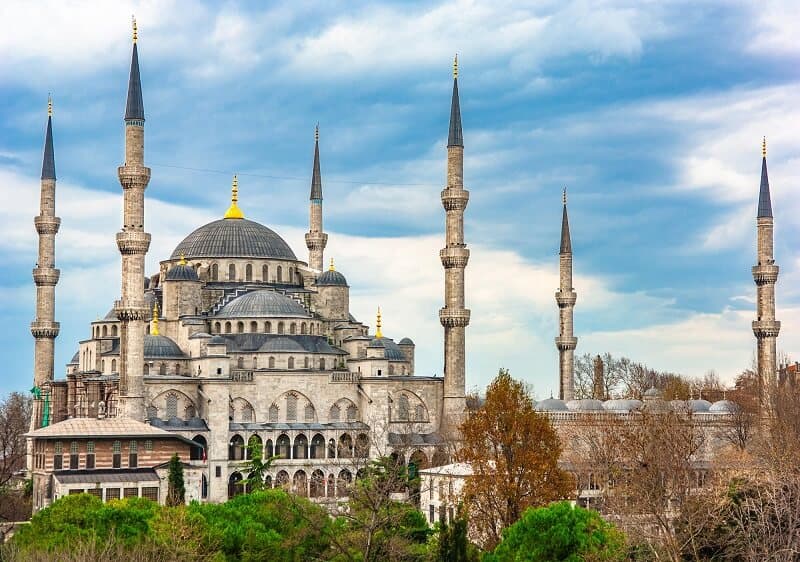
 Blue Mosque Istanbul
BLUE MOSQUE ISTANBUL
BLUE MOSQUE (Sultanahmet Mosque)
The Sultan Ahmed Mosque (Turkish: Sultan Ahmet Camii), or the Blue Mosque, is a historical imperial mosque from the Ottoman era that can be found in Istanbul, Turkey. It is both a working mosque and a major tourist destination. During Ahmed I's reign (1609–1616), its construction began. The Külliye is home to a madrasah, a hospice, and the tomb of Ahmed. Inside, the walls are covered in hand-painted blue tiles, and at night, the mosque's five main domes, six minarets, and eight secondary domes are illuminated, bathing the entire structure in a calming blue glow. Until the construction of the Blue Mosque, the Hagia Sophia was the most important mosque in Istanbul. In 1985, UNESCO designated the "Historic Areas of Istanbul," which included the Blue Mosque, as a World Heritage Site.
History of the Blue Mosque
Sultan Ahmed, tôi quyết định xây dựng một nhà thờ Hồi giáo khổng lồ ở Istanbul để khẳng định lại quyền lực Ottoman sau Hòa bình Zsitvatorok và sự mất mát tàn phá trong cuộc chiến 1603-18 với Ba Tư. Sau hơn bốn mươi năm, đây sẽ là nhà thờ Hồi giáo hoàng gia đầu tiên được xây dựng. Trong khi tổ tiên của ông đã sử dụng áo giáp chiến tranh để tài trợ cho việc xây dựng nhà thờ Hồi giáo, Ahmed I thay vào đó mượn tiền từ Kho bạc do thiếu chiến thắng quân sự đáng chú ý của ông. Bắt đầu từ năm 1609, việc xây dựng trên cấu trúc này kéo dài đến năm 1616.
Infuriating the Muslim scholars known as ulama was the fact that the sultan's army had been paid for out of the general budget rather than the spoils of war. The mosque was constructed on the site of the former palace of the Byzantine emperors and faces the Hagia Sophia, the city's primary imperial mosque at the time, and the hippodrome, a prominent symbolic location in the city's southern skyline. The south side of the mosque is built on the foundations and vaults of the previous Grand Palace.
The Blue Mosque's Architecture
The Blue Mosque represents two centuries of development in Ottoman mosque architecture and Byzantine church architecture. It is the last great mosque from the classical period of the Ottoman Empire and combines traditional Islamic architecture with some Byzantine features from the nearby Hagia Sophia. By remembering what his teacher, Sinan, had taught him, the architect made a building of the epic size and opulent beauty.
Blue Mosque's Minarets
Only two mosques in all of Turkey have as many as six minarets, and one of them is the Blue Mosque.
The Sabanci Mosque in Adana is the second. The Sultan took some heat for his arrogance after the number of minarets was made public, as they matched the number at the Ka'aba Mosque in Mecca. To solve this issue, he had a seventh minaret added to the Mecca mosque.
The Blue Mosque has four minarets, one at each of its four corners. These minarets, called Serefe, are fluted and pencil-shaped; they each have three balconies supported by stalactite corbels, whereas the other two minarets at the end of the forecourt have only two. Once upon a time, the muezzin, or prayer caller, had to make the ascent of a steep, narrow spiral staircase five times each day to make the call to prayer.
Cuộc gọi hiện đang được phát sóng qua một hệ thống thông báo công khai và có thể được nghe thấy trên toàn khu vực lịch sử của thành phố và được các nhà thờ Hồi giáo khác trong khu vực phản chiếu. Khi mặt trời lặn và nhà thờ Hồi giáo được chiếu sáng rực rỡ bởi đèn lũ lụt đầy màu sắc, đám đông người Thổ Nhĩ Kỳ và khách du lịch lớn tập hợp trong công viên trước mặt nó để nghe lời kêu gọi cầu nguyện buổi tối.
The Blue Mosque's Interior
More than 20,000 hand-made ceramic tiles, made in Iznik (Nicaea), in more than fifty different tulip designs, line the lower levels and piers of the Blue Mosque's interior. Even though the tiles on the ground floor have a classic look, the ones in the upper galleries are more ornate and feature bright colors and elaborate patterns of flowers, fruit, and cypresses. Iznik master potters Kasap Haci and Avanos and Cappadocia native Baris Efendi oversaw the production of over 20,000 tiles. Since the cost of tiles in general went up over time, the sultan issued a decree setting a standard price for them. The building's tiles gradually became of lower quality as time went on. The glazes have dulled, and the colors have faded. The tiles on the rear wall of the balcony are originals that were salvaged from the harem of the Topkapi Palace after it burned down in 1574.
Blue is the predominant color used on the upper levels of the mosque's interior. The building has over two hundred stained-glass windows, many of which feature elaborate designs. Ostrich eggs were hung from the chandeliers to keep spiders out of the mosque and prevent the buildup of cobwebs. Many of the Qur'anic verses adorning the walls were written by Seyyid Kasim Gubari, widely considered the greatest calligrapher of his era.
Thảm, được cung cấp bởi các cá nhân trung thành và thay thế khi họ mặc, bao phủ sàn nhà. Sự phong phú của cửa sổ cao, rộng tạo ra ảo tưởng của một nội thất rộng rãi. Có năm cửa sổ trong mỗi exedra của nhà thờ Hồi giáo, và một số trong số họ được bao phủ bởi những chiếc rèm cửa.
Có tổng cộng 28 cửa sổ trong ngọn đồi trung tâm, với 14 trong mỗi trong hai ngọn đồi bên ngoài (bốn trong số đó bị mù). các nhà chức trách Venetian đã tặng cho Sultan với cửa sổ thủy tinh màu như một món quà.
The mihrab is the most important part of the mosque's interior. It is made of marble and has intricate carvings, a stalactite niche, and two panels with writing on them.
Các gạch gốm phủ các bức tường liền kề. Tuy nhiên, sự phong phú của các cửa sổ trong khu vực làm giảm hiệu quả. Imam đưa bài giảng của mình vào buổi trưa vào thứ Sáu và các ngày thánh khác từ một bàn làm việc được gọi là minber, nằm ở bên phải của mihrab và được trang trí kỹ lưỡng. Ngay cả khi nhà thờ Hồi giáo có khả năng, mọi người sẽ có thể nhìn thấy và nghe thấy imam nhờ vào bố trí chu đáo.
The southeast corner is home to the royal kiosk, which features a platform, loggia, and two small private rooms for the king and queen. You can use it to enter the Blue Mosque's royal loge, which is located in the southeast corner of the mosque's upper gallery. During the 1826 crackdown on the defiant Janissary Corps, the Grand Vizier set up headquarters in these private quarters. In Turkey, this section of the palace is known as the hünkâr mahfil, and it is surrounded by ten marble columns.
Once adorned with gold and precious stones, the Blue Mosque's many lamps are now plain white. Ostrich eggs and crystal balls were hidden in the various glass jars. All of these ornaments were stolen or removed to be displayed in Istanbul museums.
Được viết bởi nhà điêu khắc vĩ đại thế kỷ 17 Ametli Kasim Gubarim, tên của các caliph và các câu từ Kinh Qur'an trang trí các bảng lớn sắp xếp các bức tường.
The Blue Mosque's Exterior
The large forecourt's facade was inspired by Istanbul's Süleymaniye Mosque but features turrets instead of minarets on the four corner domes. The court, which is enclosed by a continuous vaulted arcade, is roughly the same size as the mosque. The courtyard is quite large for its diminutive central hexagonal fountain. The architectural highlight of the courtyard is the monumental but narrow gateway that leads to it through the arcade. The small ribbed dome atop the tall lobate is topped by a fine stalactite structure.
When entering the Mosque's western court, you'll notice a heavy iron chain hanging from the ceiling. The sultan was the only person permitted to ride a horse into the Blue Mosque's courtyard. To avoid being struck by the chain, the sultan must bend over slightly whenever he enters the court. Symbolically, it served to show the ruler's respect for the divine.
Frequently Asked Questions About the Blue Mosque
Q: What is the Blue Mosque?
a): The Blue Mosque is an old mosque in Istanbul, Turkey. It is also called the Sultan Ahmed Mosque.
Q: When was the Blue Mosque built?
a)Nhà thờ Hồi giáo được xây dựng từ năm 1609 đến 1616.
Q: Who built the Blue Mosque?
a): Ahmed I, the Ottoman Sultan, was the one who built the Blue Mosque.
Q: Why is it called the Blue Mosque?
a): The mosque is called the Blue Mosque because of the blue tiles used in its interior decoration.
Q: What are the main features of the Blue Mosque?
a): The Blue Mosque has six minarets, a large central dome, and smaller domes surrounding it, as well as intricate calligraphy and tile work.
Q: How many domes does the Blue Mosque have?
a): The Blue Mosque has one central dome and eight smaller domes.
Q: What is the capacity of the Blue Mosque?
a): The Blue Mosque can accommodate up to 10,000 worshippers at a time.
Q: Is the Blue Mosque open to visitors?
a): Yes, the Blue Mosque is open to visitors and tourists, except during prayer times.
Q: What are the visiting hours for the Blue Mosque?
a): Visiting hours for the Blue Mosque are typically from 9:00 a.m. to 12:00 p.m. and from 2:00 p.m. to 4:00 p.m.
Q: How much does it cost to enter the Blue Mosque?
a): There is no admission fee to enter the Blue Mosque, but donations are appreciated.
Bạn có thể đặt tour du lịch thành phố Istanbul với hướng dẫn viên được cấp phép của chúng tôi. Các liên kết dưới đây:
Bạn có thể đặt tour du lịch thành phố Istanbul với hướng dẫn viên du lịch được cấp phép của chúng tôi. Các liên kết dưới đây:
Map of Blue Mosque