
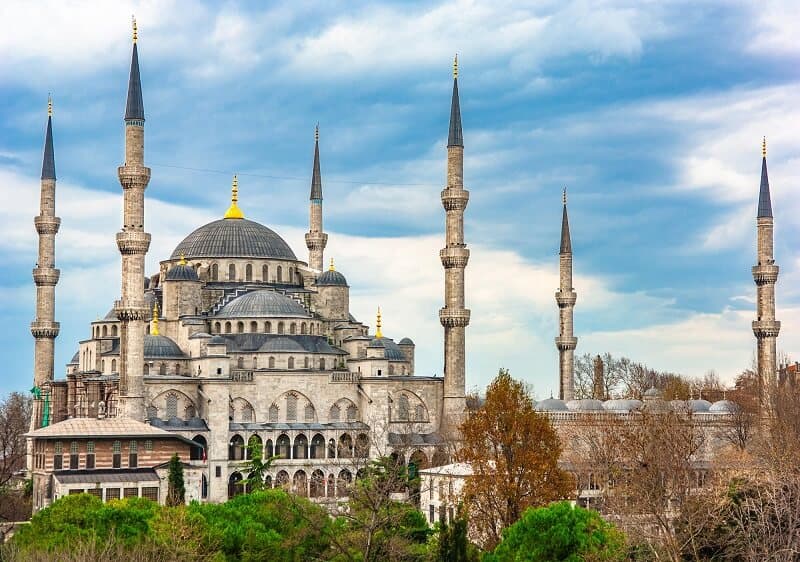
 伊斯坦布尔蓝色清真寺
BLUE MOSQUE (Sultanahmet Mosque)
The Sultan Ahmed Mosque (Turkish: Sultan Ahmet Camii), or the Blue Mosque, is a historical imperial mosque from the Ottoman era that can be found in Istanbul, Turkey. It is both a working mosque and a major tourist destination. During Ahmed I's reign (1609–1616), its construction began. The Külliye is home to a madrasah, a hospice, and the tomb of Ahmed. Inside, the walls are covered in hand-painted blue tiles, and at night, the mosque's five main domes, six minarets, and eight secondary domes are illuminated, bathing the entire structure in a calming blue glow. Until the construction of the Blue Mosque, the Hagia Sophia was the most important mosque in Istanbul. In 1985, UNESCO designated the "Historic Areas of Istanbul," which included the Blue Mosque, as a World Heritage Site.
蓝色清真寺的历史
阿哈德王,我决定在伊斯坦布尔建造一座大清真寺,以重申奥斯曼的权力,在齐塔瓦托洛克和平和在1603-18年与波斯的战争中遭受的毁灭性损失之后。经过40多年,这将是第一个被建造的帝国清真寺。虽然他的祖先曾用战争靴子资助清真寺建设,但阿哈德我因缺乏显著军事胜利而从财政部借钱。从1609年开始,这座建筑的建设一直持续到1616年。
Infuriating the Muslim scholars known as ulama was the fact that the sultan's army had been paid for out of the general budget rather than the spoils of war. The mosque was constructed on the site of the former palace of the Byzantine emperors and faces the Hagia Sophia, the city's primary imperial mosque at the time, and the hippodrome, a prominent symbolic location in the city's southern skyline. The south side of the mosque is built on the foundations and vaults of the previous Grand Palace.
The Blue Mosque's Architecture
The Blue Mosque represents two centuries of development in Ottoman mosque architecture and Byzantine church architecture. It is the last great mosque from the classical period of the Ottoman Empire and combines traditional Islamic architecture with some Byzantine features from the nearby Hagia Sophia. By remembering what his teacher, Sinan, had taught him, the architect made a building of the epic size and opulent beauty.
Blue Mosque's Minarets
土耳其只有两座清真寺有六座地雷,其中一座是蓝色清真寺。
The Sabanci Mosque in Adana is the second. The Sultan took some heat for his arrogance after the number of minarets was made public, as they matched the number at the Ka'aba Mosque in Mecca. To solve this issue, he had a seventh minaret added to the Mecca mosque.
The Blue Mosque has four minarets, one at each of its four corners. These minarets, called Serefe, are fluted and pencil-shaped; they each have three balconies supported by stalactite corbels, whereas the other two minarets at the end of the forecourt have only two. Once upon a time, the muezzin, or prayer caller, had to make the ascent of a steep, narrow spiral staircase five times each day to make the call to prayer.
此次呼叫现在通过公共公告系统播出,可以听到整个城市的历史区,并被该地区的其他清真寺响起. 随着太阳落下,清真寺被彩色洪水灯光明亮,庞大的土耳其人群和游客聚集在公园前面听到晚上祈祷的呼吁。
The Blue Mosque's Interior
More than 20,000 hand-made ceramic tiles, made in Iznik (Nicaea), in more than fifty different tulip designs, line the lower levels and piers of the Blue Mosque's interior. Even though the tiles on the ground floor have a classic look, the ones in the upper galleries are more ornate and feature bright colors and elaborate patterns of flowers, fruit, and cypresses. Iznik master potters Kasap Haci and Avanos and Cappadocia native Baris Efendi oversaw the production of over 20,000 tiles. Since the cost of tiles in general went up over time, the sultan issued a decree setting a standard price for them. The building's tiles gradually became of lower quality as time went on. The glazes have dulled, and the colors have faded. The tiles on the rear wall of the balcony are originals that were salvaged from the harem of the Topkapi Palace after it burned down in 1574.
Blue is the predominant color used on the upper levels of the mosque's interior. The building has over two hundred stained-glass windows, many of which feature elaborate designs. Ostrich eggs were hung from the chandeliers to keep spiders out of the mosque and prevent the buildup of cobwebs. Many of the Qur'anic verses adorning the walls were written by Seyyid Kasim Gubari, widely considered the greatest calligrapher of his era.
地毯,由忠实的个人提供,并在他们穿着时更换,覆盖地板. 宽敞的窗户的丰富创造了宽敞的内部的幻觉. 清真寺的每个exedra有五个窗户,其中一些被窗帘覆盖。
中心大楼共有28个窗户,每个外层大楼有14个(其中4个是盲目的)。威尼斯当局将苏丹带有彩色玻璃窗户作为礼物。
The mihrab is the most important part of the mosque's interior. It is made of marble and has intricate carvings, a stalactite niche, and two panels with writing on them.
陶瓷砖覆盖了邻近的墙壁,但是,该地区的窗户数量减少了效果,伊玛目在周五和其他圣日中午从一个名为明伯的书房讲道,位于米拉布的右侧,并且精心装饰。即使清真寺在容量之下,每个人都能够看到和听到伊玛目,感谢其精心设计。
The southeast corner is home to the royal kiosk, which features a platform, loggia, and two small private rooms for the king and queen. You can use it to enter the Blue Mosque's royal loge, which is located in the southeast corner of the mosque's upper gallery. During the 1826 crackdown on the defiant Janissary Corps, the Grand Vizier set up headquarters in these private quarters. In Turkey, this section of the palace is known as the hünkâr mahfil, and it is surrounded by ten marble columns.
Once adorned with gold and precious stones, the Blue Mosque's many lamps are now plain white. Ostrich eggs and crystal balls were hidden in the various glass jars. All of these ornaments were stolen or removed to be displayed in Istanbul museums.
最初由17世纪伟大的 ⁇ 写者阿米特利·卡西姆·古巴里姆(Ametli Kasim Gubarim)写,哈里夫的名字和《古兰经》的诗句装饰了围墙的大板块。
The Blue Mosque's Exterior
The large forecourt's facade was inspired by Istanbul's Süleymaniye Mosque but features turrets instead of minarets on the four corner domes. The court, which is enclosed by a continuous vaulted arcade, is roughly the same size as the mosque. The courtyard is quite large for its diminutive central hexagonal fountain. The architectural highlight of the courtyard is the monumental but narrow gateway that leads to it through the arcade. The small ribbed dome atop the tall lobate is topped by a fine stalactite structure.
When entering the Mosque's western court, you'll notice a heavy iron chain hanging from the ceiling. The sultan was the only person permitted to ride a horse into the Blue Mosque's courtyard. To avoid being struck by the chain, the sultan must bend over slightly whenever he enters the court. Symbolically, it served to show the ruler's respect for the divine.
关于蓝色清真寺的常见问题
Q ⁇蓝色清真寺是什么?
A 是: The Blue Mosque is an old mosque in Istanbul, Turkey. It is also called the Sultan Ahmed Mosque.
Q ⁇蓝色清真寺是什么时候建成的?
A 是清真寺建于1609年至1616年之间。
Q ⁇谁建造了蓝色清真寺?
A 是阿哈迈德一世,奥斯曼苏丹,是谁建造了蓝色清真寺。
Q ⁇为什么叫蓝色清真寺?
A 是清真寺被称为蓝色清真寺,因为它在内部装饰中使用的蓝色砖。
Q ⁇蓝色清真寺的主要特点是什么?
A 是蓝色清真寺有六座地雷,一个大中央大楼,周围的小型大楼,以及复杂的书写和砖的工作。
Q ⁇蓝色清真寺有多少个大教堂?
A 是蓝色清真寺有一个中央大楼和八个较小的大楼。
Q ⁇蓝色清真寺的能力是什么?
A 是蓝色清真寺可容纳一时最多10万名崇拜者。
Q ⁇蓝色清真寺是否对游客开放?
A 是是的,蓝色清真寺是开放给游客和游客,除了祈祷时间。
Q ⁇: 蓝色清真寺的访问时间是多少?
A 是: 参观蓝色清真寺的时间通常是上午9点到下午12点,下午2点到下午4点。
Q ⁇进入蓝色清真寺要多少钱?
A 是没有入场费进入蓝色清真寺,但捐款受到欢迎。
您可以与我们的授权导游预订伊斯坦布尔城市之旅。 链接如下:
您可以与我们的授权的旅游指南预订伊斯坦布尔市之旅。 链接如下:
蓝色清真寺地图