
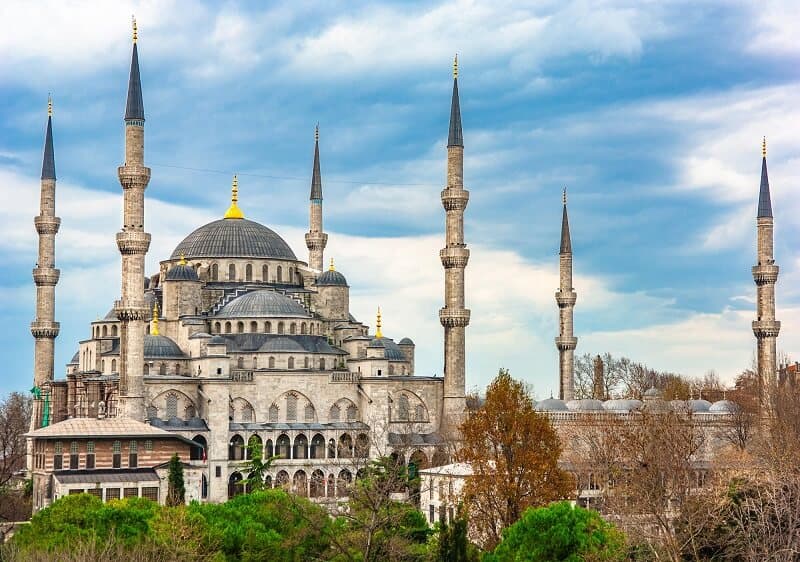
 Die Blaue Moschee Istanbul
BLUE MOSQUE (Sultanahmet Mosque)
The Sultan Ahmed Mosque (Turkish: Sultan Ahmet Camii), or the Blue Mosque, is a historical imperial mosque from the Ottoman era that can be found in Istanbul, Turkey. It is both a working mosque and a major tourist destination. During Ahmed I's reign (1609–1616), its construction began. The Külliye is home to a madrasah, a hospice, and the tomb of Ahmed. Inside, the walls are covered in hand-painted blue tiles, and at night, the mosque's five main domes, six minarets, and eight secondary domes are illuminated, bathing the entire structure in a calming blue glow. Until the construction of the Blue Mosque, the Hagia Sophia was the most important mosque in Istanbul. In 1985, UNESCO designated the "Historic Areas of Istanbul," which included the Blue Mosque, as a World Heritage Site.
History of the Blue Mosque
Sultan Ahmed, ich beschloss, eine massive Moschee in Istanbul zu bauen, um die osmanische Macht nach dem Frieden von Zsitvatorok und dem zermalmenden Verlust im Krieg von 1603-18 mit Persien wieder zu bekräftigen. Nach mehr als vierzig Jahren wäre dies die erste kaiserliche Moschee, die gebaut wird. Während seine Vorfahren Kriegsboote verwendet hatten, um den Moscheebau zu finanzieren, leihte Ahmed I stattdessen Geld von der Schatzkammer wegen seines Mangels an bemerkenswerten militärischen Siegen.
Infuriating the Muslim scholars known as ulama was the fact that the sultan's army had been paid for out of the general budget rather than the spoils of war. The mosque was constructed on the site of the former palace of the Byzantine emperors and faces the Hagia Sophia, the city's primary imperial mosque at the time, and the hippodrome, a prominent symbolic location in the city's southern skyline. The south side of the mosque is built on the foundations and vaults of the previous Grand Palace.
The Blue Mosque's Architecture
Die Blaue Moschee repräsentiert zwei Jahrhunderte der Entwicklung in der osmanischen Moscheearchitektur und der byzantinischen Kirchenarchitektur. Es ist die letzte große Moschee aus der klassischen Periode des osmanischen Reiches und kombiniert traditionelle islamische Architektur mit einigen byzantinischen Merkmalen aus der nahe gelegenen Hagia Sophia. Indem er sich daran erinnert, was sein Lehrer, Sinan, ihm beigebracht hatte, machte der Architekt ein Gebäude der epischen Größe und üppiger Schönheit.
Blue Mosque's Minarets
Nur zwei Moscheen in der Türkei haben so viele wie sechs Minarette, und eine davon ist die Blaue Moschee.
The Sabanci Mosque in Adana is the second. The Sultan took some heat for his arrogance after the number of minarets was made public, as they matched the number at the Ka'aba Mosque in Mecca. To solve this issue, he had a seventh minaret added to the Mecca mosque.
The Blue Mosque has four minarets, one at each of its four corners. These minarets, called Serefe, are fluted and pencil-shaped; they each have three balconies supported by stalactite corbels, whereas the other two minarets at the end of the forecourt have only two. Once upon a time, the muezzin, or prayer caller, had to make the ascent of a steep, narrow spiral staircase five times each day to make the call to prayer.
Der Anruf wird jetzt über ein öffentliches Ankündigungs-System ausgestrahlt und kann im gesamten historischen Stadtteil der Stadt gehört werden und von anderen Moscheen in der Gegend echo.Während die Sonne untergeht und die Moschee von farbigen Überschwemmungsleuchten brillant beleuchtet wird, versammeln sich riesige Menschenmengen von Türken und Touristen im Park vor ihm, um den Ruf zu Abendgebeten zu hören.
The Blue Mosque's Interior
More than 20,000 hand-made ceramic tiles, made in Iznik (Nicaea), in more than fifty different tulip designs, line the lower levels and piers of the Blue Mosque's interior. Even though the tiles on the ground floor have a classic look, the ones in the upper galleries are more ornate and feature bright colors and elaborate patterns of flowers, fruit, and cypresses. Iznik master potters Kasap Haci and Avanos and Cappadocia native Baris Efendi oversaw the production of over 20,000 tiles. Since the cost of tiles in general went up over time, the sultan issued a decree setting a standard price for them. The building's tiles gradually became of lower quality as time went on. The glazes have dulled, and the colors have faded. The tiles on the rear wall of the balcony are originals that were salvaged from the harem of the Topkapi Palace after it burned down in 1574.
Blue is the predominant color used on the upper levels of the mosque's interior. The building has over two hundred stained-glass windows, many of which feature elaborate designs. Ostrich eggs were hung from the chandeliers to keep spiders out of the mosque and prevent the buildup of cobwebs. Many of the Qur'anic verses adorning the walls were written by Seyyid Kasim Gubari, widely considered the greatest calligrapher of his era.
Teppiche, von treuen Personen zur Verfügung gestellt und ersetzt, wie sie ausziehen, bedecken die Böden. Die Fülle von hohen, breiten Fenstern schafft die Illusion eines geräumigen Interieurs. Es gibt fünf Fenster in jeder Exedra der Moschee, und einige von ihnen sind mit Blinden bedeckt.
Es gibt insgesamt 28 Fenster in der zentralen Kuppel, mit 14 in jeder der beiden äußeren Kuppeln (von denen vier blind sind). venezianische Behörden präsentierten dem Sultan mit geschmückten Glasfenstern als Geschenk.
The mihrab is the most important part of the mosque's interior. It is made of marble and has intricate carvings, a stalactite niche, and two panels with writing on them.
Keramikfliesen bedecken die angrenzenden Wände. Die Fülle von Fenstern in der Gegend verringert jedoch die Wirkung. Der Imam gibt seine Predigt am Mittag am Freitag und an anderen heiligen Tagen von einer Pultheile namens Minber ab, die sich rechts vom Mikhrab befindet und ausführlich dekoriert ist. Auch wenn die Moschee in der Lage ist, wird jeder dank der nachdenklichen Anordnung den Imam sehen und hören können.
The southeast corner is home to the royal kiosk, which features a platform, loggia, and two small private rooms for the king and queen. You can use it to enter the Blue Mosque's royal loge, which is located in the southeast corner of the mosque's upper gallery. During the 1826 crackdown on the defiant Janissary Corps, the Grand Vizier set up headquarters in these private quarters. In Turkey, this section of the palace is known as the hünkâr mahfil, and it is surrounded by ten marble columns.
Once adorned with gold and precious stones, the Blue Mosque's many lamps are now plain white. Ostrich eggs and crystal balls were hidden in the various glass jars. All of these ornaments were stolen or removed to be displayed in Istanbul museums.
Ursprünglich von dem großen Kalligraphen des 17. Jahrhunderts Ametli Kasim Gubarim geschrieben, schmücken die Namen der Kalifen und Verse aus dem Koran die großen Tafeln, die die Wände linieren.
The Blue Mosque's Exterior
The large forecourt's facade was inspired by Istanbul's Süleymaniye Mosque but features turrets instead of minarets on the four corner domes. The court, which is enclosed by a continuous vaulted arcade, is roughly the same size as the mosque. The courtyard is quite large for its diminutive central hexagonal fountain. The architectural highlight of the courtyard is the monumental but narrow gateway that leads to it through the arcade. The small ribbed dome atop the tall lobate is topped by a fine stalactite structure.
When entering the Mosque's western court, you'll notice a heavy iron chain hanging from the ceiling. The sultan was the only person permitted to ride a horse into the Blue Mosque's courtyard. To avoid being struck by the chain, the sultan must bend over slightly whenever he enters the court. Symbolically, it served to show the ruler's respect for the divine.
Frequently Asked Questions About the Blue Mosque
QWas ist die Blaue Moschee?
A: The Blue Mosque is an old mosque in Istanbul, Turkey. It is also called the Sultan Ahmed Mosque.
QWann wurde die Blaue Moschee erbaut?
ADie Moschee wurde zwischen 1609 und 1616 erbaut.
QWer hat die Blaue Moschee gebaut?
AAhmed I., der osmanische Sultan, war derjenige, der die Blaue Moschee erbaute.
QWarum wird sie die Blaue Moschee genannt?
ADie Moschee wird wegen der blauen Fliesen, die in der Innenarchitektur verwendet werden, als Blaue Moschee bezeichnet.
Q: What are the main features of the Blue Mosque?
ADie Blaue Moschee hat sechs Minarette, eine große zentrale Kuppel und kleinere Kuppeln um sie herum, sowie komplizierte Kalligraphie und Fliesenarbeiten.
QWie viele Kuppeln hat die Blaue Moschee?
ADie Blaue Moschee hat eine zentrale Kuppel und acht kleinere Kuppeln.
Q: What is the capacity of the Blue Mosque?
ADie Blaue Moschee kann bis zu 10.000 Anbeter gleichzeitig aufnehmen.
QIst die Blaue Moschee für Besucher geöffnet?
AJa, die Blaue Moschee ist für Besucher und Touristen geöffnet, außer während der Gebetszeiten.
Q: Wie sind die Besuchszeiten für die Blaue Moschee?
A: Die Besuchszeiten für die Blaue Moschee sind in der Regel von 9:00 bis 12:00 Uhr und von 2:00 bis 4:00 Uhr.
QWie viel kostet es, die Blaue Moschee zu betreten?
A: Es gibt keine Eintrittsgebühr für den Eintritt in die Blaue Moschee, aber Spenden werden geschätzt.
Sie können eine Istanbul City Tour mit unseren lizenzierten Reiseleitern buchen. Die Links sind unten:
Sie können eine Istanbul City Tour mit unseren lizenzierten Reiseleitern buchen. Die Links sind unten:
Map of Blue Mosque