
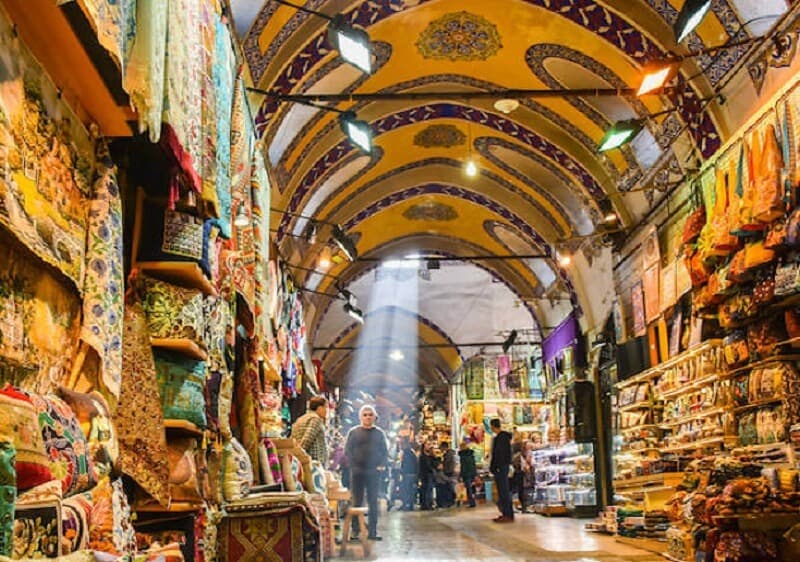
 Grand-Bazar à Istanbul
Le Grand Bazar d'Istanbul
Histoire du Grand Bazar
The Grand Bazaar is one of Istanbul's most recognizable landmarks and a bustling commercial center that currently employs 26,000 people and sees between 250,000 and 400,000 visitors every day.
It must compete with the modern shopping malls common in Istanbul, but its beauty and fascination represent a formidable advantage for it. On the 550th anniversary of the complex in 2011, the head of the Grand Bazaar Artisans Association said that it was the most visited landmark in the world.
The building's infrastructure, heating, and lighting will all be updated thanks to a restoration project set to begin in 2012. The stalls inside the market will be renovated, and any additions made later will be torn down. This plan will address the major issues plaguing the market, such as the lack of a restroom in the entire bazaar (now it is solved and there are many toilet facilities in the Grand Bazaar). Also, because there haven't been enough controls in the past few years, many dealers have taken out columns and walls from their stores. This, along with the fact that stolen lead was replaced with concrete on the roof of the market, has made it very dangerous for the earthquake that is expected to hit Istanbul in the next few years.
Except for Sundays and national holidays, the Grand Bazaar is open from 9:00 a.m. to 9:00 p.m. every day.
History of the Grand Bazaar
Shortly after the Ottoman conquest of Constantinople, in the winter of 1455–56, work began on what would become the Grand Bazaar's central market as part of a larger plan to boost the city's economy. A building specifically for the exchange of textiles was commissioned by Sultan Mehmet II. It was known in Ottoman Turkish as Bezzâzistan-Cedîd ("New Bedesten") and Cevâhir Bedestan ('Bedesten of Gems'). The Persian word bezestan, meaning "bazaar of the cloth sellers," was the inspiration for the English word bedesten. The structure, known variously as the "internal" (Ic), "ancient" (Atik), or "old" (Eski) Bedesten in Turkish, is located on the southwestern slope of Istanbul's third hill, between the ruins of the ancient Fora of Constantine and the Fora of Theodosius. It was also near the first sultan’s palace, the Old Palace (Eski Sarayi), which was also under construction in those same years, and not far from the Artopoleia (in Greek) (Άρτoπωλεία), the city’s bakers’ quarter in Byzantine times.
During the 1460s and 1461s, the Bedesten was completed and donated to the Aya Sofya Mosque's waqf. Even though most of the building is from the second half of the 15th century, academics have pointed to the Byzantine relief of a Comnenian eagle that is still on top of the East Gate (Kuyumcular Kapisi) of the Bedesten as proof that it was built in the Byzantine era.
A slave market, known in Turkish as Esir Pazari, operated not far from the Bedesten, a practice that had been maintained since Byzantine times. The old book market (Sahaflar Carsisi) was relocated from the bazaar to its present picturesque location near the Beyazid Mosque. Other important markets in the area were the "second-hand market" (Turkish: "Bit Pazari"), the "Long Market" (Uzun Carsi), which was the same as the Greek "Long Portico" (Makros Embolos), and the "Long Market."
Mehmet II had a second covered market built to the north of the first. It was called Kücük (which means "Little"), Cedit (which means "New"), or Yeni (both of which mean "New") Bedesten. The name comes from a type of thread that was woven in Bursa and had the color of sandalwood.
Après la construction du Sandal Bedesten, l’industrie textile y déménagea, tandis que le Cevahir Bedesten devint le domaine exclusif du secteur du commerce de haute qualité. Ils étaient à l’origine deux structures distinctes. Il y avait des ruines d’église et une grande citerne entre eux et la mosquée de Beyazid, comme l’a noté un voyageur français du 16ème siècle nommé Pierre Gilles. Cependant, de nombreux commerçants ont rapidement mis en place un magasin dans les espaces entre eux et autour d’eux, et bientôt un quartier entier a été consacré au commerce.
Selon un recensement effectué en 1890, le Bazaar abrite 4399 magasins ouverts, 2 bedesten, 2195 chambres, 1 hamam, 1 mosquée, 10 medrasas, 19 fontaines (2 sadirvan et 1 sebil), 1 mausolée et 24 han. Il y a 3 000 magasins répartis sur 61 rues dans la zone construite à 30,7% qui est gardée par 18 portes.
The last major disaster was an earthquake that struck Istanbul in 1894. Mahmud Celaleddin Paşa, the Minister of Public Works, oversaw the reconstruction of the damaged bazaar until 1898, during which time the size of the complex was reduced. While the Kütkculer Kapi and the old gate were demolished in the west, the Bit Pazari was left outside the new perimeter and turned into an open-air road known as Cadircilar Caddesi (the "Tentmaker Road"). Among all the hans that belonged to the market, many were left outside, and only nine remained enclosed in the structure.
Après que ses commerçants textiles aient été chassés de l’activité par la concurrence européenne, la ville d’Istanbul a acheté le Sandal Bedesten en 1914 et a commencé à l’utiliser comme maison d’enchères pour les tapis l’année suivante. En 1927, les rues et sections du bazar ont officiellement reçu leurs noms actuels.
The complex was last renovated in the 1980s. At the same time, the market's advertising posters were taken down.
The architecture of the Grand Bazaar
En termes de disposition, le Ic Bedesten est carré (43,30 m x 29,50 m). Vingt-quatre piliers en pierre soutiennent les trois rangées de baies. Chacune des tours a sa tombe en briques en toit à la trompette. 44 chambres sous-terraines (turque: mahzen) ont été construites dans les murs intérieurs et extérieurs. Bedesten reçoit sa lumière naturelle des fenêtres rectangulaires installées directement sous le toit, qui peuvent être atteintes par un appareil en bois. En raison de l'éclairage limité, le bâtiment n'était ouvert que pendant un petit nombre d'heures chaque jour, et son seul but était la vente de biens coûteux, principalement des textiles. En outre, le mahzen du Bedesten sert de voûtes. Quatre entrées distinctes donnent aux personnes accès à la structure:
The northern gate is known as the "Second-hand Book Sellers' Gate" (Sahaflar Kapisi), the southern gate is known as the "Skullcap Sellers' Gate" (Takkeciler Kapisi), the eastern gate is known as the "Jewelers' Gate" (Kuyumcular Kapisi), and the western gate is known as "Women's Clothiers' Gate" (Zenneciler Kapisi).
Le Sandal Bedesten suit le costume d'un dispositif rectangulaire (40,20 m par 42,20 m), 12 piliers en pierre portant 20 baies, et des dômes en briques surmontés d'un tambour aveugle. Seules les parois extérieures ont des fronts de magasin coupés en eux. La maçonnerie dans les deux structures est faite de débris, et les baies sont reliées par des arches en briques qui sont à leur tour reliées par des poutres de juniper.
The buildings of the Grand Bazaar, except for the Bedesten, were originally erected out of wood; it wasn't until after the devastating fire of 1700 that they were reconstructed out of stone and brick and given roofs. Except for the fur dealers' market (Turkish: Kürkcüler Carsisi), a later addition, all of the buildings in the bazaar are single-story structures. Most of the roofs are tiled, while tarmac has been installed in the area that caught fire in 1954. Bazaar goers were warned not to bring any kind of flashlight or candle, as this would only serve to attract attention and start fights. It runs roughly parallel to the roads that surround the central district of Bedesten. Regardless, the market took on a picturesque appearance, especially in its western part, due to the damage caused by the numerous fires and earthquakes throughout the centuries and the repairs done without a general plan.
What to Buy at the Grand Bazaar in Istanbul
Kilims et Rugs
One of Turkey's best-known exports is its exquisite hand-woven carpets and kilims (flat-weaves), and the Grand Bazaar is a popular place to find these rugs.
La Turquie a une longue et intéressante histoire de la fabrication de tapis. différentes régions, villes et villages sont connus pour leurs motifs et leurs couleurs uniques.
Des tapis et des kilims des pays d’Asie centrale seront disponibles aux côtés de ceux fabriqués en Turquie.
You can browse through a wide variety of carpets in the Grand Bazaar's carpet shops. The best carpet stores will give you a cup of tea and a tour of their showroom while talking about their stock and showing you different kinds of carpets.
When you go carpet shopping, don't forget to bring your sense of humor.
Sellers of carpets are well-known for being a little too enthusiastic with their tales, but you should take it in stride and consider it all in good fun. Keep in mind that, unless they were present during the carpet's production, no carpet dealer has any idea what the weaver was thinking as they created the carpet.
Carpet shopping can be confusing for the uninitiated; if you don't know what you're doing, it's best to just buy something you like. Older carpets and kilims from the village or the nomad's collection were made for the weaver's use, while newer carpets are manufactured with the tourist in mind.
La valeur des tapis antiques de Turquie et d’Asie centrale dépend de nombreux facteurs, tels que leur âge, leur artisanat, la qualité de la laine et des teintures utilisées, et leur rareté sur le marché actuel.
Lampes et lanternes
Il y a eu une forte augmentation du nombre de personnes qui veulent des lampes et des lanternes en cadeaux de la Turquie.
In the Grand Bazaar, lampshades and chandeliers come in all kinds of modern styles, from metal filigree to colorful glass mosaics.
If you'd rather shop for vintage lighting than new, the Grand Bazaar's Ic Bedesten (Old Bazaar), located in the vicinity of the bazaar's geographic center, is where you'll find most of the specialized antique shops selling such items. The oldest and most iconic structure in the Grand Bazaar is the Ic Bedesten.
Regardez dans le Cebeci Han pour quelques équipements de lumière filigré de pointe.
Les options plus petites comprennent les nombreuses lanternes en verre et en métal vendues dans le bazar.
Céramique et poterie
Les villes d’Iznik et de Kütahya, qui fabriquent depuis longtemps de la céramique, ont été les premiers endroits où la célèbre céramique turque a été fabriquée.
Les artistes turcs en céramique font également beaucoup de pièces modernes en plus des designs ottomans traditionnels qui présentent souvent des motifs de tulipes et d'autres motifs floraux.
Les carreaux et carafes de style hittite, avec une section centrale circulaire, sont basés sur des dessins anatoliens de l'âge du bronze et font d'excellents cadeaux.
Si vous prévoyez un voyage en Cappadoce pendant votre séjour en Turquie, vous voudrez peut-être vous attarder à faire des achats jusqu’à ce que vous ayez la chance de voir ce que les artistes de la céramique d’Avanos sont connus pour produire, car leur travail rappelle l’ère hitite.
In the Grand Bazaar, the main streets are lined with shops that sell cheap, mass-produced ceramics of low quality.
Visit one of the market's dedicated ceramics shops if you're in search of uniquely painted ceramics.
The Arasta Bazaar (behind the Blue Mosque) and the Grand Bazaar are both worth exploring if you're interested in purchasing ceramics in Istanbul.
métal turc
Les villes de Gaziantep, Sanliurfa et Mardin dans le sud-est de la Turquie sont connues pour produire certains des meilleurs métaleries contemporaines en Turquie.
Gardez à l'écart les achats jusqu'à votre voyage en Turquie, en particulier dans ces villes, car les prix seront plus bas là.
Certains des articles les plus vendus sont des kits de service de thé et de café et des assiettes en métal avec des gravures complexes qui sont basées sur des designs ottomans traditionnels.
Engraved Turkish coffee pots, used to brew the beverage over a stovetop, are a practical and attractive souvenir that won't take up too much space in your carry-on.
Nargile Hookah
Le nargile (pipe à eau) est un souvenir traditionnel turc utilisé pour fumer du tabac à l'arôme de fruits.
Depuis l’Empire ottoman, les gens fument du narguilé dans les cafés turcs.
Les bols de narguilé en verre ou en céramique (qui contiennent l'eau utilisée pour filtrer la fumée) peuvent prendre des conceptions élaborées.
Keep in mind that nargile components are often purchased separately, and the bowls can be used as distinctive vases if you're not interested in buying a fully functional nargile but like the look of the bowls.
Go to Ic Bedesten's antique shops if you're in search of vintage Nargile. There are many shops in the bazaar selling contemporary nargile.
bijoux
The Grand Bazaar is the best place to go in Istanbul to buy jewelry.
There's something for everyone here, from glitzy gold to delicate silver filigree work and pieces set with semi-precious stones.
For gold work, head to the main street of Kalpakcilarbasi Caddesi first, which is lined with gold shops. This is the street that runs between the main Grand Bazaar entrances of Bayazit Gate, on the west side of the bazaar, and Nuruosmaniye Gate, at the eastern end.
Parce que tant de la production est destinée au marché des mariées, les pièces ont tendance à être classiques dans le style.
Il est possible de commencer votre recherche de bijoux d'argent dans le Ic Bedesten (Old Bazaar), qui abrite de nombreux magasins dédiés au métal précieux.
Gardez un œil sur le calcédoine bleu et les bijoux zultanite, qui sont tous deux extraits en Turquie et considérés comme des pierres semi-précieuses.
Coussins et coussins
The many smaller textile items available in Turkey are great purchases if you're looking for easy-to-pack items.
Ces derniers vous permettent de ramener des meubles authentiques de style turc sans le prix lourd et le poids excessif des bagages de l'achat de tapis.
Les couvertures de coussin et d'autres petits textiles imprimés avec des dessins ottomans traditionnels sont également facilement accessibles et peu coûteux grâce à la production de masse.
Les textiles originels de suzani (textiles broyés d'Asie centrale) et les kilims vintage sont utilisés pour créer des accessoires textiles uniques (mâtisseries plates).
équipement de Hammam
Although bath products might not be the first thing that comes to mind when you think of a traditional Turkish souvenir, they have a deep history thanks to the country's hammam (Turkish bath) culture.
Towels with traditional fringed striped designs, called pestemals, are still used in modern hammams. The stalls in the bazaar will sell a wide variety of mass-produced towels, but if you're looking for something truly unique, you should browse the selection of handwoven cotton pestemals, towels, and bathrobes available at stores that specialize in hammam supplies.
Les savons à l'huile d'olive faits à la main et les moules de gratterie exfoliantes utilisées dans les hammams sont deux des plus petits articles qui font de grands cadeaux à emporter à la maison.
Accessoires pour la mode
The Grand Bazaar is a fantastic place to shop for accessories, whether you're in the market for a new scarf, pair of slippers, hat, or bag.
La Turquie a longtemps été connue pour ses produits de soie et de cuir, et il y a aussi une tradition de fabrication de sentiments qui produit aujourd'hui de nombreux articles de mode étranges et très contemporains, en particulier des cravates et des chapeaux.
Gardez à l’esprit que beaucoup des chaussettes en vente sont produites en masse avec les touristes à l’esprit et ne sont même pas faites en Turquie.
Les magasins de tissu qui courent le long de l'extrémité nord de Yaglikcilar Caddesi sont les meilleurs endroits pour trouver de la soie, du cashmere et des écharpes et des écharpes de coton de haute qualité.
In the southwest corner of the bazaar, along Parcacilar Sokak and Fesciler Caddesi, you'll find a concentration of stores selling leather goods.
Desserts et sucreries turques
Although the Spice Bazaar is where most tourists go to buy souvenirs and gifts involving spices and Turkish delight, the Grand Bazaar also has plenty of options for these kinds of purchases.
Notez que le sumac (le fruit de la crimson sèche de la plante de sumac) et le pul biber (le poivre rouge d'Alep séché) sont deux des épices les plus prometteuses de la cuisine turque.
Les mollasses de grenade sucrées et acides et le pekmez sont deux épices à ramener (les sirops de fruits condensés sont généralement fabriqués à partir de raisins ou de mules en Turquie).
Attention aux nombreuses confiseries helva fabriquées à partir de graines de sésame en plus des innombrables variétés de délices turcs (appelés lokum en Turquie), qui sont remplies de noix et aromatisées avec de l'eau de rose ou des fruits.
Advice on Shopping at the Grand Bazaar
The Grand Bazaar is open from 8.30 a.m. to 7 p.m., Monday through Saturday.
You cannot cover the breadth of the bazaar in one visit. Plan on spending at least an entire morning or afternoon here on your first visit if you want to explore or are serious about shopping, and don't expect to see everything.
Expect to get lost. Half the fun is getting lost in the Grand Bazaar and discovering one of the alley dead ends that lead to an arcaded han (old traveler inn).
Le thé et la conversation avec les commerçants locaux et les vendanges sont des parties essentielles de l'expérience. Cay (thé) vous sera offert par tous et toutes les personnes que vous rencontrez. Votre expérience ici sera beaucoup plus riche et plus amusant si vous prenez le temps de participer à cette hospitalité turque.
The initial price you are quoted depends as much on the country you are from as it does on the seller's mood at the time. For an idea of how much items cost, spend some time browsing a range of shops before purchasing.
Les commerçants et les touts parlent ici une gamme de langues.
The Grand Bazaar's larger thoroughfares are lined with souvenir shops selling the same trinkets you'll find anywhere: fridge magnets, key chains, Turkey flags, and the ubiquitous nazar boncuk (glass evil-eye protector amulets). Get away from the hustle and bustle of the main drags to find unique and exciting stores.
Des magasins de tapis peuvent être trouvés dans les environs de Halicilar Caddesi, tandis que des magasins d'or peuvent être trouvés le long de Kalpakcilarbasi Caddesi et dans les environs de la Cebeci Han et de l'Ic Bedesten.
Frequently Asked Questions About The Grand Bazaar
Q: What is the Grand Bazaar?
A :: The Grand Bazaar is a historic covered market in Istanbul, Turkey, known for its maze-like alleys filled with shops selling everything from jewelry and spices to textiles and ceramics.
Q: Where is the Grand Bazaar located?
A :: The Grand Bazaar is located in the Fatih district of Istanbul, Turkey.
Q: How old is the Grand Bazaar?
A :: The Grand Bazaar was established in the 15th century and has been in continuous operation since then.
Q: How big is the Grand Bazaar?
A :: The Grand Bazaar spans over 60 streets and contains over 4,000 shops.
Q: What kinds of products can be found in the Grand Bazaar?
A :: The Grand Bazaar is known for its wide variety of products, including jewelry, textiles, ceramics, spices, and more.
Q: What is the history of the Grand Bazaar?
A :: The Grand Bazaar has a long and rich history, having been an important center of commerce for centuries.
Q: Is the Grand Bazaar only for tourists?
A :: The Grand Bazaar is both a tourist destination and a local shopping hub, attracting both locals and visitors alike.
Q: What are the opening hours of the Grand Bazaar?
A :: The Grand Bazaar is typically open from 9:00 a.m. to 7:00 p.m., seven days a week.
Q: What is the best time to visit the Grand Bazaar?
A :: The best time to visit the Grand Bazaar is in the morning or late afternoon when the crowds are smaller and you can enjoy a more leisurely shopping experience.
Q: Is bargaining expected in the Grand Bazaar?
A :: Bargaining is expected and considered part of the shopping experience at the Grand Bazaar, so be prepared to negotiate prices with vendors.
Vous pouvez réserver une visite de la ville d'Istanbul avec nos guides touristiques agréés.
Map of Grand Bazaar