 Grand-Bazaar Istanbul
ISTANBUL GRAND BAZAAR
GRAND BAZAAR’s History
The Grand Bazaar is one of Istanbul's most recognizable landmarks and a bustling commercial center that currently employs 26,000 people and sees between 250,000 and 400,000 visitors every day.
It must compete with the modern shopping malls common in Istanbul, but its beauty and fascination represent a formidable advantage for it. On the 550th anniversary of the complex in 2011, the head of the Grand Bazaar Artisans Association said that it was the most visited landmark in the world.
The building's infrastructure, heating, and lighting will all be updated thanks to a restoration project set to begin in 2012. The stalls inside the market will be renovated, and any additions made later will be torn down. This plan will address the major issues plaguing the market, such as the lack of a restroom in the entire bazaar (now it is solved and there are many toilet facilities in the Grand Bazaar). Also, because there haven't been enough controls in the past few years, many dealers have taken out columns and walls from their stores. This, along with the fact that stolen lead was replaced with concrete on the roof of the market, has made it very dangerous for the earthquake that is expected to hit Istanbul in the next few years.
Except for Sundays and national holidays, the Grand Bazaar is open from 9:00 a.m. to 9:00 p.m. every day.
History of the Grand Bazaar
Shortly after the Ottoman conquest of Constantinople, in the winter of 1455–56, work began on what would become the Grand Bazaar's central market as part of a larger plan to boost the city's economy. A building specifically for the exchange of textiles was commissioned by Sultan Mehmet II. It was known in Ottoman Turkish as Bezzâzistan-Cedîd ("New Bedesten") and Cevâhir Bedestan ('Bedesten of Gems'). The Persian word bezestan, meaning "bazaar of the cloth sellers," was the inspiration for the English word bedesten. The structure, known variously as the "internal" (Ic), "ancient" (Atik), or "old" (Eski) Bedesten in Turkish, is located on the southwestern slope of Istanbul's third hill, between the ruins of the ancient Fora of Constantine and the Fora of Theodosius. It was also near the first sultan’s palace, the Old Palace (Eski Sarayi), which was also under construction in those same years, and not far from the Artopoleia (in Greek) (Άρτoπωλεία), the city’s bakers’ quarter in Byzantine times.
During the 1460s and 1461s, the Bedesten was completed and donated to the Aya Sofya Mosque's waqf. Even though most of the building is from the second half of the 15th century, academics have pointed to the Byzantine relief of a Comnenian eagle that is still on top of the East Gate (Kuyumcular Kapisi) of the Bedesten as proof that it was built in the Byzantine era.
A slave market, known in Turkish as Esir Pazari, operated not far from the Bedesten, a practice that had been maintained since Byzantine times. The old book market (Sahaflar Carsisi) was relocated from the bazaar to its present picturesque location near the Beyazid Mosque. Other important markets in the area were the "second-hand market" (Turkish: "Bit Pazari"), the "Long Market" (Uzun Carsi), which was the same as the Greek "Long Portico" (Makros Embolos), and the "Long Market."
Mehmet II had a second covered market built to the north of the first. It was called Kücük (which means "Little"), Cedit (which means "New"), or Yeni (both of which mean "New") Bedesten. The name comes from a type of thread that was woven in Bursa and had the color of sandalwood.
Efter Sandal Bedesten byggdes flyttade textilindustrin dit, medan Cevahir Bedesten blev den exklusiva domänen för high-end detaljhandeln. De var ursprungligen två separata strukturer. Det fanns kyrkliga ruiner och en stor cistern mellan dem och Beyazid-moskén, som noterades av en fransk resenär på 1600-talet som hette Pierre Gilles. Men många handlare etablerade snabbt en butik i utrymmena mellan och runt dem, och snart var en hel distrikt tillägnad handel.
Enligt en folkräkning som gjordes 1890, var Bazaar hem för 4 399 öppna butiker, 2 bedesten, 2195 rum, 1 Hamam, 1 moské, 10 medrasas, 19 fontäner (2 sadirvan och 1 sebil), 1 mausoleum och 24 han.
The last major disaster was an earthquake that struck Istanbul in 1894. Mahmud Celaleddin Paşa, the Minister of Public Works, oversaw the reconstruction of the damaged bazaar until 1898, during which time the size of the complex was reduced. While the Kütkculer Kapi and the old gate were demolished in the west, the Bit Pazari was left outside the new perimeter and turned into an open-air road known as Cadircilar Caddesi (the "Tentmaker Road"). Among all the hans that belonged to the market, many were left outside, and only nine remained enclosed in the structure.
Efter att dess textilhandlare drivits ur affärer av europeisk konkurrens köpte staden Istanbul Sandal Bedesten 1914 och började använda den som ett auktionshus för mattor året därpå. År 1927 fick gatorna och delarna av basaren officiellt sina nuvarande namn.
The complex was last renovated in the 1980s. At the same time, the market's advertising posters were taken down.
The architecture of the Grand Bazaar
Ic Bedesten är kvadrat (43,30 m x 29,50 m). Tjugo fyra stenpelare stöder de tre raderna av vikar. Var och en av tornen har sin blindtrummade tegelkupol. 44 underjordiska kupolrum (turkiska: mahzen) byggdes i inre och yttre väggar. Bedesten får sitt naturliga ljus från rektangulära fönster installerade direkt under taket, som kan nås via en ambulant gjord av trä. På grund av den begränsade belysningen var byggnaden endast öppen för ett litet antal timmar varje dag, och dess enda syfte var försäljning av dyra varor, mestadels textilier. Dessutom tjänade bedestenens mahzen som kupoler. Fyra separata ingångar ger människor tillgång till strukturen:
The northern gate is known as the "Second-hand Book Sellers' Gate" (Sahaflar Kapisi), the southern gate is known as the "Skullcap Sellers' Gate" (Takkeciler Kapisi), the eastern gate is known as the "Jewelers' Gate" (Kuyumcular Kapisi), and the western gate is known as "Women's Clothiers' Gate" (Zenneciler Kapisi).
Sandal Bedesten följer en kostym med en rektangulär layout (40,20 m till 42,20 m), 12 stenpelare med 20 vikar och tegelrum som toppas med en blind trumma. Endast de yttre väggarna har lagerfronter skuren i dem. Masoneriet i båda strukturerna är gjord av skräp, och vikarna är anslutna med tegelbågar som i sin tur är anslutna med juniperbågar. Järnportar skyddade ingångarna till båda strukturerna.
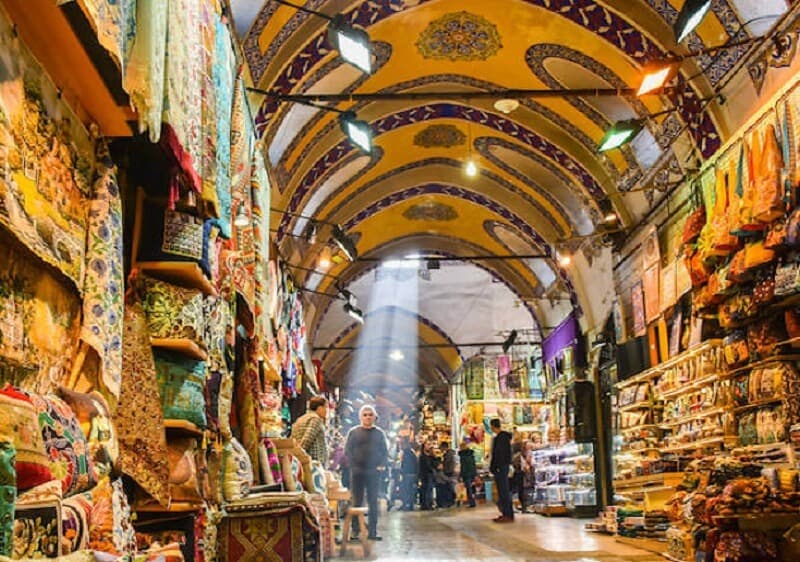
The buildings of the Grand Bazaar, except for the Bedesten, were originally erected out of wood; it wasn't until after the devastating fire of 1700 that they were reconstructed out of stone and brick and given roofs. Except for the fur dealers' market (Turkish: Kürkcüler Carsisi), a later addition, all of the buildings in the bazaar are single-story structures. Most of the roofs are tiled, while tarmac has been installed in the area that caught fire in 1954. Bazaar goers were warned not to bring any kind of flashlight or candle, as this would only serve to attract attention and start fights. It runs roughly parallel to the roads that surround the central district of Bedesten. Regardless, the market took on a picturesque appearance, especially in its western part, due to the damage caused by the numerous fires and earthquakes throughout the centuries and the repairs done without a general plan.
What to Buy at the Grand Bazaar in Istanbul
Kilims och Rugs
One of Turkey's best-known exports is its exquisite hand-woven carpets and kilims (flat-weaves), and the Grand Bazaar is a popular place to find these rugs.
Turkiet har en lång och intressant historia av att göra mattor. Olika regioner, städer och byar är kända för sina unika mönster och färger.
Mattor och kilim från Centralasien kommer att finnas tillgängliga tillsammans med de som tillverkas i Turkiet.
You can browse through a wide variety of carpets in the Grand Bazaar's carpet shops. The best carpet stores will give you a cup of tea and a tour of their showroom while talking about their stock and showing you different kinds of carpets.
When you go carpet shopping, don't forget to bring your sense of humor.
Sellers of carpets are well-known for being a little too enthusiastic with their tales, but you should take it in stride and consider it all in good fun. Keep in mind that, unless they were present during the carpet's production, no carpet dealer has any idea what the weaver was thinking as they created the carpet.
Carpet shopping can be confusing for the uninitiated; if you don't know what you're doing, it's best to just buy something you like. Older carpets and kilims from the village or the nomad's collection were made for the weaver's use, while newer carpets are manufactured with the tourist in mind.
Värdet av antika mattor från Turkiet och Centralasien beror på många faktorer, såsom deras ålder, hantverk, kvaliteten på den använda ullen och färgämnena och deras brist på den nuvarande marknaden.
Lampor och lanterner
Det har varit en stor ökning av antalet människor som vill ha lampor och lanterner som gåvor från Turkiet.
In the Grand Bazaar, lampshades and chandeliers come in all kinds of modern styles, from metal filigree to colorful glass mosaics.
If you'd rather shop for vintage lighting than new, the Grand Bazaar's Ic Bedesten (Old Bazaar), located in the vicinity of the bazaar's geographic center, is where you'll find most of the specialized antique shops selling such items. The oldest and most iconic structure in the Grand Bazaar is the Ic Bedesten.
Titta i Cebeci Han för några banbrytande filigree ljusfäste.
Mindre alternativ inkluderar de många glas- och metallljuslampor som säljs i basaren.
Keramik och pottery
Städerna Iznik och Kütahya, som har tillverkat keramik under lång tid, var de första platserna där berömda turkiska keramik tillverkades.
Turkiska keramikkonstnärer gör nu också massor av moderna bitar utöver de traditionella ottomanska mönstren som ofta har tulpanmotiv och andra blommiga mönster.
Hittitiska stilar och carafer, med en cirkulär mittsektion, är baserade på anatoliska mönster från bronsåldern och gör utmärkta presenter.
If you are planning a trip to Cappadocia while in Turkey, you may want to hold off on making any purchases until you have a chance to see what the ceramic artists of Avanos are known for producing, as their work is reminiscent of the Hittite era.
In the Grand Bazaar, the main streets are lined with shops that sell cheap, mass-produced ceramics of low quality.
Visit one of the market's dedicated ceramics shops if you're in search of uniquely painted ceramics.
The Arasta Bazaar (behind the Blue Mosque) and the Grand Bazaar are both worth exploring if you're interested in purchasing ceramics in Istanbul.
Turkiska metall
Städerna Gaziantep, Sanliurfa och Mardin i sydöstra Turkiet är kända för att producera några av de bästa samtida metallvarorna i Turkiet.
Håll av på inköp tills din resa till Turkiet, specifikt till dessa städer, eftersom priserna kommer att vara lägre där.
Några av de bästsäljande varorna är te- och kaffetjänstpaket och metallplattor med invecklade gravyrer som bygger på traditionella ottomanska mönster.
Engraved Turkish coffee pots, used to brew the beverage over a stovetop, are a practical and attractive souvenir that won't take up too much space in your carry-on.
Nargile Hookah
Nargile (vattenrör) är en traditionell turkisk souvenir som används för att röka frukt-smakad tobak.
Sedan tiden för det ottomanska riket har folk rökt nargile i turkiska kaféer.
Glas eller keramiska nargillskålar (som håller vattnet som används för att filtrera röken) kan ta på sig utarbetade mönster.
Keep in mind that nargile components are often purchased separately, and the bowls can be used as distinctive vases if you're not interested in buying a fully functional nargile but like the look of the bowls.
Go to Ic Bedesten's antique shops if you're in search of vintage Nargile. There are many shops in the bazaar selling contemporary nargile.
smycken
The Grand Bazaar is the best place to go in Istanbul to buy jewelry.
There's something for everyone here, from glitzy gold to delicate silver filigree work and pieces set with semi-precious stones.
For gold work, head to the main street of Kalpakcilarbasi Caddesi first, which is lined with gold shops. This is the street that runs between the main Grand Bazaar entrances of Bayazit Gate, on the west side of the bazaar, and Nuruosmaniye Gate, at the eastern end.
Eftersom så mycket av produktionen riktar sig till brudmarknaden tenderar bitarna att vara klassiska i stil.
Det är möjligt att börja din sökning efter silver smycken i Ic Bedesten (Old Bazaar), som är hem för många butiker som ägnas åt ädelmetall.
Håll ett öga på blå kalcedon och zultanit smycken, som båda är utvunna i Turkiet och anses halvdyrbara stenar.
Kuddarna och kuddarna
The many smaller textile items available in Turkey are great purchases if you're looking for easy-to-pack items.
Dessa tillåter dig att ta tillbaka några äkta turkiska stil möbler utan den höga prislapp och övervikt bagage vikt av att köpa mattor.
Textilier kan hittas i en otrolig mängd olika mönster och stilar. kuddar och andra små textilier tryckta med traditionella ottomanska mönster är också lättillgängliga och billiga tack vare massproduktion.
De ursprungliga suzani tygerna (Central Asian broderade textilier) och vintage kilim används för att skapa unika textil tillbehör (flat weave mattor).
Hammarby utrustning
Although bath products might not be the first thing that comes to mind when you think of a traditional Turkish souvenir, they have a deep history thanks to the country's hammam (Turkish bath) culture.
Towels with traditional fringed striped designs, called pestemals, are still used in modern hammams. The stalls in the bazaar will sell a wide variety of mass-produced towels, but if you're looking for something truly unique, you should browse the selection of handwoven cotton pestemals, towels, and bathrobes available at stores that specialize in hammam supplies.
Handgjorda olivolja tvål och exfolierande scrubbing mits som används i hammam är två av de mindre föremålen som gör bra gåvor att ta hem.
Tillbehör för mode
The Grand Bazaar is a fantastic place to shop for accessories, whether you're in the market for a new scarf, pair of slippers, hat, or bag.
Turkiet har länge varit känt för sina silke- och läderprodukter, och det finns också en traditionell känslig tillverkningstradition som idag producerar många konstiga och mycket moderna modeprodukter, särskilt slippor och hattar.
Tänk på att många av de skjortor som säljs är massproducerade med turister i åtanke och inte ens tillverkas i Turkiet.
De tygbutiker som går längs den norra änden av Yaglikcilar Caddesi är de bästa ställena att hitta högkvalitativ handgjord silke, kashmir och bomullsskal och skal.
In the southwest corner of the bazaar, along Parcacilar Sokak and Fesciler Caddesi, you'll find a concentration of stores selling leather goods.
Turkiska godis och efterrätter
Although the Spice Bazaar is where most tourists go to buy souvenirs and gifts involving spices and Turkish delight, the Grand Bazaar also has plenty of options for these kinds of purchases.
Observera att sumac (den torkade krämigfrukten i sumacplantan) och pul biber (den torkade Aleppo röda pepparen) är två av de mest framträdande kryddorna i turkiskt kök.
Söt-och-sur granatäpple molass och pekmez är två kryddor värda att ta tillbaka (kondenserade fruktsirap är vanligtvis gjorda av druvor eller mulberry i Turkiet).
Se upp för de många helva-sockerierna gjorda av sesamfrön förutom de otaliga sorterna av turkisk delikatess (kallas lokum i Turkiet), som är fyllda med nötter och smaksatta med rosenvatten eller frukt.
Advice on Shopping at the Grand Bazaar
The Grand Bazaar is open from 8.30 a.m. to 7 p.m., Monday through Saturday.
You cannot cover the breadth of the bazaar in one visit. Plan on spending at least an entire morning or afternoon here on your first visit if you want to explore or are serious about shopping, and don't expect to see everything.
Expect to get lost. Half the fun is getting lost in the Grand Bazaar and discovering one of the alley dead ends that lead to an arcaded han (old traveler inn).
Te och samtal med lokala butiksägare och touts är viktiga delar av upplevelsen. Cay (te) kommer att erbjudas dig av vem som helst och alla du möter. Din upplevelse här kommer att vara mycket rikare och roligare om du tar dig tid att delta i denna turkiska gästfrihet.
The initial price you are quoted depends as much on the country you are from as it does on the seller's mood at the time. For an idea of how much items cost, spend some time browsing a range of shops before purchasing.
Butiksinnehavare och touts här talar ett antal språk.
The Grand Bazaar's larger thoroughfares are lined with souvenir shops selling the same trinkets you'll find anywhere: fridge magnets, key chains, Turkey flags, and the ubiquitous nazar boncuk (glass evil-eye protector amulets). Get away from the hustle and bustle of the main drags to find unique and exciting stores.
Matta butiker kan hittas i närheten av Halicilar Caddesi, medan guldbutiker kan hittas längs Kalpakcilarbasi Caddesi och i närheten av Cebeci Han och Ic Bedesten.
Frequently Asked Questions About The Grand Bazaar
Q är: What is the Grand Bazaar?
a är: The Grand Bazaar is a historic covered market in Istanbul, Turkey, known for its maze-like alleys filled with shops selling everything from jewelry and spices to textiles and ceramics.
Q är: Where is the Grand Bazaar located?
a är: The Grand Bazaar is located in the Fatih district of Istanbul, Turkey.
Q är: How old is the Grand Bazaar?
a är: The Grand Bazaar was established in the 15th century and has been in continuous operation since then.
Q är: How big is the Grand Bazaar?
a är: The Grand Bazaar spans over 60 streets and contains over 4,000 shops.
Q är: What kinds of products can be found in the Grand Bazaar?
a är: The Grand Bazaar is known for its wide variety of products, including jewelry, textiles, ceramics, spices, and more.
Q är: What is the history of the Grand Bazaar?
a är: The Grand Bazaar has a long and rich history, having been an important center of commerce for centuries.
Q är: Is the Grand Bazaar only for tourists?
a är: The Grand Bazaar is both a tourist destination and a local shopping hub, attracting both locals and visitors alike.
Q är: What are the opening hours of the Grand Bazaar?
a är: The Grand Bazaar is typically open from 9:00 a.m. to 7:00 p.m., seven days a week.
Q är: What is the best time to visit the Grand Bazaar?
a är: The best time to visit the Grand Bazaar is in the morning or late afternoon when the crowds are smaller and you can enjoy a more leisurely shopping experience.
Q är: Is bargaining expected in the Grand Bazaar?
a är: Bargaining is expected and considered part of the shopping experience at the Grand Bazaar, so be prepared to negotiate prices with vendors.
Du kan boka en Istanbul stadsrundtur med våra licensierade guider. Länkarna är nedan:
Map of Grand Bazaar